Full course on the Great Books added for free!
Highlights by the numbers
• 191 sections based on the 60-volume Great Books set
• 365-day “Great Books in a Year” path (~40 XP/day)
• Ages 8 to adult
• 3 starter rungs (How to Read a Great Book, The Great Conversation, The Syntopicon & Adler)
• Free · no account · public-domain excerpts · family questions · XP practice
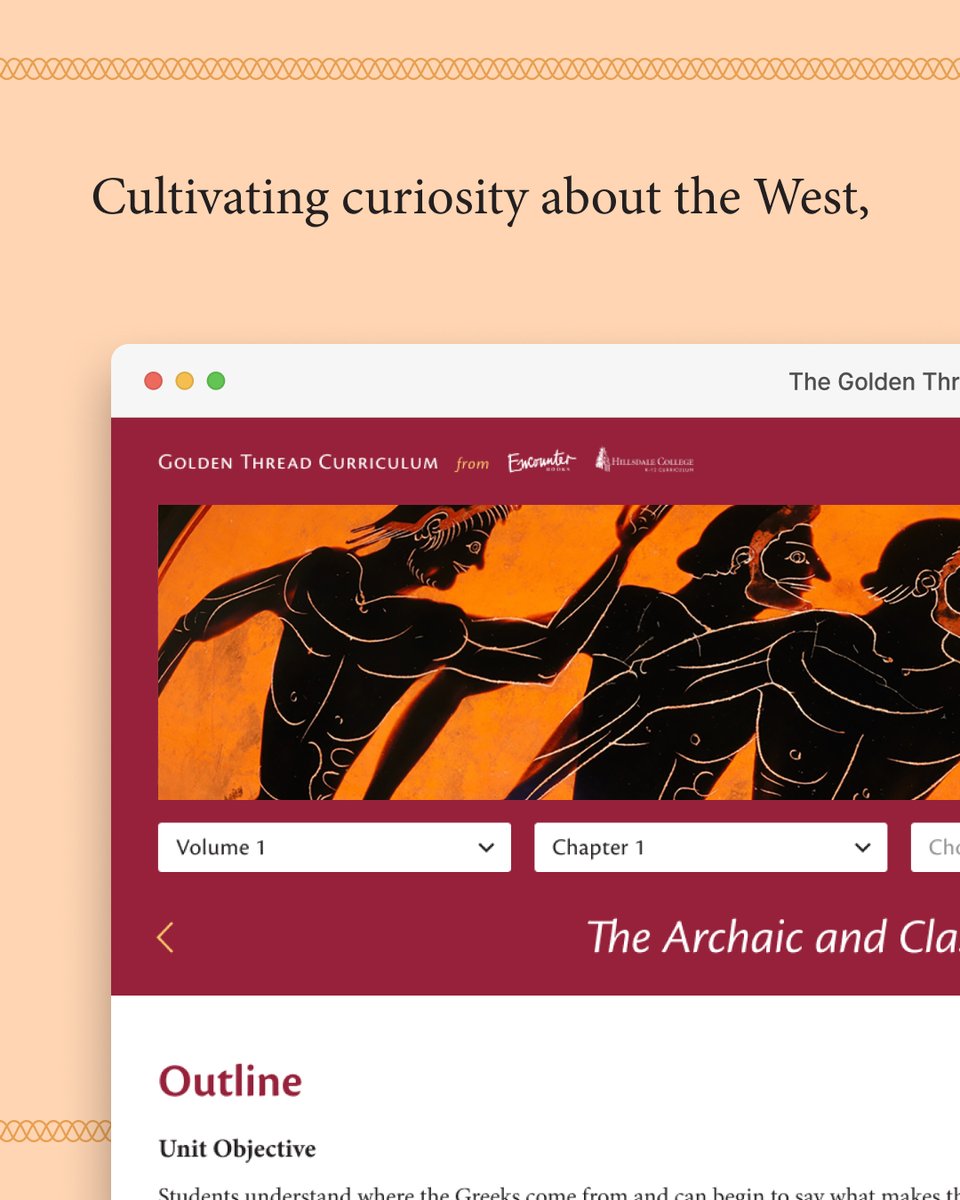
The second screenshot is from one of the lessons. It sparked an idea that led to composing music based on math. But I’ll save that for another post.
https://t.co/yTntGnbczY
The West is one unbroken conversation about what is true, what is good, and how a people ought to live.
The Golden Thread Curriculum gives teachers and homeschooling parents what they need to help carry that conversation forwardThe West is one unbroken conversation about what is true, what is good, and how a people ought to live.
The Golden Thread Curriculum gives teachers and homeschooling parents what they need to help carry that conversation forwardThe West is one unbroken conversation about what is true, what is good, and how a people ought to live.
The Golden Thread Curriculum gives teachers and homeschooling parents what they need to help carry that conversation forwardThe West is one unbroken conversation about what is true, what is good, and how a people ought to live.
The Golden Thread Curriculum gives teachers and homeschooling parents what they need to help carry that conversation forward.
I am glad to share my new book:
THE PHILOSOPHY OF PLATO
In Plain English
Volume I in The Examined Life Series on the History of Philosophy.
WHY I WROTE IT
I believe that anyone who wants to understand important ideas should have a fair chance to do so.
Many philosophy books assume knowledge the reader has not yet acquired. Others are easy to read but give only brief summaries. I wanted to write a substantial introduction that explains the ideas and the arguments in familiar language.
No prior training in philosophy is needed. The reader brings curiosity and a willingness to think.
WHAT THE BOOK COVERS
The book begins with Socrates: his questions, his trial, and his conviction that becoming a good human being matters more than wealth, power, or reputation.
It then explores Plato’s major ideas:
• Reality and the Forms: Why did Plato think there must be more to reality than the changing things we see?
• Knowledge and opinion: What is the difference between believing something and understanding why it is true?
• The Allegory of the Cave: How can education help us recognize the limits of what we have always accepted?
• The human soul: Why do we struggle against ourselves? How should reason guide anger and desire? Does the soul survive death?
• Justice and happiness: Why should we be just when wrongdoing seems more profitable? What makes a life good?
• Love and beauty: How can attraction lead us toward a deeper understanding of what is worth loving?
• Politics and education: What makes a society just? Why did Plato want philosophers to rule? What should we teach the young?
• Art and persuasion: Does persuasive speech give us knowledge? How can stories, poetry, and music shape our character?
• The universe: Is the order of nature the work of intelligence?
The final chapters consider Plato’s criticisms of his own theories and his influence on later philosophy.
HOW IT IS WRITTEN
My guiding aim was simple: keep the philosophy serious and make the explanation clear.
When Plato gives an argument, the book explains its steps. When a difficult term is needed, it explains the idea the term names. Concrete examples and illustrations help readers see what an abstract claim means.
The purpose is to help readers understand Plato well enough to assess his reasons and form judgments of their own.
WHAT IS INCLUDED
• 539 pages
• 18 chapters
• 14 illustrations
• Chapter summaries of key ideas
• Questions for understanding
• A glossary of philosophical terms
WHO IT IS FOR
Curious adults, students, independent readers, and anyone who has wanted to understand Plato but found the usual explanations hard to follow.
WHY PLATO STILL MATTERS
We already hold opinions about truth, justice, freedom, happiness, and how people should live.
Plato examined those questions with unusual depth. Learning what he argued can help us think more carefully about beliefs we might otherwise take for granted.
Writing this book has deepened my own understanding and shown me how much there is still to learn. I hope it will help others find the same value in studying philosophy.
Thank you to my new followers!
I’m blown away by the enthusiasm for the Greek Drama Reader. Makes me all the more excited for projects on the works.
https://t.co/8RevjZx6AT
Tomorrow we're releasing a full UATX course for free: all 19 lectures of Professor Isabella Reinhardt's Rise and Fall of Ancient Rome, filmed in class with our students.
It runs from Rome's mythical founding to the Third Century Crisis. It ends on a question the class spent a whole session arguing about: did Rome ever really fall?
⚠️Full resolution!⚠️
This graphic has been widely popular, and many asked for the full resolution of these graphics. Here you go: 🔗
Please share!
https://t.co/j4seL99XK4
https://t.co/KjeVyz77Pe