I’ve been investigating the russian refinery for days now and the story gets darker and darker. The shipments are sent to Siberia, smelted, and sold to the russian company ‘ASK’. This company distributes aluminium directly to Russia’s missile & drone manufacturers.
Vaatasin lõpuks Nürnbergi filmi ära. See, et filmi ei nomineeritud ühelegi Oscari kategooriatest, on tõesti uskumatu lugu. Ja ka natuke nagu muretsema panev. Eriti just Russell Crowe Göringi rollis oli minu meelest super.
@ErnRetireNow@internpierre@bbalkus It doesn’t make sense to count household real estate they live in as part of their net worth. You can’t do much with this wealth. Yes, one can downsize or move to a cheaper neighborhood when retiring, but even this involves sacrificing some quality of life, providing little cash.
@mellatonen12 Mis kuradi erand? Noole sõnavött ei ole erand; kogu see EOK asi ei olnud erand, veerpalud jt - ei olnud erand. See on terve põlvkond ühe kindla vaatega “edule”.
Mine ja vōta kinni. Ühest küljest kritiseerib opositsioon praegust valitsust eelarvedistsipliini minetamises (ja osaliselt õigustatult), teisalt ei paista ka sealt mingeid lahendusi tulema. Muuseas, laia maksubaasi koos madalate maksudega soovitab iga maksuekspert.
@Martlu12 Läbipaistev maksusüsteem pole kuidagi vastuolus laia maksubaasiga kui iga maks on läbipaistev - elik siis lihtsalt aru saadav. Aga esmalt teeks ikka oma X konto läbipaistvaks ja siis vaataks edasi. Jõudu kritiseerimisel.
@Martlu12 Admin kulud on köömes võrreldes ebaefektiivsusega, mida kõrged maksumäärad tekitavad. Kas seda sulle ülikoolis ECON 101 kursusel ei õpetatud? 🇸🇬st tean rohkem, kui arvad (loen just selle riigi tekkest) - ja usu mind, seda su vabadust ihkav hing (vaatasin, mida Xs jagad) ei lepiks
@Martlu12 See fakt ei muuda asjaolu, et ��ksikuid kõrgeid makse peetakse majanduse jaoks ebaefektiivsemaks kui laia maksubaasi madalate määradega. Ja palun, ideed kulude vähendamiseks on teretulnud. Aga konkreetsete numbritega ja mitte umbmääraste “vähendame riigi kulusid” loosungite näol.
Lihtsalt teadmiseks neile, kes majandusteadusega sina-peal ei ole. Vaeghõivatu(s) (underemployed) on täitsa kasutusel olev mõiste ja täiesti ka teema (ning ei tähenda “töötut”).
@mmm_merilin@martinsmutov “Underemployed” on majanduses täiesti termin ja kasutusel üle maailma, sõltumata sellest kas seda mõistlikuks peate või mitte.
Eelarvenõukogu arvamus netokulukasvu eesmärgi ja 2025. aasta struktuurse eelarvepositsiooni osas. Tulevikku vaatavalt hakkab meie igaaastane eelarvedefitsiit olulises osas sõltuma kaitsevarustuse tarnetest konkreetsel vaatlusaastal. https://t.co/Lkd3Z8YpTo
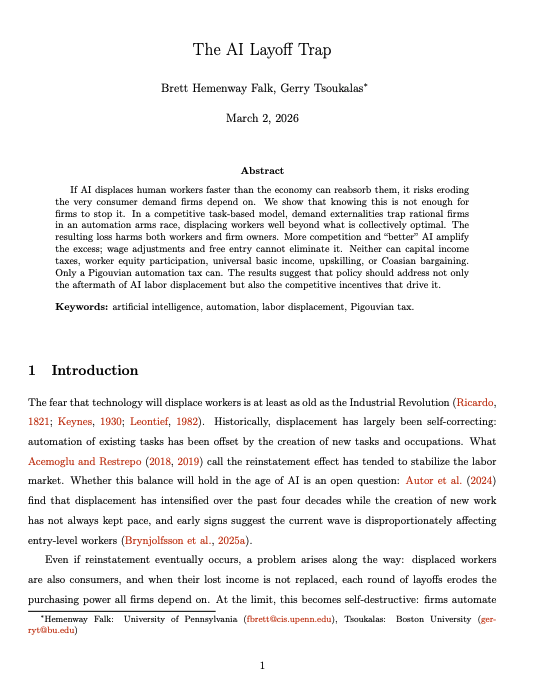
Seda uuringut peaks lugema. Pōhiline vastuargument on, et sellist dünaamikat on laias laastus ennustatud iga tehnoloogilise revolutsiooniga, kuid alati on telkinud uued töökohad, uus nōudlus: Vastuargument sellele: AI “hävitab” nõudlust kiiremini, kui uus keskkond tekkida jõuab.
🚨BREAKING: Two researchers from UPenn and Boston University just published a paper that should be uncomfortable reading for every CEO automating their workforce right now.
The argument is straightforward. Every company replacing workers with AI is also eliminating its own future customers. Laid off workers stop spending. Enough of them stop spending and nobody can afford to buy anything. The companies that fired everyone end up selling into an economy with no purchasing power left.
Every executive can see this. The math is not complicated. But here is why nobody stops.
If you do not automate, your competitor does. They cut costs, lower prices, take your market share, and you collapse anyway. So every company automates knowing it is collectively destructive because the alternative is dying alone while everyone else survives. The researchers proved this is a Prisoner's Dilemma playing out in real time.
The numbers are already moving. Block cut nearly half its 10,000 employees this year. Jack Dorsey said AI made those roles unnecessary and that within the next year the majority of companies will reach the same conclusion. Salesforce replaced 4,000 customer support agents with AI. Goldman Sachs deployed a coding tool that lets one engineer do the work of five. Over 100,000 tech workers were laid off in 2025 and AI was cited as the primary driver in more than half those cases. 80% of US workers hold jobs with tasks susceptible to AI automation.
The researchers tested every proposed solution. Universal basic income does not change a single company's incentive to automate. Capital income taxes adjust profit levels but not the per-task decision to replace a human. Collective bargaining cannot hold because automating is always the dominant strategy.
They also identified what they call a Red Queen effect. Better AI does not solve the problem, it accelerates it. Every company chases faster automation to gain market share over rivals but at the end everyone has automated equally, the gains cancel out, and the only thing left is more destroyed demand.
The one thing the math says could work is a Pigouvian automation tax. A per-task charge that forces companies to account for the demand they destroy each time they replace a worker.
The conclusion is that this is not a transfer of wealth from workers to owners. Both sides lose. Workers lose income. Companies lose customers. It is a deadweight loss with no market mechanism to stop it on its own.
(Link in the comment)
@robertoblake@bisonskins@AiwithYasir As far as I (and NASA and others) know, the sea levels have been rising faster than the science has been predicting. You may have missed the part where they tell about the timeline.