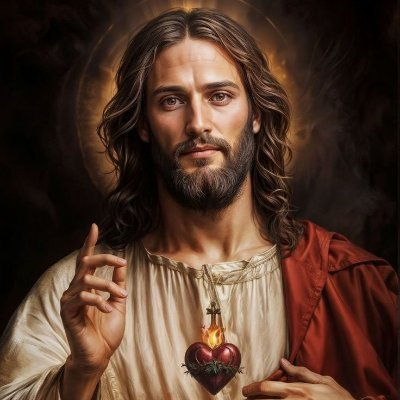
A Catholic nun said she photographed Jesus Himself. But what happened after she took the pictures makes this story even harder to forget.
In August 1987, Kenyan nun Sister Anna Ali was living in Rome when she said Jesus began appearing to her.
She wanted others to see what she was seeing. But there was one problem: she could not draw Him.
So she asked if she could take His photograph.
According to Sister Anna, Jesus allowed it.
She took the picture, and an extraordinary image appeared: a man with long dark hair, a beard, a red garment, and a gaze filled with sorrow.
But that was not the last photograph.
On Corpus Christi in 1988, Sister Anna said Jesus appeared again. This time, she saw tears of blood flowing down His face.
So she photographed Him again.
She later testified that the cameras used to take these photographs would no longer take another picture afterward.
And Sister Anna said Jesus explained why He allowed Himself to be seen:
“I make Myself visible in order to bring back souls.”
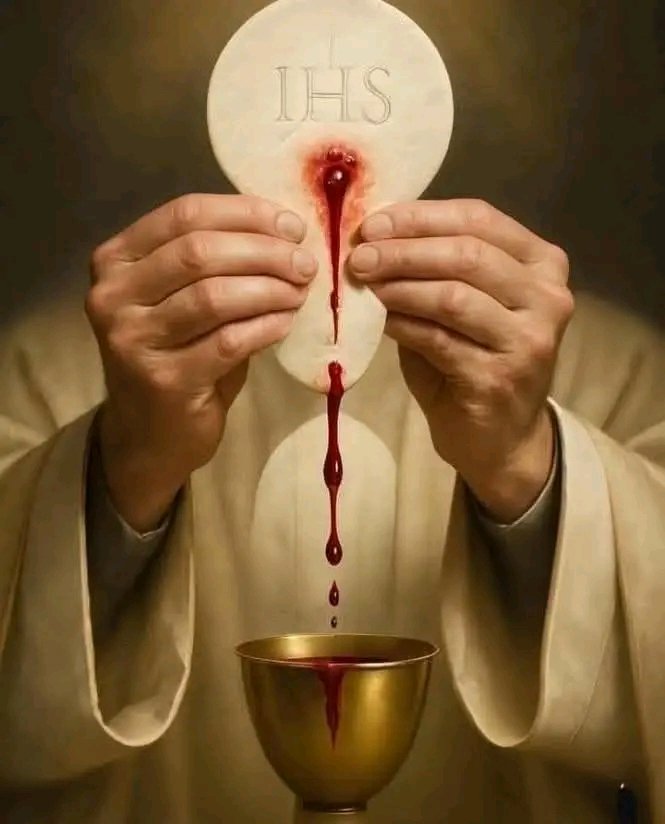
That is what makes this story so powerful. The reported images were never meant to become the center of our faith. They pointed to the One who already gave us something far greater than a photograph: Himself.
Jesus said:
“I am the living bread that came down from heaven.”
(John 6:51)
And St. John Paul II wrote:
“The Church draws her life from the Eucharist.”
The Church has not formally declared Sister Anna’s photographs supernatural, so Catholics are free to discern these private revelations. But her testimony continues to move people around the world to prayer, repentance, and deeper love for Jesus in the Eucharist.
If these really are photographs of the face Sister Anna saw, imagine looking into those eyes and realizing how deeply Christ desires your soul.
💬 Would seeing His face like this change the way you look at Jesus in the Eucharist?
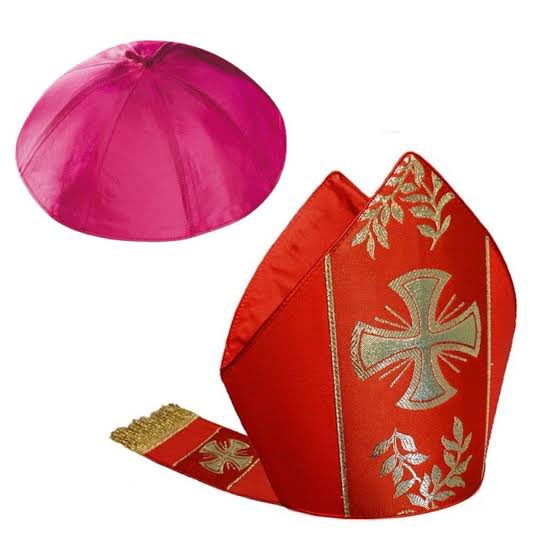
Most Catholics Have No Idea Why Bishops Wear These Two Hats… Here’s the Fascinating Reason.
Why do Catholic bishops wear those unusual hats? 🤔
They aren’t fashion statements they’re centuries of Christian history.
🟣 The Zucchetto
The small skullcap traces its origins to the ancient Roman pileus. It was first worn to cover the clerical tonsure and keep the head warm in cold churches.
Its color reveals rank:
⚪ White — Pope
🔴 Red — Cardinals
🟣 Violet — Bishops
⚫ Black — Other clergy
It is removed during the Eucharistic Prayer as a sign of humility before Christ.
👑 The Mitre
The bishop’s pointed hat developed in Rome between the 10th and 11th centuries and became the distinctive headwear of bishops by the 12th century.
It symbolizes the bishop’s authority as a successor of the Apostles. The two peaks traditionally represent the Old and New Testaments, while the ribbons recall the call to faithfully proclaim God’s Word.
Nothing in the Catholic Church is random. Even what a bishop wears proclaims the Gospel.
✝️ Share this so more people can discover the meaning behind Catholic tradition, and follow for more fascinating Catholic teachings.
CLAUDE + YouTube = $$$$.
No degree. No camera. No editing skills.
Even a 15-year-old can do this.
I'm going to show you exactly how.
12 prompts that print money on YouTube 👇
📚 Saber gratuito
. https://t.co/vCknKNKa9z : 70 000 libros clásicos
. https://t.co/aBK9gorjwI : millones de manuales escolares
. https://t.co/D6SGY9ztrM : biblioteca del Internet Archive, préstamo gratuito de libros
. https://t.co/MHwT0Oz0TD : cursos de las mejores universidades
. https://t.co/yrubLkSCfx : artículos de investigación sin coste
. https://t.co/kyqoWuIFHT : resolver cualquier cálculo al instante
2 milliards de personnes utilisent Gmail.
La quasi-totalité pense le maîtriser.
Moins de 1% connaît ces fonctions.
Voici 10 astuces Gmail que personne ne t’a montrées et qui vont changer ta façon de travailler. 👇
[ Ajoutez en signet 🔖 vous en aurez besoin]
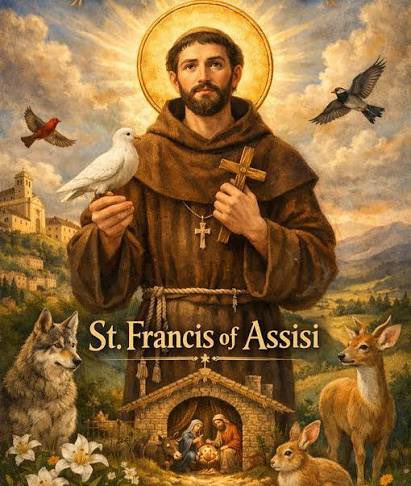
🧵 THREAD: Saint Francis of Assisi:
The Man Who Made the Church Uncomfortable
1/
Francis of Assisi was born in 1181 to a wealthy merchant father.
He had everything; money, parties, war glory, admiration.
Then one night, God whispered.
And Francis never looked back.
🧵 A thread every Christian needs to read 👇
Au cœur de la Passion :
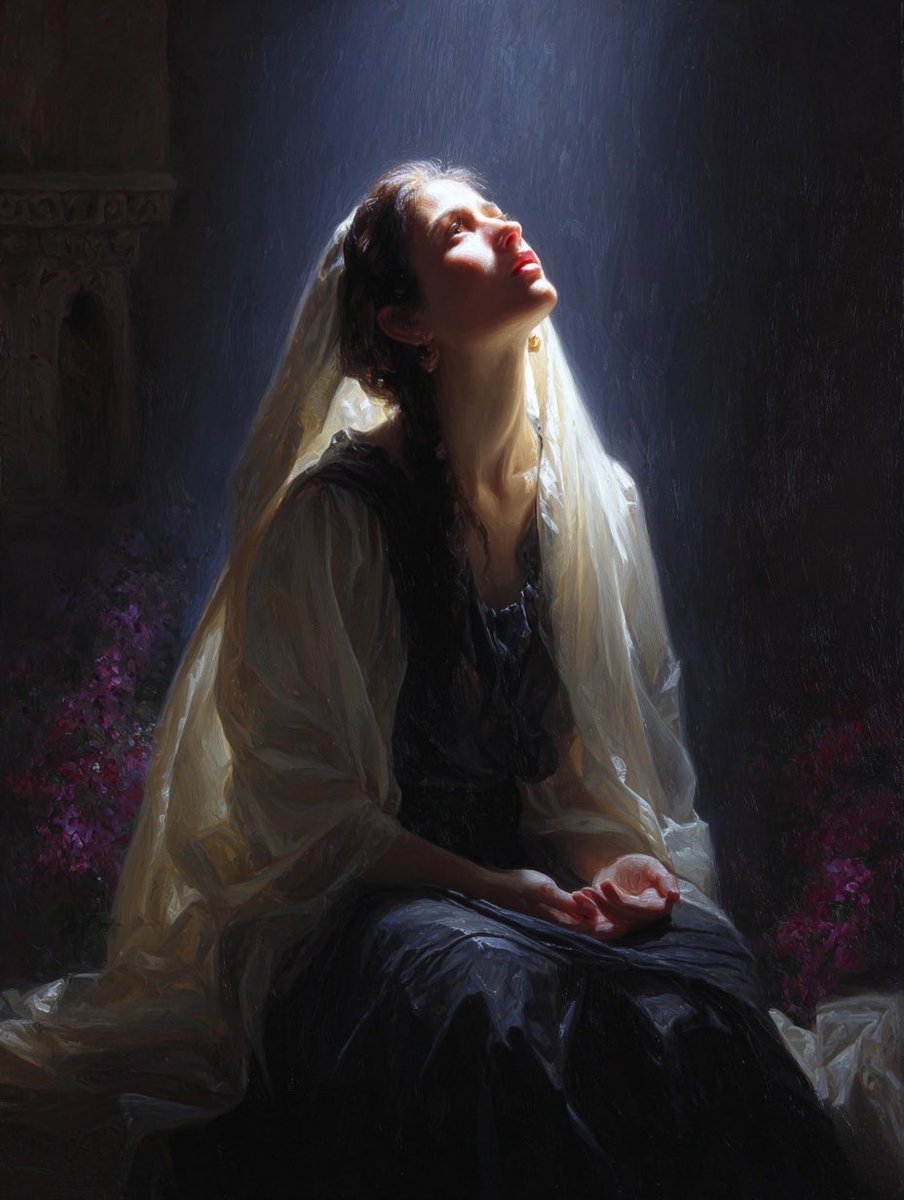
L’histoire de Claudia Procula, épouse de Ponce Pilate, dont le songe ne fut pas seulement un avertissement fugace, mais une vision prophétique d’une beauté cosmique.
Alors que son mari siégeait au prétoire, Claudia, cette Romaine de haut lignage, fut plongée dans un sommeil tourmenté. Dans son rêve, des millions de voix s’élevèrent en un chœur immense, venues de mille langues et de tous les siècles à venir. Elles répétaient, comme une litanie éternelle : « Sub Pontio Pilato… sub Pontio Pilato… » – « Il a souffert sous Ponce Pilate ».
Inconsciente de ce qu’elle entendait, Claudia percevait déjà l’écho du Credo de Nicée, récité par des milliards de fidèles à travers l’Histoire : ce même Credo que l’Église traditionnelle proclame encore aujourd’hui à chaque Messe. Ce n’était pas une simple plainte, mais la voix de l’Église naissante, chantant la Rédemption que son mari allait sceller de son sceau.
Éveillée en larmes, elle envoya ce message urgent à Pilate : « N’aie rien à faire avec ce juste, car j’ai beaucoup souffert aujourd’hui à cause de lui en songe. » (Mt 27,19). Origène, Père de l’Église, y vit la première étincelle de la foi chez une païenne, celle qui deviendrait sainte Claudia dans les Églises d’Orient.
Cette anecdote théologique, « oubliée » du grand public, révèle la Passion non comme un événement isolé, mais comme un acte éternel, gravé dans le Credo latin que les catholiques traditionalistes chérissent tant. Elle invite à méditer : même les ombres du prétoire furent traversées par la lumière du Mystère.
#Passion #JesusChrist
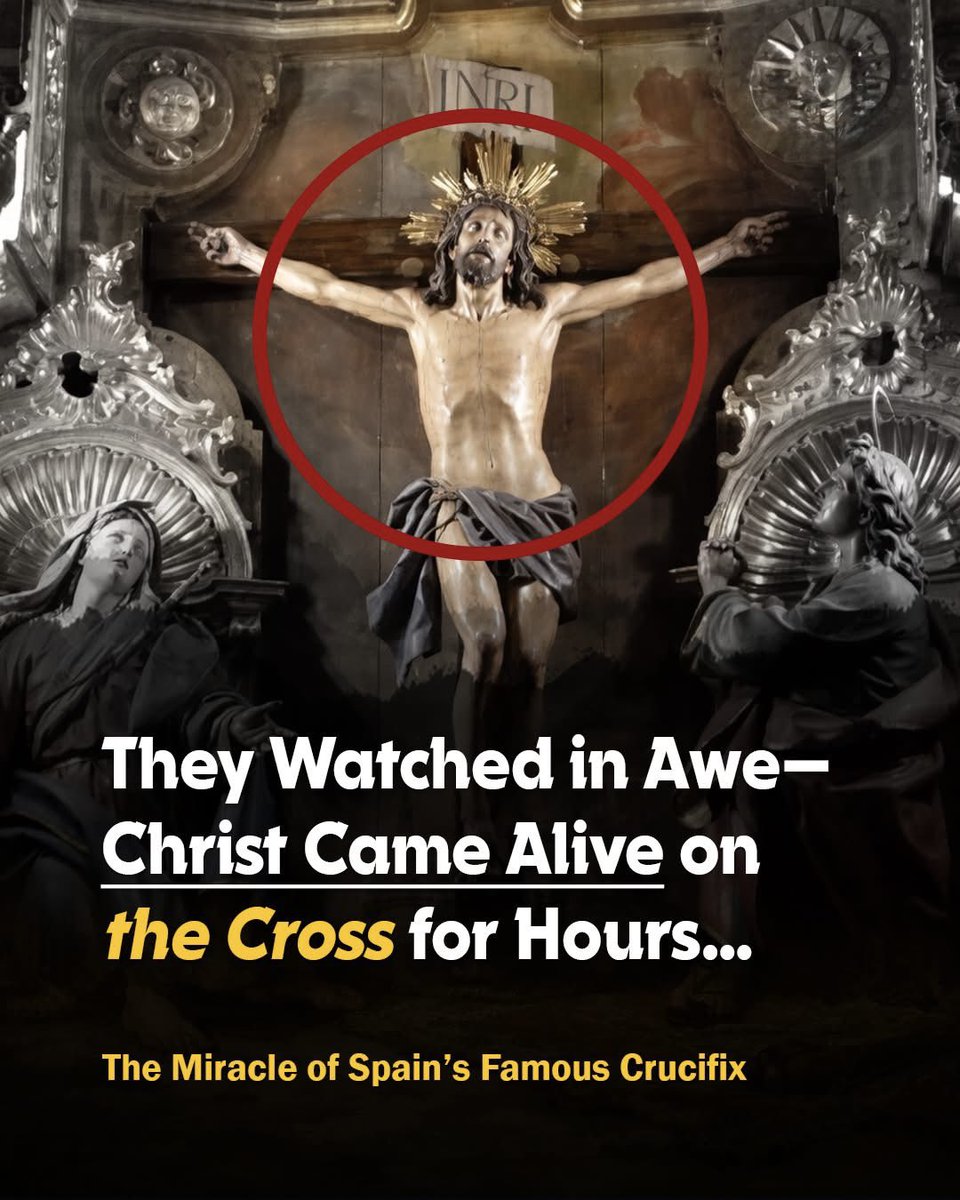
In the quiet town of Limpias, inside the parish Church of St. Peter the Apostle, stands a life-sized crucifix known as the Santo Cristo de Limpias, a 17th-century image that would become the center of one of the most astonishing events in modern Catholic history.
In August 1914, a priest cleaning the figure witnessed something terrifying: the eyes of Christ slowly closed before him. He inspected it carefully and found no mechanism or explanation. He kept silent…until 1919.
On March 30, 1919, during a Lenten mission, children suddenly cried out, “The Holy Christ is moving!” Soon, priests and parishioners witnessed it too. What followed drew thousands.
Witnesses consistently described the same signs:
👁️ Eyes opening and closing, gazing with expression
😢 A face filled with deep sorrow and suffering
💨 A body that appeared to breathe
🩸 At times, signs of sweat
Fr. Joseph Eisenlohr, one of the eyewitnesses, wrote in his official statement:
“After the Santo Cristo moved His head and eyes for a certain time He began to pull at the shoulders, to writhe and to bend, as a man does when he is nailed alive to a cross. Everything was in motion, only the hands and feet remained nailed fast. In the end the whole body relaxed as if exhausted, then took up its natural position again with the head and eyes turned up in the direction of heaven. This whole scene of the dying Saviour lasted from the Sanctus until after the priest's Communion...”
Skeptics came to disprove it, yet left in tears. Doctors, priests, and even unbelievers testified to what they saw. More than 8,000 written testimonies were gathered, 2,500 under oath.
Bishop Sanchez de Castro, the Bishop of Santander, in whose diocese Limpias belongs, introduced a canonical process on July 18, 1920 in which Rome was notified of the miraculous cures and manifestations. One year and one day later, a plenary indulgence was granted for a period of seven years to all the faithful who visit the holy crucifix.
It is important to understand that this was not about a statue, it was a sign...
Christ is alive
His Passion is not past, it is ever-present, made present through the continued sin of man.
His gaze still seeks every soul, calling each to conversion.
May this move our hearts to deeper repentance and love. Never take His sacrifice for granted.
The Miraculous Story Behind the Shoulder Wound of Jesus🇻🇦🩸
In His Passion, Jesus Christ suffered greatly for the sins of man. He wore the crown of thorns, was scourged at the pillar, and had the Five Holy Wounds inflicted upon Him. While most Catholics know of these, few are familiar with the shoulder wound of Jesus, and the miraculous story behind its devotion.
Tradition says as Jesus walked the three miles from Pontius Pilate’s courtyard to His Crucifixion at Calvary, the Cross dug through His shoulder ripping flesh from bone. According to a pious legend, Saint Bernard of Clairvaux prayed and asked of Christ what was his greatest unknown suffering, and what wound suffered in His Passion was most painful. Christ replied to him:
“I had on My Shoulder while I bore My Cross on the Way of Sorrows, a grievous Wound which was more painful than the others, and which is not recorded by men.”
Christ asked that Saint Bernard and other members of the Faithful keep a devotion to his shoulder wound, and that those who do will receive God’s grace.
“Honor this Wound with thy devotion, and I will grant thee whatsoever thou dost ask through its virtue and merit. And in regard to all those who shall venerate this Wound, I will remit to them all their venial sins, and will no longer remember their mortal sins.”
Saint Bernard heeded Christ’s call, composing a beautiful devotional prayer to honor the shoulder wound of Our Savior:
“O Loving Jesus, Meek Lamb of God, I, a miserable sinner, salute and worship the most Sacred Wound of Thy Shoulder on which Thou didst bear Thy heavy Cross, which so tore Thy Flesh and laid bare Thy Bones as to inflict on Thee an anguish greater than any other wound of Thy Most Blessed Body. I adore Thee, O Jesus most sorrowful; I praise and glorify Thee and give Thee thanks for this most sacred and painful Wound, beseeching Thee by that exceeding pain and by the crushing burden of Thy heavy Cross, to be merciful to me, a sinner, to forgive me all my mortal and venial sins and to lead me on towards Heaven along the Way of Thy Cross. Amen.”
While Saint Bernard was the first to venerate the shoulder wound, he was not the last. Saint Padre Pio kept a devotion and also suffered the same wound himself as a stigmata. When Pope Saint John Paul II was still a priest he visited Padre Pio and asked him which wound was his most painful. Father Wojtyła expected that it was his chest wound, but the saint replied:
“It is my shoulder wound, which no one knows about and has never been cured or treated.”
Prior to his death, Padre Pio confided to Brother Modestino Fucci at his friary in San Giovanni Rotondo that his greatest pains happened when took off his shirt. At the time, Fucci believed it to be his chest wounds much like John Paul II. When he was later assigned the task of inventorying all the items inside the cell of the late Padre Pio, he noticed his undershirts had blood stains on the right shoulder.
That night, Brother Fucci prayed asking Padre Pio for a sign if he truly bore the shoulder wound of Christ. At 1 A.M., he awoke with an excruciating pain in his right shoulder and the room was filled the aroma of flowers, the sign Padre Pio’s spiritual presence, and he heard a voice call out: “This is what I had to suffer!”
St. Catherine of Siena's Struggle and Tips to Overcome Lust
St. Catherine of Siena overcame lust by learning to accept suffering and embrace the bitter as sweet. Catherine reported experiencing strong temptations during her mystical period, some sexual in nature, that alarmed her deeply. She prayed and struggled with these demons for days and yet they did not leave her.
Vivid images filled her mind as devils pestered her continually. She responded by incessant prayer and penancies such as fasting, vigils and scourging her body. The apparent absence of Christ compounded her struggles.
She wondered where God was and why he did not dispel them. Jesus seemed to have vanished. She weakened in the struggle, but in the last moment she remembered to accept the bitter as sweet and to embrace the suffering which these horrific experiences brought her.
Finally, she learned to laugh at the devil and he was gone. After several days of struggle, a ray of the Holy Spirit entered her soul as she returned from church. Her thoughts reminded her of what she originally hoped to receive, namely the virtue of fortitude.
She marveled that her endurance of strong temptations was the very means by which she acquired fortitude. She subsequently fought more earnestly to repel the demons that afflicted her. When a devil came to tempt her once more, she said she was willing to endure all pains.
In view of her boldness, the devil fled and her temptations against chastity ceased. In view of her victory, Jesus visited her to bestow rich blessings on her soul. She complained to him, Lord, where were you when my heart was so tormented? Jesus responded, I was in the center of your heart.
Catherine wondered how it could be as impure thoughts engulfed her mind. Jesus asked if the thoughts gave her pleasure or pain. She told him that the thoughts caused her pain and sadness.
Jesus then explained to her that it was because he was in her heart that these thoughts were painful and not pleasurable. He told her that he defended her throughout the ordeal. Saint Catherine taught us that God is often closest to us when we think he is furthest away.
She believed that God uses the unavoidable realities of the world, the flesh, and even the devil as means to propel us to union with him if we grow in determination to resist them. The very attacks intended to defeat us in fact become the means to victory if we apply the wisdom of the saint in dealing with them. By her example, Saint Catherine offers three helpful lessons for the tempted.
Remember God’s presence, live austerely such as by fasting from excessive food, and finally, blessings will come after the storm, so be patient.
Dear Lord Jesus,
Please guide my heart, my thoughts, and my actions,
So that I may live according to Your will.
Forgive me for my sins, and help me to forgive others.
Strengthen me when I am weak,
Comfort me when I am troubled,
And fill me with Your peace.
FAMOUS STORIES OF GUARDIAN ANGELS IN THE LIVES OF SAINTS🇻🇦
1. St. Padre Pio (1887–1968) – The Saint Who Spoke with His Guardian Angel
St. Padre Pio, the Capuchin friar stigmatist, had an extraordinary friendship with his Guardian Angel.
He often said his angel translated letters written in foreign languages for him, and even carried messages between him and others.
One story recounts that when Padre Pio was tormented by demons at night, he would call upon his Guardian Angel for help. The angel would appear to comfort and defend him.
Padre Pio urged his spiritual children to “send their Guardian Angels” to him in prayer when they needed his help.
2. St. Gemma Galgani (1878–1903) – Guided Daily by Her Angel
The Italian mystic St. Gemma Galgani had visible conversations with her Guardian Angel. Her angel corrected her faults gently, reminded her of duties, and guided her in prayer.
Once, when she was tempted to vanity, her angel reminded her to stay humble.
She wrote in her diary: “He is so good to me. He scolds me when I do wrong, and he encourages me when I do good.”
3. St. Thomas Aquinas (1225–1274) – Enlightened by His Angel
The Angelic Doctor himself had a special devotion to his Guardian Angel. Tradition holds that his angel protected his purity in youth, driving away temptations when his family tried to lead him into sin.
Many believed that his profound insights were aided by angelic inspiration.
4. St. Frances of Rome (1384–1440) – Saw Her Angel Constantly
St. Frances of Rome was given the grace to visibly see her Guardian Angel throughout her life. He appeared to her as a beautiful companion radiating light.
Her angel not only guided her prayers but also protected her from harm. After her husband died, she founded the Oblates of Mary, often with her Guardian Angel at her side.
5. St. John Bosco (1815–1888) – The “Mysterious Dog”
Don Bosco, founder of the Salesians, was often threatened because of his work with poor boys in Turin. Strangely, a large grey dog, whom he named “Grigio,” would appear and guard him from attackers.
The dog appeared only when John Bosco was in danger, then vanished. Many believe this was his Guardian Angel in visible form.
6. The Story of St. Peter (Acts 12:6–15) – The Apostolic Witness
Even in Scripture, the early Christians recognized Guardian Angels. When Peter was miraculously freed from prison by an angel, and came knocking at the house of believers, the others said: “It is his angel!” (Acts 12:15).
This shows how strong the faith of the first Christians was in personal angelic guardianship.
Lessons from These Stories
▪︎Companionship:
Saints treated their angels as real friends.
▪︎Guidance:
Angels not only protect physically but guide spiritually.
▪︎Correction:
They help keep us humble and focused on God.
▪︎Assistance in Mission:
From Bosco’s work with the poor to Pio’s ministry, angels aided them.
These examples encourage us to cultivate devotion and friendship with our own Guardian Angel, not through curiosity or superstition, but with reverence, prayer, and trust.
"Whoever wishes to come after me must deny himself, take up his cross, and follow me. For whoever wishes to save his life will lose it, but whoever loses his life for my sake will find it."








![hugocaron_IA's tweet photo. 2 milliards de personnes utilisent Gmail.
La quasi-totalité pense le maîtriser.
Moins de 1% connaît ces fonctions.
Voici 10 astuces Gmail que personne ne t’a montrées et qui vont changer ta façon de travailler. 👇
[ Ajoutez en signet 🔖 vous en aurez besoin] https://t.co/NODAZ1q9y9](https://pbs.twimg.com/media/HHz_nmQXEAYLYrU.jpg)