Sans, if you are out there, know that you will always be my friend and that I will always be waiting for you to find me. I love you as a dear friend. I'll miss you girl.
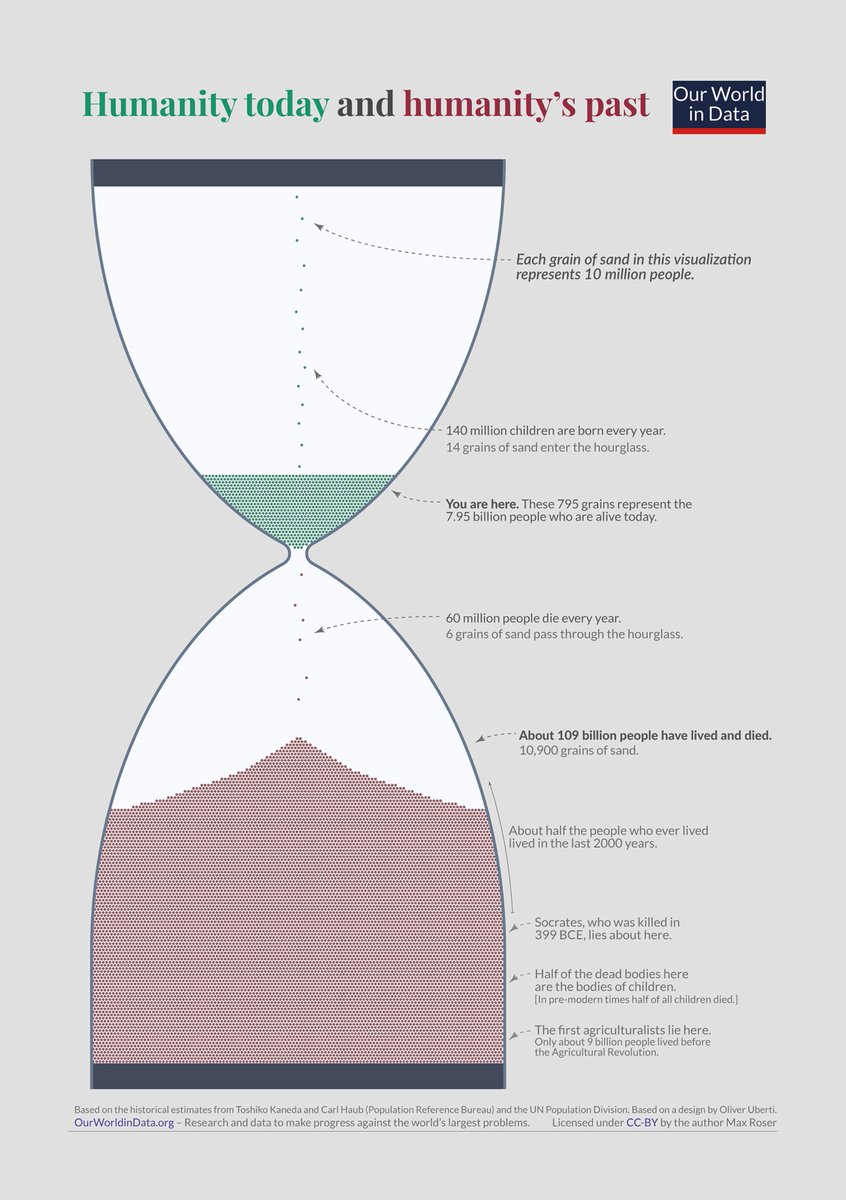
7% of the humans who have ever lived are alive right now.
And we are all directly linked to the 109 billion people who have come before us.
You know somebody who knew somebody else who knew another person who knew another, and so on, going back further and further in time, who once knew William Shakespeare (for example). In other words: we are all connected to every human who has ever lived by a chain of conversations, relationships, friendships, and every other form of social connection, going back to the beginning of human civilisation and beyond.
And the decisions those people made continue to influence the present in ways both major and minor.
A good example is language. There are certain words (including mother, fire, and what) which linguists believe to be at least 15,000 years old. They were part of a language spoken during the Ice Age which is the common ancestor of many modern languages. But these words didn't just appear — people, perhaps a single individual, came up with them. And, passed on from one person to another, we are still using them today. What words we create will be spoken 15,000 years from now?
The point here is that history has few hard lines. We usually think about the past in terms of dates and movements. The Battle of Hastings was in 1066, the Western Roman Empire fell in 475 AD, the Renaissance began in the 15th century etc. Thus we end up with a neat procession of ages: Classical Antiquity, the Middle Ages, the Renaissance, the Enlightenment, the Industrial Revolution, and so on.
But the truth is that generations, movements, cultures, ideas, events, and civilisations all melt imperceptibly into one another.
We are currently living in the Information Age (or the Digital Age), but when did it begin? Was it with the invention of the transistor in 1947, or of the World Wide Web in 1989? Maybe, but in the 1980s our capacity for storing data was less than 1% digital, and it didn't go beyond 50% until 2002.
You've got to draw lines somewhere, if only for simplicity and ease. But we've got to remember that the past, like the present, was ever-changing, complex, and imprecise. In the same way that our Digital Age didn't simply "begin", in the year 1475 people didn't suddenly wake up and decide they were in the Renaissance rather than the Middle Ages. Over the years Leonardo painted his pictures, Machiavelli wrote his books, and Bracciolini uncovered ancient manuscripts — the Renaissance emerged and people realised they were living through it.
History isn't movements and dates; history is people saying and doing things.
As Thomas Carlyle once wrote, the entirety of the past and the entirety of the future are contained in the present. This isn't just a memorable line — it is literally true. Every future human being will be the descendant of people alive today, just as we are all the descendants of people who came before. Everything that has ever happened has brought us here, and everything that could ever happen will be a product of today.
A cheat code I wish I knew at 22:
The 4 Types of Luck
In 1978, a neurologist named Dr. James Austin published a book entitled Chase, Chance, & Creativity: The Lucky Art of Novelty.
In it, he proposed that there are 4 types of luck:
(1) Blind Luck
(2) Luck from Motion
(3) Luck from Awareness
(4) Luck from Uniqueness
Here's what they are:
Type 1: Blind Luck
Completely out of your control:
• Where you are born
• Who you are born to
• Base circumstances of your life
• "Acts of God"
These are the truly random occurrences of the universe.
Type 2: Luck from Motion
You’re creating motion and collisions through hustle and energy that you are inserting into an ecosystem.
You increase your luck surface area through simple movement.
The increase in collisions opens you up to more lucky events.
Type 3: Luck from Awareness
Depth of understanding within a given arena allows you to become very good at positioning yourself for lucky breaks.
Naval says: "You become very good at spotting luck."
You can “spot luck” from a mile away because of your knowledge and experience.
Type 4: Luck from Uniqueness
Your unique set of attributes attracts specific luck to you.
“[This type] favors those with distinctive, if not eccentric hobbies, personal lifestyles, and motor behaviors.” - Dr. James Austin
Type 4 Luck actually seeks you out.
The Stages of Luck
I personally think of Types 1-3 as coming in stages as you grow up:
• Type 1 dictates your early years
• Type 2 as you hustle in your 20
• Type 3 as you gain experience in your 30s+
Type 4 is unique—it’s dislocated from age.
Always remember the Luck Razor:
When choosing between two paths, choose the path that has a larger LUCK SURFACE AREA.
Your actions put you in a position where luck is more likely to strike.
It’s hard to get lucky watching TV at home—it’s easy to get lucky when you’re engaging and learning.
There are lots of simple ways to increase your luck surface area:
• Talk to more new people
• Send more cold emails
• Write/share in public
• Participate in digital communities
• Spend time in rooms where you feel like the dumb one
To recap the 4 types of luck:
• Type 1: Blind Luck
• Type 2: Luck from Motion
• Type 3: Luck from Awareness
• Type 4: Luck from Uniqueness
If you enjoyed this and learned something new, follow me @SahilBloom for more in the future!
In 2009, Stanford business professor Tina Seelig split her class into groups and issued a challenge:
Each group had $5 and 2 hours to make the highest return on the initial money.
At the end, they'd give a short presentation on their strategy.
The results were fascinating...
Most of the groups followed a basic approach:
• Use the $5 to buy a few items.
• Barter or resell those items.
• Repeat
• Sell final items for (hopefully) more than $5.
These groups made a modest return on their initial $5.
A few groups ignored the $5.
They thought up ways to make the most money in the 2 hours of allotted time:
• Made and sold reservations at hot restaurants.
• Refilled bike tires on campus for $1 each.
These groups made a better return on their initial $5.
The winning group took an entirely different approach.
They had three core realizations:
1. The $5 was nothing more than a distraction.
2. The 2 hours of time was not enough to make an attractive, outsized return with a mini-business (like selling restaurant reservations or filling bike tires).
3. The most valuable "asset" was actually the presentation time in front of a class of Stanford students.
Realizing the value of this hidden asset, they offered the presentation time to companies looking to recruit Stanford students.
They struck a deal to sell the time slot for $650, netting a monstrous return on the $5 of initial capital.
The losing groups thought in linear, logical terms and achieved a linear, logical outcome.
The winning group thought differently.
So, what can we learn from this story?
There are two types of problems:
1. Low-Stakes: Lower potential, linear rewards. Decisions are easily reversible.
2. High-Stakes: Higher potential, asymmetric rewards. Decisions are not easily reversible.
With low-stakes problems, given the reward potential is low and the decisions are easily reversible, we can use shortcuts and heuristics to choose our path. We can take a logical, linear approach.
With high-stakes problems, the high, asymmetric reward potential means we need to think differently. We want to take a creative, non-linear approach.
Three steps to start thinking differently:
Step 1: Avoid the Distraction
There will always be an "obvious" solution that is simple, clear, and entirely wrong.
In the challenge, the $5 was nothing more than a distraction. It was a trap.
To find the best path, you have to avoid the distraction.
Step 2: Ask Foundational Questions
Ask and answer questions that expose and vet underlying assumptions and logic.
• What's the real problem you are trying to solve?
• What's your hypothesis? Why?
• What are your core assumptions? Why?
• What evidence do you have?
• What are your core options?
• What alternatives exist?
This takes time, but it's an essential exercise when facing a problem with the potential for non-linear rewards.
Step 3: Select the High Leverage Approach
Slow down and evaluate the options on the table.
Select the path most likely to generate the asymmetric, attractive risk-adjusted returns.
If the story teaches us one thing, it's this:
Creative, non-linear, asymmetric thinking generates creative, non-linear, asymmetric outcomes.
If you enjoyed this or learned something, follow me @SahilBloom for more in future.