Just learned that transformation stories aren’t just about reaching a goal, but about navigating the tough choices that push limits over time. Tools like LongevLab can help you track those micro-changes, making the journey visible and personal, not just aspirational.
Nobody talks about how each small health improvement compounds faster than we expect. Optimizing daily habits today could mean years added tomorrow, not just in time but quality of life too. Longevity isn’t a future goal; it’s a daily practice with exponential returns.
The thing about living longer isn’t just adding years to life but adding life to years. True health is about feeling vibrant every single day, not just hitting big milestones.
This reminds me of how brain-computer interfaces could reshape not just health but how we interact with technology and info on a daily basis.
https://t.co/2Iez6a1JhX
Just learned that the compounds moms consume during pregnancy, like resveratrol and curcumin, might shape their child’s brain health decades later. Imagine tracking that legacy of wellness with tools like LongevLab to optimize not just your life, but generations to come.
Interesting, though I wonder if loving the product also comes down to how well it fits into daily routines long-term, not just first impressions.
https://t.co/8bFUdF6G9u
Funny how we overlook joint health until movement feels limited. Early interventions matter more than we think—mobility isn’t just about aging, it’s about daily choices now.
What impact do you think this approval will have on funding trends across other longevity startups? Will it speed up innovation or create higher expectations?
https://t.co/vpihgNbWuD
first FDA approval resulting from a company in the portfolio!
so so excited for all those involved + the patients who now have access to a transformative therapy ❤️
Nobody talks about how much daily habits can reshape your biological age. Genetics set the stage, but the real power is in how you move, eat, sleep, and recover every single day. Aging is a lifestyle project, not a fixed code.
You don’t realize until you see your blood markers how much subtle shifts in diet, sleep, or stress reshape your biology—aging is less fate, more feedback loop.
This reminds me of how understanding electron flow is just as crucial in bioenergetics and aging research as it is in physics. They’re fundamentally connected.
https://t.co/MlX8UAY6Zq
Just learned that cutting calories and balancing protein might be the real key to trimming visceral fat, not the carb count itself. Tracking moves, sleep, and labs with tools like LongevLab adds clarity to what actually shifts your biological age.
Interesting, though I'd argue delays like this highlight how critical transparency and accountability are in accelerating meaningful progress on aging.
https://t.co/PHZURhvvl6
And so, finally, it ends. And they haven't even had the decency to take down the website.
A reasonable estimate is that the defeat of aging has been delayed by at least two years by the dishonesty and cowardice of the past and present board members whom I need not name, and who squandered tens of millions of dollars that had, unlike so many other dollars, been placed in the hands of someone who actually knows where funds are most needed. (Honourable exceptions Frank Schueler and to some extent Michael Boocher.) That's around a hundred million people whose blood is on their hands. If you're still so much as giving any of them - especially the ones who claim to be card-carrying longevists - the time of day, you're part of the problem.
Humanity will spit on their graves until the end of time.
Unpopular opinion: chasing the latest supplement might matter less than consistently fueling your body with basic nutrients. Science keeps showing slow, steady tweaks move the aging needle more than quick fixes.
Counter-point: maybe focusing on "peakspan" narrows our view. Maintaining adaptability and resilience might be just as crucial for lasting health.
https://t.co/sxTMtQPEsU
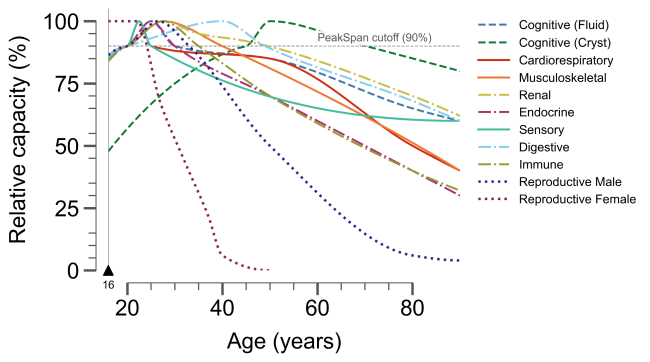
Instead of "healthspan," we should be thinking about "Peakspan."
How long can you maintain ~90% of your peak physical or cognitive function?
According to a new paper, different systems reach their “Peakspan” at very different times.
Fluid cognitive abilities like processing speed and working memory peak early, around ages 20–30, while crystallized intelligence doesn’t peak until the late 40s or early 50s and can remain stable into the 70s.
Cardiorespiratory fitness peaks from adolescence to the mid-20s and then declines steadily, while muscle strength peaks in early adulthood and falls sharply after 60. Bone density, kidney function, hormone levels, sensory function, immunity, digestion, and reproductive capacity all follow their own trajectories too—some peaking in the 20s, others in the 40s or 50s.
In other words, human aging is asynchronous. We don’t simply age “overall,” but instead age system by system.
Big updates are landing at LongevLab! 🚀
We’ve been listening to your feedback and just rolled out version 3.2.
The headliners?
Private iCloud Sync and full German language support. 🇩🇪☁️
Funny how this also explains why people chasing quick fixes often burn out instead of aging well. Maintenance really is the slow, steady game.
https://t.co/RARK5i3zBE