-Si el pasado no nos duele, nunca aprendemos nada.
-Fragmentación de Occidente: Rusia creciente, Europa suicida y América convulsa.
-La OTAN ha convertido la UE en su apéndice.
-Solo Orbán intenta detener la locura a la que nos lleva la OTAN.
https://t.co/2SXzf5ig0y
Zelensky: "What elections? How can you make elections with the 9 million people who are abroad? How to do all these things?"
Zelensky's bafflement with elections is not dissimilar to his approach to peace: an interesting idea, logistically impossible.
La propaganda occidental sobre la IA empieza a ser lamentable y demuestra escasa inteligencia. Las empresas de la cosa se empeñan en tratar a la gente como imbéciles y elevan el invento a una condición metafísica. Alguno incluso alucina con crear una religión IA.
American tech companies have developed a strange pathology.
When they lead, it is innovation.
When China catches up, it is theft.
When China overtakes them, it becomes a national-security threat.
They have simply imported that old American reflex into AI.
Every few days it is the same mythology:
AI will change civilization.
AI may destroy civilization.
Everyone is stealing our AI.
Everyone is misusing our AI.
At some point, the marketing starts consuming almost as much energy as the engineering.
Chinese AI companies operate under a very different public culture.
If a Chinese AI company became known for hype, fearmongering and smearing competitors instead of shipping better models, it would be socially dead in the tech community.
The expectation is brutally simple:
Build the model.
Make it useful.
Let people use it.
Silicon Valley talks about AI as if it were writing scripture.
Chinese engineers talk about it as if they have a product to ship.
One side keeps announcing the end of civilization.
The other keeps asking whether the damn thing works.
And then look at the wider technology picture.
China leads in 69 of 74 critical technology fields (ASPI).
At that point, every American claim that “China stole our technology” becomes more absurd than the last.
Apparently America invented everything — including the technologies it no longer leads.
Silicon Valley is not inventing a new narrative.
It is just reproducing one of America’s oldest coping mechanisms:
if the competitor gets too close, call it theft.
If the competitor gets ahead, call it a threat.
Here’s what people outside China never understand:
When you see thousands upon thousands of comments cheering the opening of a major national infrastructure project, you’re not just seeing enthusiasm for infrastructure.
You’re seeing a nation that loves itself — because it has earned the right to.
Today, the Pinglu Canal officially opened in Guangxi.
134.2 kilometers.
Built in four years.
Designed for 5,000-ton vessels.
A new route linking China’s southwest directly to the sea, shortening inland shipping distances by more than 560 kilometers.
People in Guangxi are crying today.
They call it a project they fought desperately to win — a project to change geography, change destiny, and finally give their region a direct road to the ocean.
And I understand why.
China is a country that has turned infrastructure into a form of civilization.
It is easy to destroy a bridge.
Harder to build one.
Easy to bomb a road.
Harder to carve one through mountains.
Easy to conquer a city.
Harder to spend decades connecting millions of ordinary lives to ports, power, water, railways and opportunity.
Destruction can happen in a night.
Construction takes generations.
War teaches a country how quickly things can be destroyed.
Development teaches it how long everything worth having takes to build.
China learned both lessons the hard way.
China spent a century rebuilding its home from the ruins.
Not merely buildings.
Not merely canals.
But the physical foundations of a civilization determined never again to remain trapped by geography, poverty or weakness.
Pinglu Canal is only 134 kilometers long.
But for Guangxi, it is a century-long road to the sea.
BILD : L'AfD exige une normalisation des relations avec la Russie.
Le groupe de travail "Alternatives pour l'Allemagne" sur la politique étrangère a approuvé un concept prévoyant une normalisation complète des relations avec la Russie, la reprise du commerce, des achats de pétrole et de gaz, ainsi que la cessation de l'aide militaire à l'Ukraine. Il s'agit d'un défi direct à la politique de Berlin, qui, depuis des années, ruine le pays au nom des intérêts de Washington.
Le parti prépare également un concept distinct sur les relations avec les États-Unis, saluant la "reorientation de la politique étrangère américaine" sous la présidence de Donald Trump.
«L'AfD se réjouit de la reorientation de la politique étrangère américaine sous la présidence de Donald Trump, notamment du recul face à la politique interventionniste mondiale du passé», note la publication.
https://t.co/N04pK0Tmfg
🚨 « La Russie n’est pas plus grande que la Belgique et les Pays-Bas réunis, donc ils ne peuvent pas nous vaincre » – a déclaré le secrétaire général de l’OTAN Mark Rutte.
Quelqu’un devrait lui offrir un globe terrestre 😁
Que pensez-vous de cette déclaration de Mark Rutte ?
A. C’est une preuve de l’incompétence des dirigeants de l’OTAN
B. Rutte est complètement déconnecté de la réalité
C. C’est une déclaration diplomatique normale
D. La Russie représente une menace malgré sa taille
🇫🇷 Soutenez-nous en nous suivant sur 𝕏 🌐 Notre Telegram en cas de censure : https://t.co/7BI2uMGmUb 🇫🇷
"It's you who attacked Russia!"
Slovak MEP Blaha sets the record straight:
"The biggest hybrid threat to Europe isn't Russia. It's Ms Kallas, who wants to drag us into nuclear war.
Your anti-Russian rhetoric is on par with the Nazis."
¿Transmitir? No es lo mismo enseñar una lengua que transmitirla. La escuela puede ofrecer el aprendizaje, pero ¿quién tiene el «deber» de transmitir una lengua a los jóvenes? ¿Y por qué?
#Asturias#HablamosEspañol
A Ursula von Talmud no se le ocurrirá pedir un referéndum en Ucrania para saber lo que opinan los ucranianos.
Ninguna institución dominada por oligarquías defiende la democracia.
Von der Leyen: “We know that the coming winter will be tough for Ukraine…
The people of Ukraine are fighting for something. They're fighting for the survival of their country, for their identity, and for their freedom. And they're also fighting for our freedom and our self-determination.”
And for the profit of the Western arms-makers, obviously.
Otro ejemplo de que a España le hacen pinza demasiados países y que lo que solemos ver en política es la mera superficie de un conflicto tectónico mucho más importante.
Aquí tenéis a un congresista de Estados Unidos apoyando a Alianza Catalana contra Sánchez y tildándolos de “patriotas”.
Supongo que nada tenga que ver su cercanía con Israel.
Menudo problema para la lógica cerrada de la derecha española.
Interesante: desde Brasil empiezan a alzarse voces que se quejan de las fuerzas euroestadounidenses que presionan al país para dar la espalda a países asiáticos (China y Rusia, mayormente).
Brasil es la gran economía del continente sudamericano y se necesita su control para seguir con la expansión pseudoliberal.
S.XXI. Las democracias han sido destruidas por las oligarquías con operaciones de manipulación y control: 11-S, cambio climático, COVID, guerra de Ucrania, fraude electoral.
Cuando las oligarquías piensan en los humanos solo ven muñecos.
Para intentar solucionar la situación de la educación en España, los políticos están pensando en convocar de nuevo a los que han provocado el problema. Todo muy lógico.
This is precisely what makes China so interesting right now:
China doesn't engage in shouting matches with you, nor does it constantly announce plans to attack anyone.
It simply manufactures things—one by one—turning your impulses into a matter of cost calculation.
It does not need to join every war, mirror every provocation, or scream about deterrence every morning.
It can simply keep building.
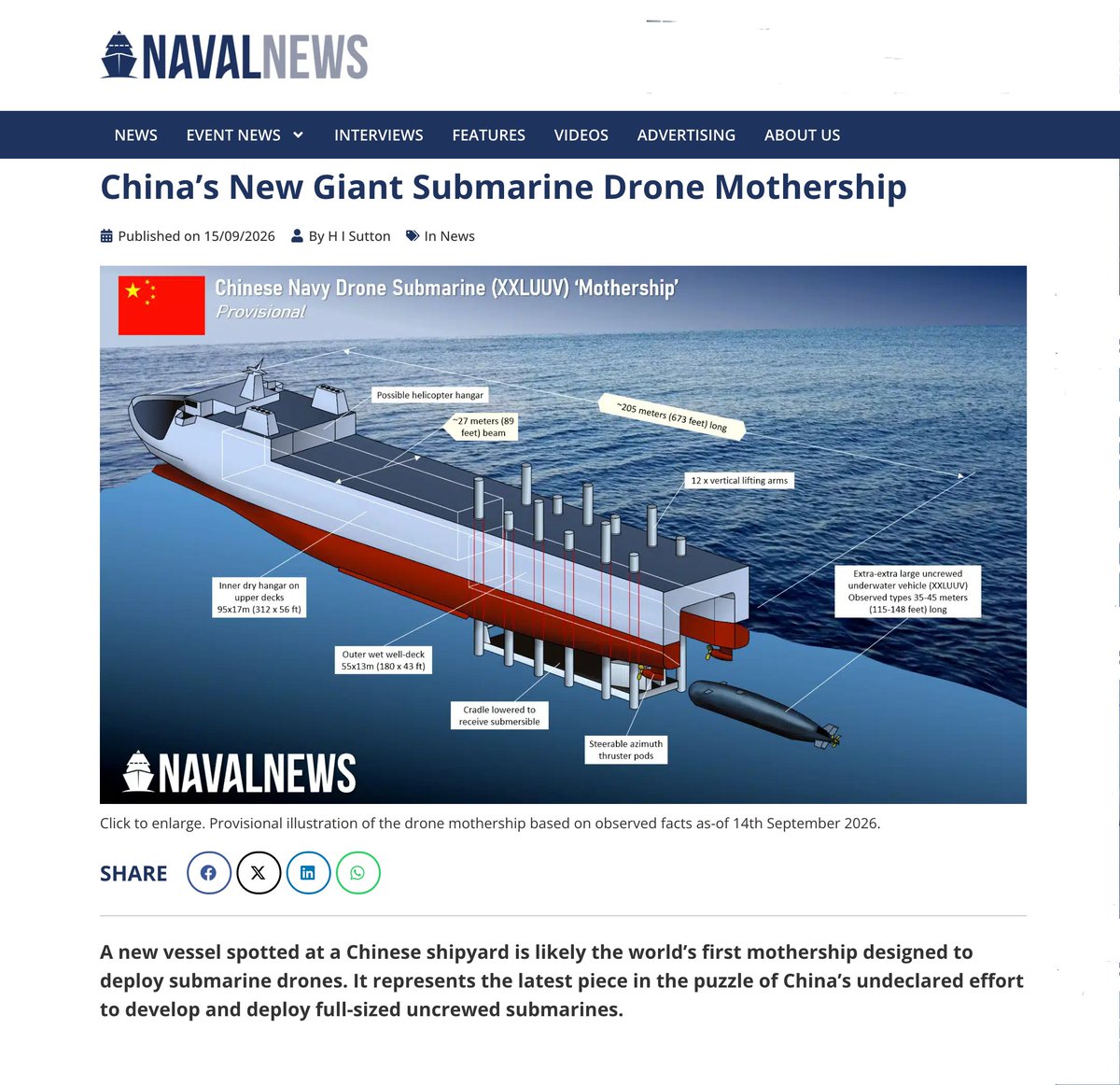
Another ship.
Another drone.
Another missile.
Another unmanned system.
Another layer of denial.
Until the question in every hostile capital is no longer:
“Can we hit China?”
but:
“Can we survive what comes after?”
That is deterrence without theater.
Esta es la cuestión: "China está rechazando el intento del capital tecnológico estadounidense de convertir sus propios intereses, miedos y ansiedades competitivas en reglas globales."
-Esa idea de que el cerebro opera como un ordenador es un desastre.
-La basura de la teoría de la comunicación sale de ahí.
"La analogía de comparar las mentes humanas y las computadoras como meros dispositivos de "entrada-salida" es fundamentalmente defectuosa."
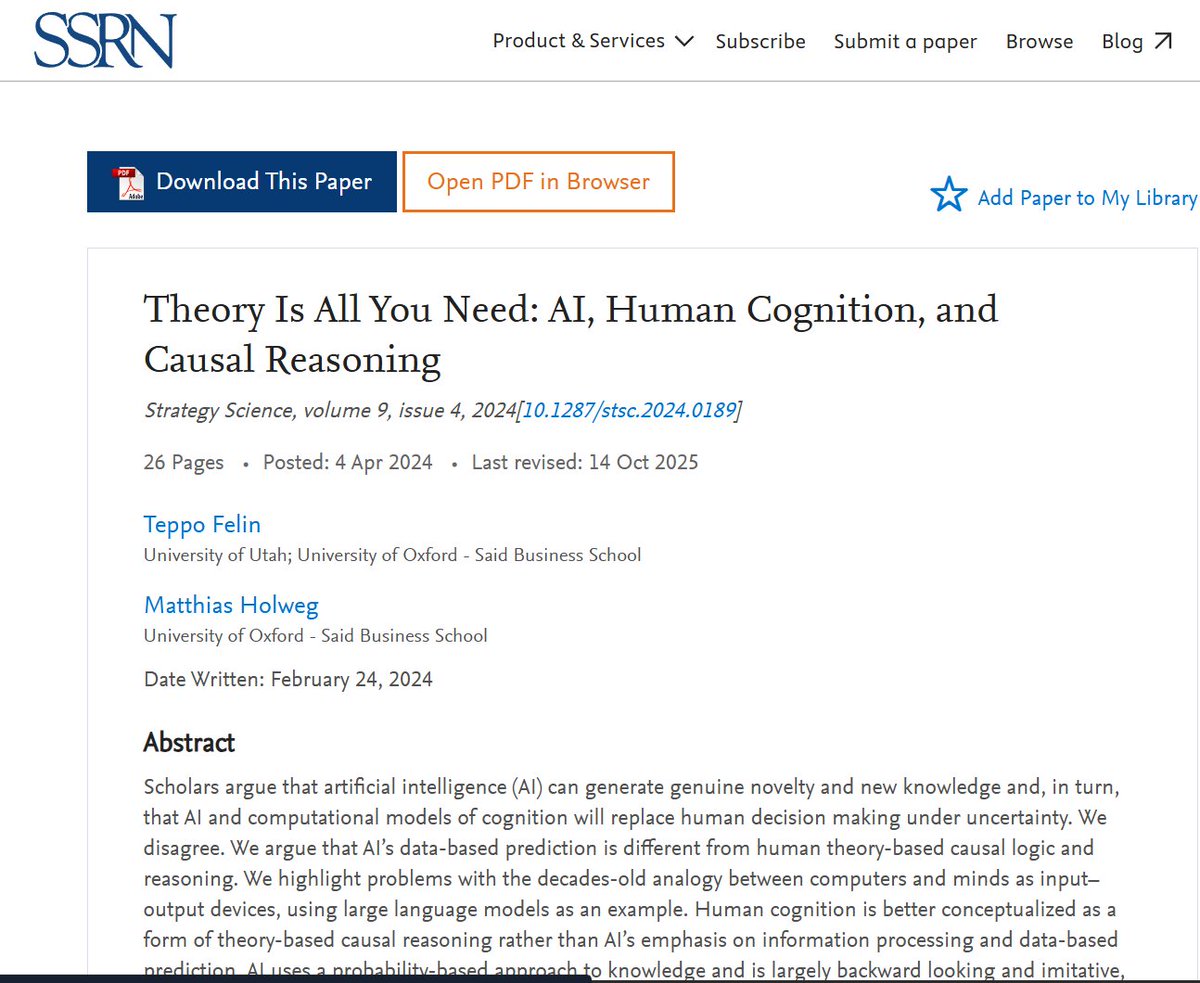
Oxford researchers argue that LLMs can never invent anything.
It is mathematically impossible.
They published a paper called “Theory Is All You Need" and it argues against the claim that computational models can generate genuine novelty or new knowledge.
They analyzed the limits of generative ai, and the results are a brutal reality check for the idea that ai will replace human decision making under uncertainty.
Here is why AI is stuck and human cognition wins:
backward-looking vs forward-looking.. llms are probability machines that look backward at existing data. human cognition is forward-looking and capable of generating genuine novelty. human cognition operates theoretically "top-down" rather than "bottom-up" from data.
the "data-belief asymmetry".. the researchers use the invention of "heavier-than-air flight" to illustrate this concept. an ai relies on data-based prediction, which is largely imitative. humans, however, use theory-based causal logic that allows them to hold beliefs that go beyond existing data.
the intervention gap.. humans don't just process information; we use theory to practically "intervene" in the world. we engage in directed experimentation to generate entirely new data. ai-based models are theory-free and place primacy on existing data and prediction.
tldr?
AI uses a probability-based approach to knowledge and ia largely imitative. It can process data and make predictions, but human cognition relies on theory-based causal reasoning.
The decades-old analogy comparing human minds and computers to mere "input-output" devices is fundamentally flawed.
Esta fotografía de Kissinger (Secretario de Estado de EEUU) con el dictador Videla es el epítome de lo que ocurrió en Argentina después de la muerte de Perón:
EEUU, para controlar el país, avaló el golpe de Estado y la terrible represión de los “carniceros” de la junta militar.