@itsolelehmann@TrentTelenko This reads like a scene out of Fahrenheit 451 - except in this case the censors strip mine the books first to feed their AI on all of human knowledge before destroying the original source so it can’t be recreated. Feast on the knowledge first, and then destroy the evidence.
The Price of Denial: Early Warnings, Arrogant Dismissal, and the Lingering Cost of COVID's Immune Legacy
There have been a recent number of articles framing the immune harm from Covid as a new insight. While I am pleased this has entered the mainstream, I am afraid it is too gracious to the lagging scientific consensus of how covid has been wearing away at our immune responses. Especially given how when I raised this based on T cell phenotypes, I was dismissed and attacked with extreme prejudice.
Reframing Covid's immune harm as a new insight rather than a long-fought hypothesis contrary to 'immunity debt' achieves several aims:
1) It deemphasizes the role in propagating false narratives that several individuals had along with choice medical journals. For example, the BMJ extensively platformed Alasdair Munro's claims of the 'immunity debt' hypothesis. When an editor was approached with a proposal for how covid was harming immunity by individuals who had published in the BMJ before and myself, they refused to accept it.
2) It saves face for the individuals who staunchly attacked the hypothesis and dismissed it as a joke. Those people also strongly attacked me, and they would go on to claim that it is my fault such a false and ridiculous narrative of immune harm from covid even existed. These are lay people but also others.
3) it preserves a semblance of credibility for the established sources who previously denied the hypothesis and obfuscated it.
4) It shirks accountability for the duty of discernment, consideration, and equipoise that stewards of information and knowledge, like the BMJ, had to the public. They had access to the hypothesis and rationales previously and chose to trounce on it and dismiss it with extreme prejudice. To me, it highlights how many of the experts were ill-equipped to grasp early immunological changes and project them to their outcomes.
This was not just an oversight, it was an editorial choice. The author of the BMJ article, Nick Tsergas, confided that the editors wanted to avoid controversy and drama. They wanted to whitewash its history. What did I do to earn such controversy? Tell the truth before other scientists could see. By the time immune harm manifests there is much damage already done.
In the first half of 2020, I noted that SARS-CoV-2 had been shown in preprints to downregulate MHC Class I, overstimulate and kill CD8 T cells, and would likely accumulate harm with reinfections. I noted this even in mild cases and was dismissed by many figures, including Francois Balloux Marc Veldhoen, Zeynep Tufekci, and Antonio bertoletti. They did not dismiss kindly. Bertoletti, a senior professor at Duke NUS would reply under my posts calling me a clown and insulting me constantly. I was a medical student at the time and this behavior seemed inappropriate and offensive, especially considering how I was engaging him with genuine concern when I was discussing T cell death with him in the summer of 2020.
By late 2022, I was pointing out that many people, after even mild infections, appeared to have reductions in plasmacytoid dendritic cells and other immune changes without reporting symptoms that would fit the conventional definition of Long COVID. These were not dramatic claims; they were mechanistic observations grounded in emerging data. However, the implications were stark. I had numerous media appearances discussing that immune harm was occurring. This was discussed in The Tyee by Andrew Nikiforuk.
https://t.co/qwDICB5xrr
In April 2023, https://t.co/jcfALtlfsM published a piece that characterized concerns about lasting immune effects from mild infections as exaggerated. They quoted Professor Danny Altmann, who stated there was “no phenotype” resembling immunodeficiency, only “nuanced differences” that did not translate to real-world consequences. The article framed early warnings as misinformation, implying that those raising them were overstating risks. This was not neutral correction; it was authoritative closure of debate. The message was clear: mild infection left no meaningful immune scar outside severe disease or formally diagnosed Long COVID. Discussion effectively ended there for many. https://t.co/Ia0h8xW5TO
Where did factcheck find the authority to promise that no such immune harm was occurring? Did they truly seek to understand what the consequences of broad t cell activation, differentiation, and death would manifest in? The dismissal was reckless and arrogant. And now proven wrong.
The personal cost for telling the truth when people were actually concerned about covid was immediate and lasting. I was tagged in threads alongside senior immunologists who dismissed the ideas outright, accused (implicitly or explicitly) of fearmongering or misinterpreting preliminary data. These characterizations spread quickly on social media, embedding themselves in timelines and memories. People lied about me. Zeynep and Jeremy Kamil said that I had paid for my own PhD, when it was actually paid directly by the National Cancer Institute for my discovery of a linked mechanism of T cell death and differentiation. Years later, a search of my name still surfaces echoes of those accusations, unaccompanied by context or correction. Professional relationships cooled; invitations to collaborate quietly dried up. I lost a fellowship offer at the National Cancer Institute as Tom Misteli, the head of NCI research, wrote how, "I needed to learn what I can and can not say." The energy spent defending basic mechanistic possibilities was energy not spent on research or clinical work. It was isolating, and it was unnecessary.
This manifested into something remarkably shocking and completely unprecedented in scientific literature. My two greatest and most eminent antithetical-fans teamed up and published an article mocking my twitter handle, saying that mild breakthrough infections correlated with 'fit and happy' t cells. https://t.co/B5z7CGPt3W
It was shared across social media with an interpretation to mock my claim that T cells were harmed. People that mocked me cheered, like the Harvard professor Mark Davis, along with zeynep saying that it was a good rebuttal to 'looney twitter-only claims.' On Indie Sage, Christina Pagel did not disagree with the scientific content but expressed disappointment at the devolution of my interlocutors, that she was not a fan of shaming and mocking no matter how outlandish my claims were. She was wrong on both counts. Their mockery is now a testament to their ignorance and the devolution. This is not something they can retract, only deny publicly.
When it occurred I reached out to the editor and he asked me if I would like to reply about the scientific content. I wanted to, but, on advice of a friend who was mortified at the conduct of the individuals and the journal itself, asked for an investigation of bullying from professors. The journal concluded the investigation saying that only my followers would know that I was the one being referenced, so were under no fault or obligation to amend the title. They retracted the offer for my response. (I included this saga and the emails to Nick and the BMJ. They chose not to include it.)
I continued to watch the literature. The signals did not vanish: persistent T-cell alterations, exhausted phenotypes, subtle shifts in innate compartments. These were not the province of fringe voices; they appeared in mainstream journals, yet the narrative remained that mild infection was immunologically inconsequential for most. The possibility that repeated or even single mild infections could erode immune resilience was treated as speculative at best, irresponsible at worst. I paid a price for insisting otherwise, not in fame or notoriety, but in the quieter currency of reputation and peace of mind.
Now, in early 2026, the conversation has shifted. A recent Daily Mail article discusses widespread reports of people “getting sicker more often,” with doctors noting struggling immune defences against routine bugs. The piece quotes Danny Altmann again, this time describing the hypothesis of lasting immune harm from mild COVID as “reasonable.”
The idea is presented as fresh and worthy of consideration. There is no mention of the earlier certainty that no such phenotype existed, no acknowledgement that some of us were attacked for articulating precisely this possibility years ago.
The system lacks both memory and foresight.
The absence of reckoning is striking. Those who confidently declared “no phenotype” now entertain the same hypothesis without reference to prior denial. No correction, no apology, no credit to those who endured the backlash. This is not personal grievance alone; it reflects a broader pattern in science where consensus resists challenge until the evidence becomes overwhelming, then absorbs the insight as if it were always obvious. History is replete with such examples (Semmelweis, Warren and Marshall), yet we seem incapable of learning the lesson.
The societal toll compounds the individual one. Delayed acceptance meant delayed mitigation: fewer precautions against reinfection, less urgency in studying immune reconstitution, slower recognition that population-level immune dysregulation might follow waves of mild cases. Excess respiratory illness, rising cancer concerns, unexplained reactivations. These are not abstract. They represent preventable burden born of a refusal to countenance uncomfortable possibilities when they were first raised.
Vindication, when it arrives quietly and without acknowledgement, is a hollow reward. The smears linger longer than the evidence ever did. Yet the deeper failure is not personal. It is the persistent hubris that treats early, mechanistic warnings as threats rather than contributions. Until we cultivate the humility to listen when the data are still emerging, rather than demanding certainty before engagement, we will pay this price again in the next crisis. I hope the record shows that some of us tried to warn you, not for credit, but because the immune system deserved better stewardship than it received.
I am glad I can look upon this period knowing that I did my very best, was ruthless, about conveying what seemed so clear to me, in very unambiguous terms. What is happening was more important than my professional standing as a fragile, early-career immunologist, because I was placed in a niche position as a specialist in T cell aging and death.
Hey @3M, it's high time you stopped playing.
People outside of Asia have been begging you for years to make respirators like these. Stop teasing already.
Do you hate making more money???
@AndrewHewat Well said. It is troubling to me that the # of pts with glioblastoma has increased quite significantly YOY. Also 2 of my techs had abscesses req drainage/hospitalization in the past week despite being quite fit and not having diabetes.
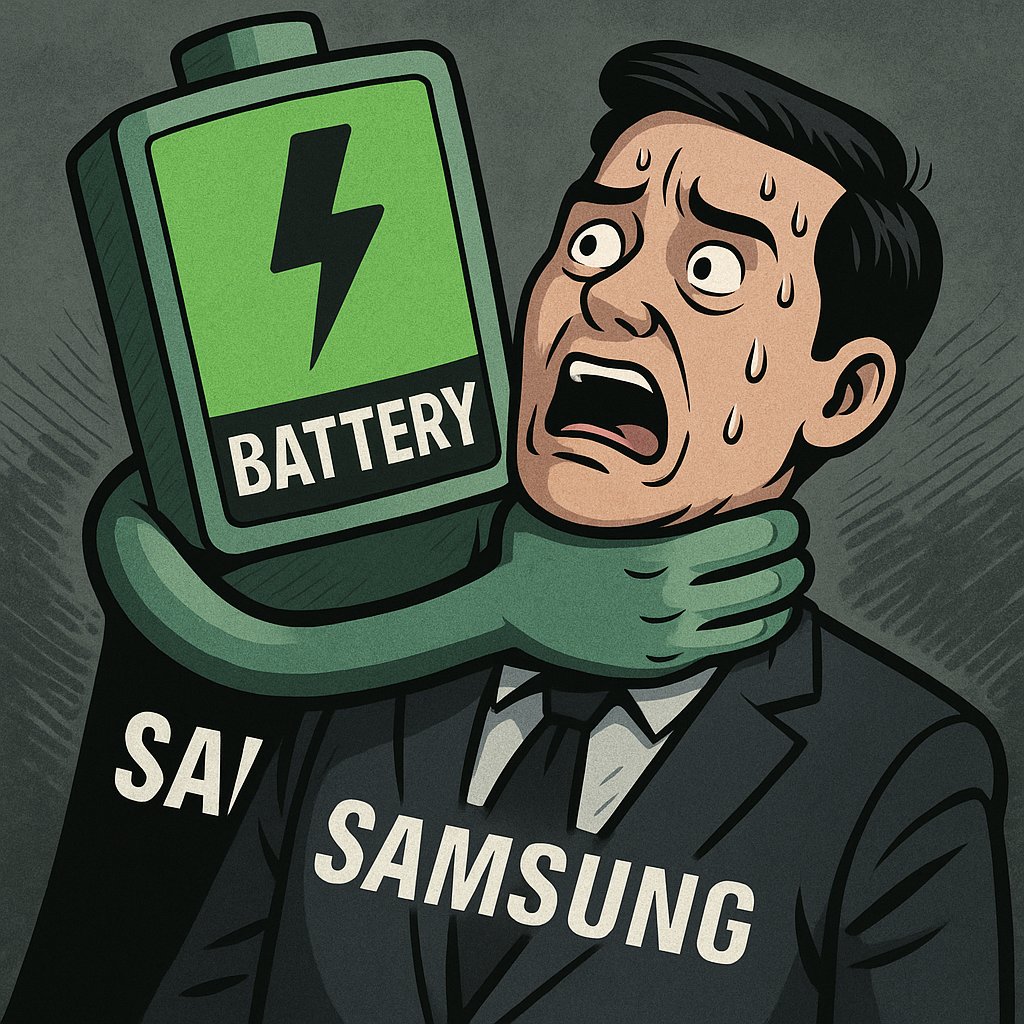
“18 Domino Effects of Samsung’s Too-Small Battery”
— Don’t blame Samsung for not trying. It’s just being strangled by its own battery.
1️⃣ Small battery = crippled performance.
No matter how powerful the chip is, the power wall strangles it. The Snapdragon 8 series can’t unleash full power — run at max for a minute and it throttles to survive.
2️⃣ Small battery = watered-down animation.
It’s not that One UI doesn’t want fancy visuals — blur, depth, and transparency all eat power, and a tiny battery kills the fun before it starts.
3️⃣ Small battery = slow AI.
Galaxy AI’s object erase, photo repair, and text summary features all demand compute. With tight power budgets, the AI crawls forward like it’s stuck in the 4G era.
4️⃣ Small battery = limited camera algorithms.
Night mode, HDR, and AI enhancement all consume power. To avoid overheating, Samsung cuts frame stacking — dark areas smear, bright areas blow out.
5️⃣ Small battery = fast heat, early throttling.
Within minutes the phone turns into a hand-warmer. Games, camera, and AI tasks quickly trigger power-saving throttles.
6️⃣ Small battery = killed background apps.
One UI’s power-saving logic is ruthless. Background apps are slaughtered — music stops, navigation dies — the “eco mode” ruins the experience.
7️⃣ Small battery = shrunken HDR.
Real-time HDR can’t run at full strength. Fewer merged frames mean dull contrast and weaker dynamic range.
8️⃣ Small battery = cramped hardware.
Low-density cells eat up internal space. There’s no room for a larger main sensor or bigger vapor chamber for cooling.
9️⃣ Small battery = weaker speakers.
Shrunk cavities make the sound hollow, thin, and powerless — no tuning can fix missing physics.
🔟 Small battery = weak haptics.
The X-axis motor gets downsized; vibration feels airy and soft. That crisp mechanical “kick” you get from Chinese flagships? Gone.
11️⃣ Small battery = AI that can’t stay awake.
Background AI recognition and voice assistants get suspended to save power. Forget 24/7 “always-on intelligence.”
12️⃣ Small battery = dimmer outdoor screen.
Under sunlight, power drain skyrockets. Samsung’s fix? Auto-limit brightness and peak luminance duration — it glows bright for a second, then fades fast.
13️⃣ Small battery = camera drains and downgrades.
During long photo or video sessions, the battery melts away. Small capacity forces lower video bitrate and frame rate just to survive the shoot.
14️⃣ Small battery = S Pen eats the space.
The Ultra’s built-in stylus takes up room, forcing Samsung to cut hundreds of mAh from the cell.
15️⃣ Small battery = permanent range anxiety.
Light users charge once a day; power users, twice. You carry a power bank like a life-support pack.
16️⃣ Small battery = frozen creativity.
Samsung’s designers dream of AI wallpapers, smart desktops, dynamic effects — all killed by one phrase: “too power-hungry.”
17️⃣ Small battery = brand damage.
When rivals pack bigger cells and still dare to push performance, your “premium” phone that cuts corners looks stingy, not refined.
18️⃣ Small battery = strategic collapse.
In the AI era, power is performance. Without energy, even the smartest algorithm is just dead silicon.
> Samsung’s biggest problem isn’t the chip or the OS — it’s that the energy pool is too small to hold its ambitions.
While others move toward 10 000 mAh phones with full-time AI and high-end imaging, Samsung is still counting watts.
When the battery’s small, every dream gets strangled before takeoff.
@LateReaponder I like the Samsung ones. Legitimate and don't overheat. There are some nice youtube videos (ProjectFarm guy) who tests out various batteries and a lot of off-brands don't deliver
1) More interestingly, they've appointed Srikanth Kethu as head of R&D. From the July 14th press release: "Srikanth will lead Hyderabad operations, support Malaysia Fab2 ramp, and drive strategic growth across India... His deep expertise in product development, systems integration, and cross-border team building makes him uniquely qualified to help lead Enovix through its next phase of global growth." This is a man with significant automotive and industrial networks. (The criticism below that he shouldn't attend such an event because it has nothing to do with it is, in short, bizarre.)
https://t.co/CEd12LGjFf
I also suspect that Enovix is supplying a lot of samples to car manufacturers. These could be regular coin cells, since that's what they start with when they take samples. Personally, I think OLA Electric and Volvo Energy are already more deeply involved.
@kelpieforest@EnovixBurner@doh_in I'm thinking the Xiaomi 17 ultra as the leaked battery photo is rectangular and could be swapped for the AI-1. Timeline is right too
$envx
“Xiaomi hasn’t yet announced global release plans, but a European launch for at least some of the models is likely in the spring, potentially around the MWC trade show in late February, when it may also reveal an even more powerful Xiaomi 17 Ultra.” https://t.co/EigoPzoGXy
@spenbaker@spenbaker@2percentisfair@doh_in Interesting. The Xiaomi 17 Ultra battery (4th one below) is not L-shaped and very well could be the form factor that matches Enovix: https://t.co/A2g1na5J7p
Multiple suppliers of ENVX + conventional one?
"As soon as I was back to work in September, I immediately identified four patients with Covid [in my studio]"
Italian medical professional
"Covid is back."
"[Some] people with masks are back [in Rome]"
Concerns over a new Covid wave in Italy
https://t.co/KHZtjNkftI
How many people do you know who have developed these things since they caught Covid:
Long term fatigue
Vulnerability to infections
High blood pressure
Breathing difficulties
Chest pain
Heart palpitations
Dizziness
Migraines
Brain dysfunction
Memory problems
Difficulty concentrating
Depression
Anxiety
Sleep disturbances
Digestive issues
Irritable bowel symptoms
New food intolerances
Allergies or sensitivities
Joint pain
Muscle weakness
Muscle aches
Skin rashes
Hair loss
Diabetes
Weight gain
Weight loss
Thyroid problems
Poor temperature regulation
Hormonal imbalances
Reduced exercise tolerance
Chronic cough
Asthma-like symptoms
Loss of smell or taste
Tinnitus
Hearing problems
Vision problems
Nerve pain
Numbness or tingling
Balance problems
Seizures
Blood clotting issues
Strokes or mini-strokes
Heart inflammation
Autoimmune conditions
Post-exertional malaise
Swelling in legs or feet
Kidney problems
Liver problems
New or worsened menstrual problems
Erectile dysfunction
Fertility issues
That may be the number of people you know with Long Covid.