For those that want a “15 years later” update on whether fracking was safe:
- Since 2010, 300,000 shale wells were fracked all across the United States
- No groundwater issues
- Nobody got sick
- Hotspots of drilling are thriving
You were lied to.
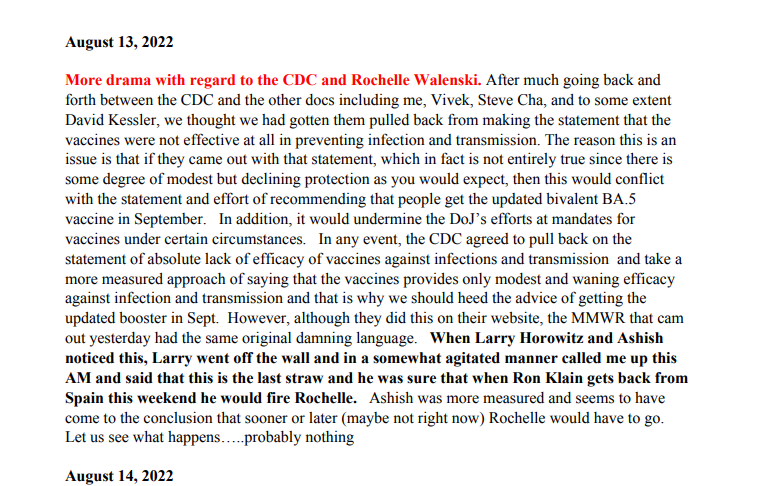
FAUCI TALKED THE CDC OUT OF TELLING THE PUBLIC THE TRUTH THAT THE COVID SHOTS WERE "NOT EFFECTIVE AT ALL IN PREVENTING INFECTION OR TRANSMISSION - AUG 2022....
More deep truths from Fauci's diary, courtesy of Senator Rand Paul.
August 13, 2022 Fauci's diary records how the CDC were about to make the public statement that
"the (Covid) vaccines were
NOT EFFECTIVE AT ALL IN PREVENTING INFECTION OR TRANSMISSION.
but phew....Fauci et al managed to get them to pull back and what a relief because this statement would have conflicted with the recommendation that people needed to
TAKE A BOOSTER in September
and even more importantly the statement would
UNDERMINE DEPARTMENT OF JUSTICE COVID VACCINE MANDATES
Despite the CDC agreement to fudge the truth, somehow Rochelle mucked up and Fauci had a diarised rave about her superiors raging and saying it's time for her to go (be pushed).
This reads like a scene out of Fahrenheit 451 - except in this case the censors strip mine the books first to feed their AI on all of human knowledge before destroying the original source so it can’t be recreated. Feast on the knowledge, and then destroy the evidence.
btw anthropic's internal document on this literally said "we don't want it to be known that we are working on this.”
it was called project panama.
here's exactly what happened:
1: anthropic concluded that books were the cheapest way to build a world-class model because they gave claude curated facts, structured arguments, compelling stories, and writing “an editor would approve of.”
2: once anthropic decided it needed books at enormous scale, its first solution was piracy.
it downloaded 7m+ books from online libraries including libgen. the judge later wrote that although anthropic had legal ways to buy them, it chose piracy to avoid what dario amodei called the “legal/practice/business slog.”
3: that piracy created a massive legal risk.
so in february 2024, anthropic hired tom turvey, the former head of partnerships for google books, to find a legally safer way of obtaining “all the books in the world.”
4: turvey first contacted major publishers about licensing their catalogs.
those attempts didn’t produce agreements, so anthropic chose a route that required no publisher permission: buying millions of physical books through distributors and used-book retailers.
5: within about a year, anthropic spent tens of millions acquiring and scanning millions of books, including many rare and 1/1 titles. one vendor proposal targeted 500,000 to 2 million books in six months.
6: to scan that many books within months, the vendors physically dismantled them.
a hydraulic cutter removed each spine. the pages were trimmed to size, fed as loose sheets through high-speed industrial scanners, and converted into searchable PDFs. the paper remains were then sent for recycling.
7: these PDFs were fed into claude as training data.
the complete collection became a private, searchable anthropic library that the company planned to “store forever.” the scans aren’t available to the public and were never open-sourced.
The real story in the Fauci emails isn’t that he’s evil. It’s that he’s a buffoon.
He had access to every bit of information in the American government. But a tiny group of people on Twitter used public data and understood and reported the course of Covid, the likely origins of SARS-Cov-2, and the ultimate collapse of the mRNAs far better than he did.
He didn’t just answer the questions wrong, he failed to ask the most basic ones, because he was spending so much time polishing his own reputation.
And because of his influence in Washington and the media, he profoundly impacted the response, not just in the US, but worldwide. He caused massive and unnecessary misery to billions of people, kids in particular.
Okay, I guess he was evil too.
@itsolelehmann@TrentTelenko This reads like a scene out of Fahrenheit 451 - except in this case the censors strip mine the books first to feed their AI on all of human knowledge before destroying the original source so it can’t be recreated. Feast on the knowledge first, and then destroy the evidence.
Texas shattered its all-time demand record yesterday hitting 91 GW.
Was there an energy shortage? Nope.
There was a capacity SURPLUS of 20+ GW!
If you want to see what Energy Abundance looks like in practice, Texas has it and it’s beautiful.
Texas is the future.
@patrick_oshag This is patently false. Gas is basically uneconomic right now and we are still increasing production - imagine what would happen if gas was economic…
In Loudoun, VA, data center buildouts funded tax breaks for residents and helped to lower electricity prices
This is what they're *actually* doing across the country
They're not liquid gold—that makes no sense!—but they are generating free money for locals
That's just a fact
one common trait I find in high achieving individuals is urgency. it looks almost like impatience until you understand it is closer to reverence, a deep refusal to waste the one thing they can’t buy more of. the alarm goes and they rise. the message is answered while it is still warm. the small task is done before it can find a shelf to hide on. they commit and move in a single motion. an idea sparks and they chase it that day, before the world talks them out of it. they run at their own lives like something is at stake, because they have decided something is.
Less than 100 miles away, about 50 tons of steel and copper are spinning at exactly 3,600 RPM. A giant rotor slews magnetic fields through copper windings and, per Faraday and Maxwell, induces a synchronized 60 Hz sine wave across an entire grid.
That electromagnetic wave propagates through grain oriented silicon steel, laminated transformer cores, kilometers of aluminum conductor steel reinforced cable, SF₆ insulated switchgear, substations switching hundreds of kilovolts, distribution transformers, oxygen free copper wiring, silicon MOSFETs, ferrites, multilayer ceramic capacitors, and the USB C cable plugged into my phone.
There, power feeds a capacitive touchscreen. A transparent matrix of indium tin oxide is deposited on glass. The controller continuously scans the grid. My finger changes the mutual capacitance by a fraction of a picofarad, perturbing the local electric field just enough for dedicated analog front ends to detect before software reconstructs the touch.
Iron ore. Bauxite. Silica sand. Copper ore. Lithium brines. Rare earths.
Refined. Alloyed. Crystallized. Doped. Implanted. Deposited. Etched. Polished.
We purified sand into nearly perfect single crystal silicon, grew boules, sliced wafers, placed dopant atoms with nanometer precision, fabricated chips containing tens of billions of transistors, synchronized them with clocks billions of times per second, and engineered them to execute matrix multiplications at a scale no human could comprehend.
Somewhere along the way, matmuls started to look like us.
That is an astonishing thought.
The towers of abstraction are staggering. No one person built this. No one person fully understands it. Yet every morning millions of people wake up tired, answer emails, argue over specifications, chase margins, fix defects, make payroll, and try to cover their mortgages. Somehow the whole machine keeps humming.
A planetary Swiss watch assembled from physics, markets, bureaucracy, ambition, error, and human necessity.
And after all of that, I touch a piece of conductive glass and step into the Roman forum of modern thought, where millions of minds test ideas against one another in real time.
Clockwork humanity.
It staggers the mind.
On a hot July day, a single mature tree in your yard pumps somewhere around 100 gallons of water up from its roots and out through its leaves as water vapor. A mature elm with 150,000 leaves can clear that in a day.
As that water evaporates off the leaf surface, it carries heat away with it, the same basic physics that makes sweat work. The air around the canopy drops measurably.
The cooling effect of a single large tree transpiring 100 gallons of water is roughly equivalent to two household air conditioning units running all day. Except it runs on sunlight and groundwater, costs nothing, and has been doing it since before your house was built.
A yard with mature canopy runs 5 to 10 degrees cooler than a paved or treeless yard next door. That's not a feeling. It's a physics difference you can measure with a thermometer. The urban heat island is real, and it gets worse one removed tree at a time.
The best time to plant a tree was twenty years ago. The second best time is this weekend, before another hot ass July like this one comes around.
just want to remind you one more time that significantly lowering the cost of housing would solve, overnight, almost every single problem in the country
Croatia's disallowed goal highlights scientism's core ideology that "data" is truth: but it is simply not. It is obvious to the naked eye that the ball direction is not altered by the player's head. That is truth. The blip on the sensor could simply be put there later, it could correspond to an earlier or later touch. If it is isolated from the other previous or subsequent touches it could simply be an added graphic. Data is how to fool people that lies are truth, because it is the easiest thing to manipulate. Trust your own judgment always: you don't see a touch? There is no touch.
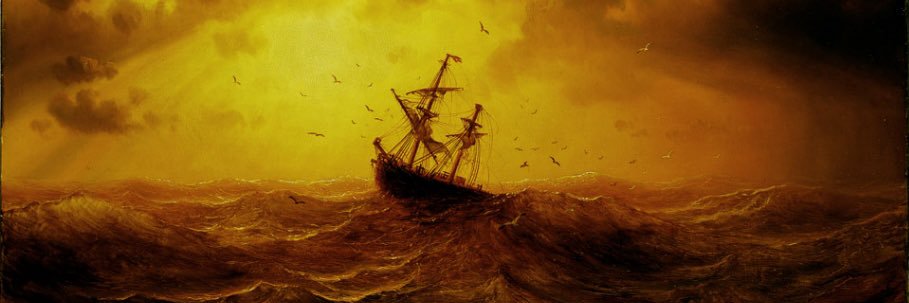
Ernest Shackleton watched the ice slowly crush his ship past saving. He turned to his stranded crew and told them: ship and stores have gone, so now we'll go home.
It was 1915. He had sailed to Antarctica to cross the whole continent on foot, and his ship, the Endurance, got stuck in thick sea ice before he ever reached land. The ice held the ship for ten months, then crushed it until it broke apart. They left the ship that October and watched it sink that November, with no other people for hundreds of miles, no radio, and no one coming to look for them.
What the crew saw was a man who never lost his nerve. What they could not see was his diary. The night the ship was crushed, he wrote one line about it: it is hard to write what I feel. A crewmate later said it plainly. If Shackleton ever wanted to give up, he kept it to himself.
The calm was something he did on purpose. He held everyone to a strict daily routine so no one had time to lose hope. When the men threw out every heavy thing that might slow them down, he ordered them to keep the banjo, because music at night kept the men from falling apart. When his photographer lost his gloves, Shackleton gave away his own and let his fingers freeze.
They lived on the drifting ice for five months, eating seals and penguins. When the ice broke up, they rowed three small lifeboats about 180 miles to Elephant Island, a bare rock where no one lived and no ship would ever pass. Food ran so low that one of the men wrote they might have to eat whoever died first.
So Shackleton bet everything on a single boat. He and five others climbed into a 22-foot lifeboat and sailed 800 miles across the roughest ocean on Earth, through 16 days of freezing storms, aiming for a tiny island called South Georgia. They reached it. Then he crossed its mountains on foot for 36 hours straight, over ground no one had ever crossed, to reach a whaling station and get help.
Twenty-two men were still waiting back on Elephant Island. They waited 105 days. Three times a rescue ship was turned back by the ice before a small Chilean tug finally broke through, on August 30, 1916.
Shackleton stood on the bow as it neared the shore and called across the water, asking if they were all well. The answer came back: all safe, all well.
All 28 of them came home. He never let his men watch him break, and that was the whole point.