How can childhood experiences (and Pokémon) reorganize the brain?
Stanford neuroscientist Kalanit Grill-Spector @kalatwt joins us to discuss how childhood visual experiences, like words, faces, and even video games, shape how we see the world as adults.
https://t.co/IxuGhCdHmM
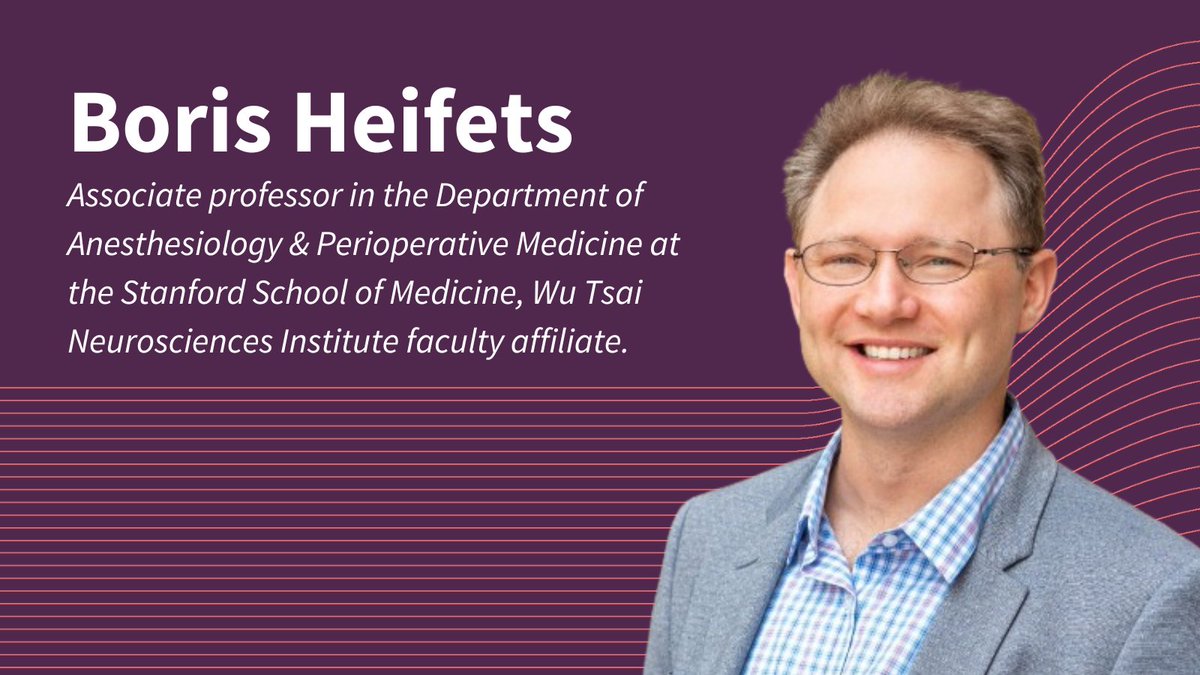
When I saw the news about the new executive order to fast-track psychedelic clinical trials and devote more $$$ to psychedelics research, I knew just who to call. Thanks, @TheBorisLab, for walking us through the policy and the science and sharing a peak into your crystal ball!
The federal government is fast-tracking psychedelic clinical trials for mental health.
Stanford anesthesiologist Boris Heifets @TheBorisLab joins us to discuss psilocybin, ibogaine, clinical trials, and the evolving landscape of psychedelic medicine.
https://t.co/LEmuic3THO
Did you know that most Parkinson's patients experience constipation, loss of smell, or sleep disruptions up to a decade before movement symptoms?
This week's guest, Kathleen Poston, says these early symptoms present the field with an incredible opportunity. Take a listen!
Symptoms like constipation, sleep disturbances, and loss of smell can appear years before Parkinson's diagnosis. In today's podcast, Kathleen Poston discusses ongoing research exploring where Parkinson's begins and how to slow its progression.
Listen now: https://t.co/MALwFVGZAA
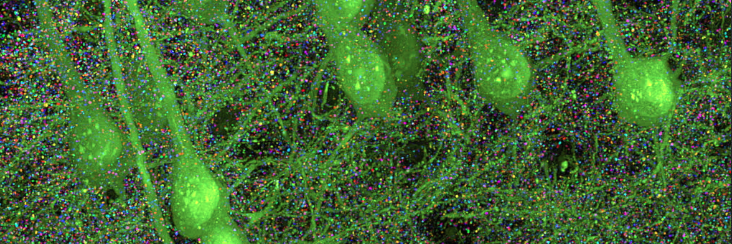
A different perspective can shed new light on old questions — *literally* in the case of this week's guest, @StanfordBrain faculty scholar Guosong Hong, a materials scientist who recently kicked off a Big Ideas in Neuroscience collaboration to make the brain transparent!
Could we make the brain see-through?
Light scatters in brain tissue, limiting how deeply we can study neural activity. In today’s podcast, Guosong Hong discusses how transparent brains could help scientists better understand how neural circuits work.
https://t.co/XxdnJY3qjf
Could we make the brain see-through?
Light scatters in brain tissue, limiting how deeply we can study neural activity. In today’s podcast, Guosong Hong discusses how transparent brains could help scientists better understand how neural circuits work.
https://t.co/XxdnJY3qjf
This paper was so cool I kept writing "this is wild" in the margins. I love how @ChristophThaiss and his team followed the science all the way from microbes in the guts of aging mice to changes in gut-brain communication and its impact on memory formation!
Could boosting gut–brain communication prevent memory loss?
New research by @ChristophThaiss suggests restoring vagus nerve activity can reverse cognitive decline in aging mice. He joins today's podcast to discuss microbes, memory, and internal senses.
https://t.co/OIjZcQM8SP
I've been thinking about this study ever since I heard Claire present the early stages of the work at one of our symposia several years back. So glad to be finally be able to share this unusual and fascinating story! Congrats to the team for this new publication.
On today's podcast, we talk with neuroscientists Claire Bedbrook and Ravi Nath (@BrunetLab, @KarlDeisseroth Lab) about their new study, which found that an animal's lifespan can be predicted surprisingly early just by observing its behavior.
Listen now: https://t.co/Ng2quV1OqZ
This week on the podcast, we talk with one of our Big Ideas in Neuroscience teams about their initiative to kick-start a new neuroscience of pregnancy. About time, too!
How does pregnancy reshape the mother's brain at a molecular level?
In today’s podcast, @NiraoShah and Katrin Svensson (@SvenssonLab) discuss the new Stanford Neuro-Pregnancy Initiative with Longzhi Tan and what neuroscience can tell us about pregnancy.
https://t.co/7K0mRVqqZl
So glad to be back with the 1st episode of our 9th (!) season of From Our Neurons to Yours! This week we are talking with Vinod Menon about the brain network that causes our minds to wander when we're not focused on anything else -- and what it means for who we are!
Why do our minds wander?
Our podcast is back! Today, we speak with cognitive scientist Vinod Menon about the brain's default mode network behind daydreaming, rumination, and our sense of self—and its links to ADHD, depression, and Alzheimer’s disease.
https://t.co/VvfZ4O6mTl
Meet Dr. Hülya Torun (@hulyatorunn), a postdoctoral researcher at the Brain Resilience Lab.
"Science generates the accumulation of knowledge so that physicians can use that knowledge to heal people, and I think that was the reason that I wanted to be a neuroscientist."
Meet Dr. Hülya Torun (@hulyatorunn), a postdoctoral researcher at the Brain Resilience Lab.
"Science generates the accumulation of knowledge so that physicians can use that knowledge to heal people, and I think that was the reason that I wanted to be a neuroscientist."
Could treating anxiety ease constipation? Why does keto reduce seizures? Do gut microbes influence memory?
Our 12th annual symposium explored how our brains and bodies communicate—and what that means for our health and well-being.
Learn more: https://t.co/Xf7WnRy5C0
"The Emergent Mind" has been living rent free in my head for the past month — I have trouble thinking about the brain without finding a new application.
Check out my conversation with neural network pioneer Jay McClelland, and stay tuned for more on AI and neuroscience in 2026!
How does intelligence emerge from neural networks in our brains and artificial networks in machines?
Stanford cognitive scientist Jay McClelland explains on our podcast, exploring the neural network view of the mind and what it means for AI.
Listen now: https://t.co/cjARPr9xOD
How can brain activity predict stock prices or viral videos?
In today’s podcast, Stanford neuroeconomist Brian Knutson explores how brain signals shape choice, risk, and attention—bridging neuroscience, psychology, and economics.
Listen now: https://t.co/kGQurPD1GA
This conversation made me re-evaluate my own social "diet" in a world that seduces us with convenient isolation at every turn. Thanks @dr_benrein for the food for thought!
Why does social isolation reshape the brain?
Neuroscientist, science communicator, and author of 'Why Brains Need Friends' @dr_benrein shares how connection influences brain health, and what science says about loneliness in the modern world.
https://t.co/sUtPyBm13u
We're incredibly proud of this recognition — thanks so much to our guests, our listeners, and especially to @osbornemc and our incredible production team.
Our podcast has won two Signal Awards for brand storytelling in the Science & Education category!
🥈 Silver Signal Award
🏅 Listener's Choice Award
Thanks to our fascinating guests, wonderful audience, host @lore_nick, and podcast producer @osbornemc for making this possible!
Wu Tsai Neuro affiliate Jessica Ross and colleagues used TMS pulses to induce movements in people's hands—a common testing ground for new ideas in the field. By carefully timing those pulses to music, the team found they could double the impact of TMS.
https://t.co/LM70XUZtgz
I was floored by this conversation. Thanks so much to Dr. Ballon and soon-to-be-doctor Pagdon for helping me better understand how our sense of reality is built, and what it feels like to have it slip!
What can neuroscience tell us about psychosis?
Stanford psychiatrist Jacob Ballon and peer advocate Shannon Pagdon join our podcast to explore neuroscience, lived experience, and the shift toward recovery-oriented care.
Listen now: https://t.co/bTfFXG5t8H
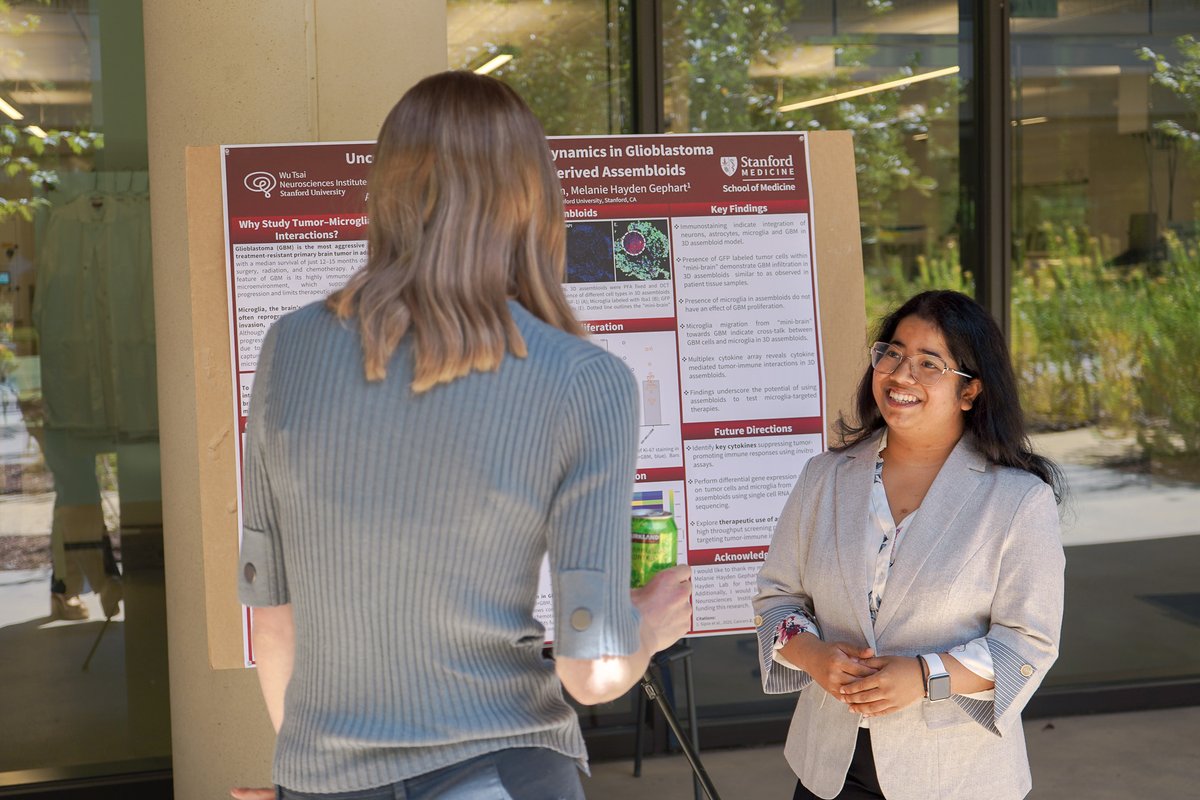
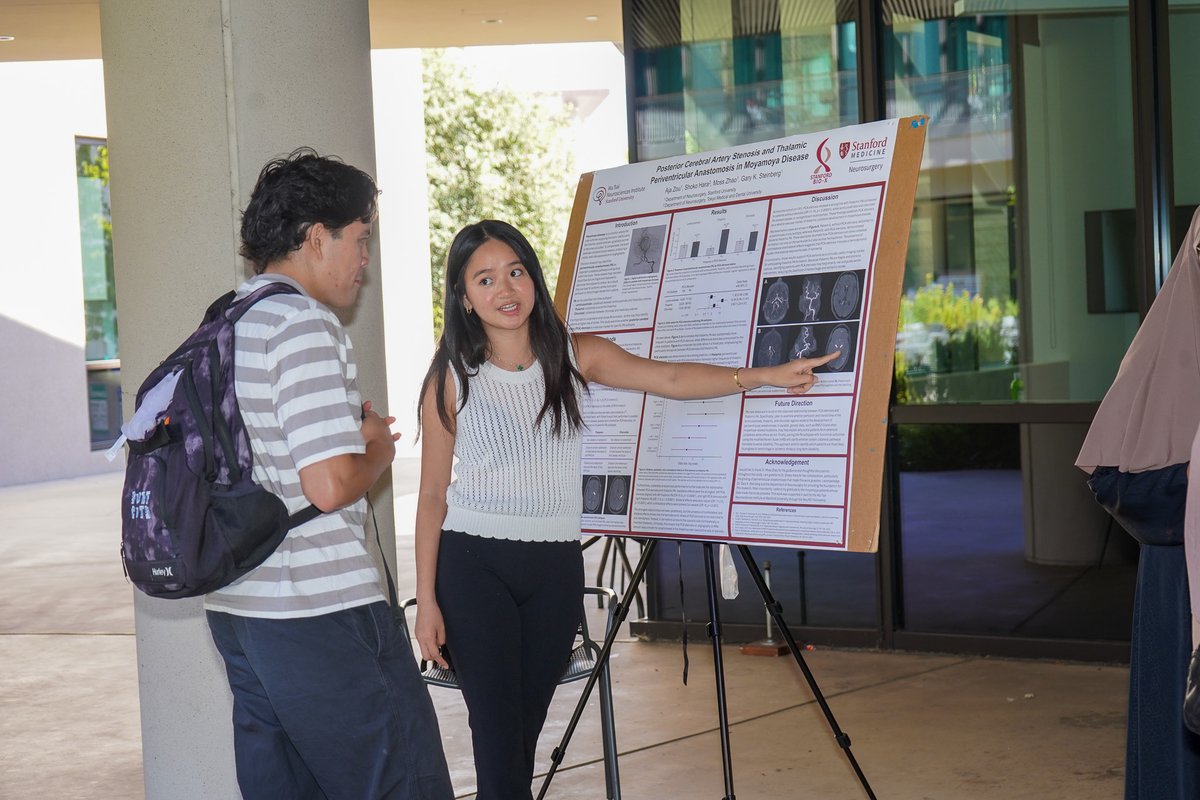
Stanford undergrads and local community college students paired with Wu Tsai Neuro researchers to find new ways to head off strokes, predict Alzheimer's disease, and more at the Annual NeURO and NeURO-CC Poster Session.
Read the full story in the comments.