„Was in der Politik im Moment passiert ... ist extremst beängstigend! ... Nicht die Bürger oder die AfD tragen die Schuld am aktuellen Zustand, sondern einzig und allein die schlechte Arbeit der Altparteien.“
Schauspielerin Tina Ruland nimmt kein Blatt vor den Mund. (1/2)
Alarm in der Notaufnahme. "Sowas haben wir noch nie erlebt"...wann hab ich das schon mal gehört?...Diesmal ist es halt Hitze...Wer Panikpropaganda einmal verstanden hat, der versteht auch diesmal...😎
https://t.co/oFcvsuolFO
Berichte über den von Rupert Lowe veröffentlichten Rape Gang Inquiry Report, der die Vergewaltigung von über 250.000 britischen Mädchen offenlegt:
ARD: 0
ZDF: 0
NDR: 0
RBB: 0
HR: 0
BR: 0
WDR: 0
SR: 0
SWR: 0
MDR: 0
Der Bericht ist tausendmal schlimmer als Gesänge auf Sylt.
Tausendmal schlimmer als ein Kaffeekränzchen in Potsdam.
Tausendmal schlimmer als der Fall George Floyd.
Und tausendmal schlimmer als die Beziehungsprobleme von D-Promis.
Unser objektiver Qualitätsjournalismus.
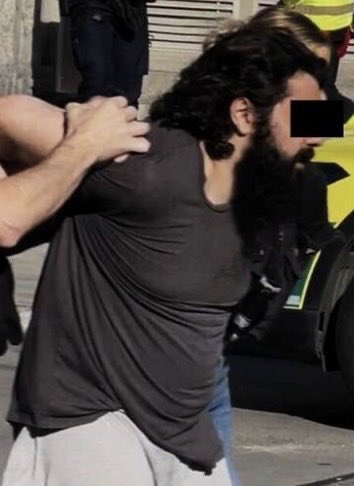
Neues zum Schweizer Terroristen
- Nesip Dedeler, 31
- Türke mit Schweizer Pass
- 2009 in Winterthur eingebürgert
- verbeitete IS-Propaganda, 2015 Anzeige
- 2024: wandert in Türkei aus "von Bildfläche verschwunden"
- 25. Mai 2026: meldet sich bei der Polizei, redet "wirre Aussagen", Einweisung in Psychiatrie Winterthur
- 26. Mai 2026: verlässt unerlaubt die Einrichtung, wird von Polizei gesucht
- 27. Mai 2026: Arzt diagnostiziert, dass er keine Gefahr für andere darstelle, darf Psychiatrie verlassen
Kompletter Wahnsinn. Mal wieder.
Bestätigter BioNTech-Impfschaden ME/CFS.
Ehre wem Ehre gebührt:
Susana Santini (ZDF), die diesen Beitrag produziert hat, wird von Betroffenen als ehrliche Journalistin beschrieben, die nicht wegschaut. Sie liest sogar bei mir mit, wie ich eben festgestellt habe…
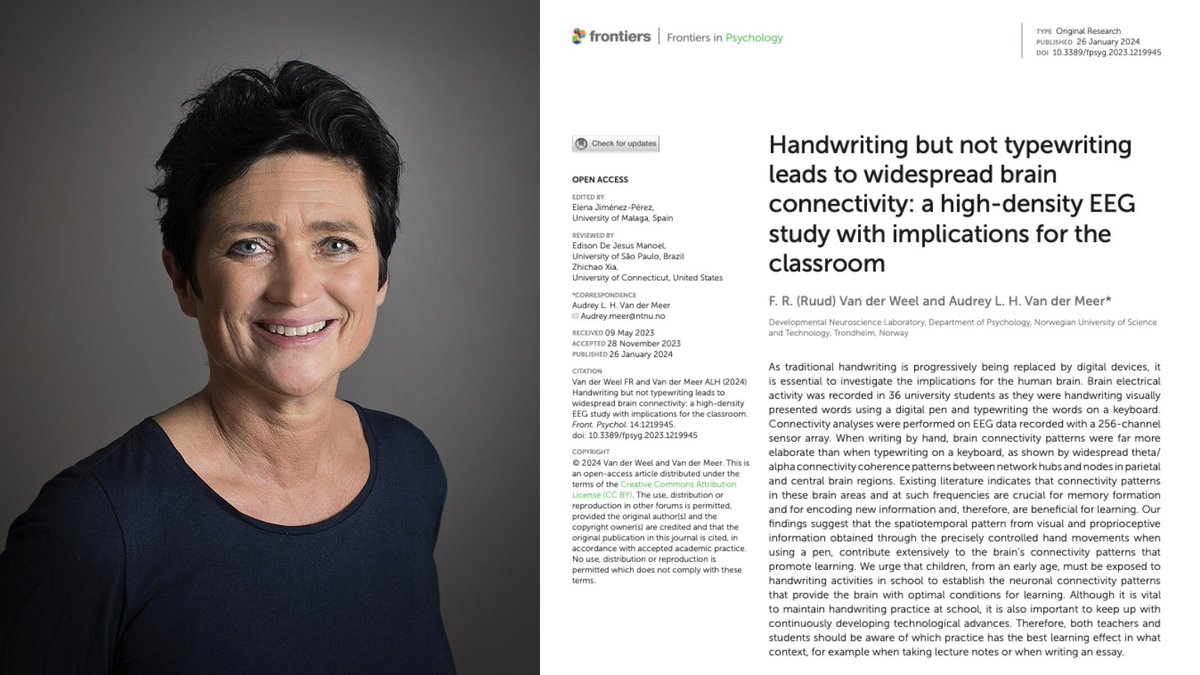
A Norwegian neuroscientist spent 20 years proving that the act of writing by hand changes the human brain in ways typing physically cannot, and almost nobody outside her field has read the paper.
Her name is Audrey van der Meer.
She runs a brain research lab in Trondheim, and the paper that closed the argument was published in 2024 in a journal called Frontiers in Psychology. The finding is brutal enough that it should have changed every classroom on Earth.
The experiment was simple. She recruited 36 university students and put each one in a cap with 256 sensors pressed against their scalp to record brain activity. Words flashed on a screen one at a time.
Sometimes the students wrote the word by hand on a touchscreen using a digital pen, and sometimes they typed the same word on a keyboard. Every neural response was recorded for the full five seconds the word stayed on screen.
Then her team looked at the part of the data most researchers had ignored for years, which is how different parts of the brain were communicating with each other during the task.
When the students wrote by hand, the brain lit up everywhere at once.
The regions responsible for memory, sensory integration, and the encoding of new information were all firing together in a coordinated pattern that spread across the entire cortex. The whole network was awake and connected.
When the same students typed the same word, that pattern collapsed almost completely.
Most of the brain went quiet, and the connections between regions that had been alive seconds earlier were nowhere to be found on the EEG.
Same word, same brain, same person, and two completely different neurological events.
The reason turned out to be something nobody had really paid attention to before her work. Writing by hand is not one motion but a sequence of thousands of tiny micro-movements coordinated with your eyes in real time, where each letter is a different shape that requires the brain to solve a slightly different spatial problem.
Your fingers, wrist, vision, and the parts of your brain that track position in space are all working together to produce one letter, then the next, then the next.
Typing throws all of that away. Every key on a keyboard requires the exact same finger motion regardless of which letter you are pressing, which means the brain has almost nothing to integrate and almost no problem to solve.
Van der Meer said it plainly in her interviews.
Pressing the same key with the same finger over and over does not stimulate the brain in any meaningful way, and she pointed out something that should scare every parent who handed their kid an iPad.
Children who learn to read and write on tablets often cannot tell letters like b and d apart, because they have never physically felt with their bodies what it takes to actually produce those letters on a page.
A decade before her, two researchers at Princeton ran the same fight using a completely different method and ended up at the same answer. Pam Mueller and Daniel Oppenheimer tested 327 students across three experiments, where half took notes on laptops with the internet disabled and half took notes by hand, before testing everyone on what they actually understood from the lectures they had watched.
The handwriting group won by a wide margin on every question that required real understanding rather than surface recall.
The reason was hiding in the transcripts of what the two groups had actually written down.
The laptop students typed almost word for word, capturing more total content but processing almost none of it as they went, while the handwriting students physically could not write fast enough to transcribe a lecture in real time, which forced them to listen carefully, decide what actually mattered, and put it in their own words on the page.
That single act of choosing what to keep was the learning itself, and the keyboard had quietly skipped the choosing and skipped the learning along with it.
Two studies. Two countries. Same answer.
Handwriting makes the brain work. Typing lets it coast.
Every note you have ever typed instead of written went into your brain through a thinner pipe. Every meeting, every book highlight, every idea you captured on your phone instead of on paper was processed at half depth.
You did not forget those things because your memory is bad. You forgot them because typing never woke the part of the brain that would have made them stick.
The fix is the thing your grandmother already knew.
Pick up a pen. Write the thing down. The slower road is the faster one.
Precht entlarvt die Dummheit des aktuellen Angst-Narrativs „der Russe steht bald vor der Tür“.
Fast auf dem Niveau der Corona-Todesseuche aus der Hölle. Aber nur fast.
Täglich finden Gruppenvergewaltigungen statt, aber dagegen demonstrieren Luisa Neubauer und Bärbel Bas nie. Das zeigt: Der Fernandes-Fall wird benutzt, um Prinzipien des Rechtsstaats zu beschneiden. https://t.co/MR0yvbpUiS
EILMELDUNG – KISS-Mitbegründer Gene Simmons sagt, es sei an der Zeit, dass Prominente wie Ben Stiller und Mark Ruffalo „die Klappe halten“.
„Die Menschen arbeiten hart für ihren Lebensunterhalt und wollen sich nicht von Leuten belehren lassen, die in Villen wohnen und Rolls-Royces fahren. Es ist Zeit, die Klappe zu halten.“
Quelle @Rightanglenews
Könnte das mal jemand Grönemeyer, Kerkeling und Co schicken.
Wer andere Menschen 2026 als "Ratten" bezeichnet, weil sie eine ihm nicht genehme Partei demokratisch, frei und geheim wählen, ist als moralisch-ethischer Leuchtturm möglicherweise etwas ungeeignet.