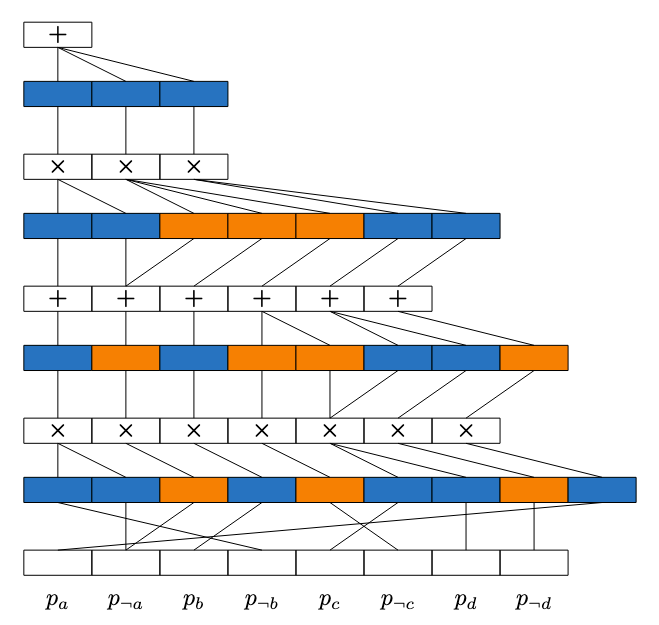
We learn more expressive mixture models that can subtract probability density by squaring them
🚨We show squaring can reduce expressiveness
To tackle this we build sum of squares circuits🆘
🚀We explain why complex parameters help, and show an expressiveness hierarchy around🆘
AI people going on about Johnson-Lindenstrauss lemma like it was discovered yesterday.
it’s just another example of how most folks don’t read or know anything more than 5 years old
Happy to share a major milestone: after years of development, we are officially launching Version 1.0 of the GeometricKernels library!
To top it off, our accompanying paper has just been published in JMLR (MLOSS)! 🎉
https://t.co/orSv60ydUX
I am a bit late to the party, but I am happy to share that our latest work was accepted to #ICLR2026 🥳🥳
📜 How to Square Tensor Networks and Circuits Without Squaring Them
https://t.co/5dKwvVtkD4
Good news everyone! This year we will be organizing a workshop on Unifying Concept Representation Learning at ICLR'26!
The workshop is about unifying ideas and techniques from #NeSy AI, #XAI and #Causal representation learning. Have a look at the CfP!
Congratulations to everyone who got their @NeurIPSConf papers accepted 🎉🎉🎉
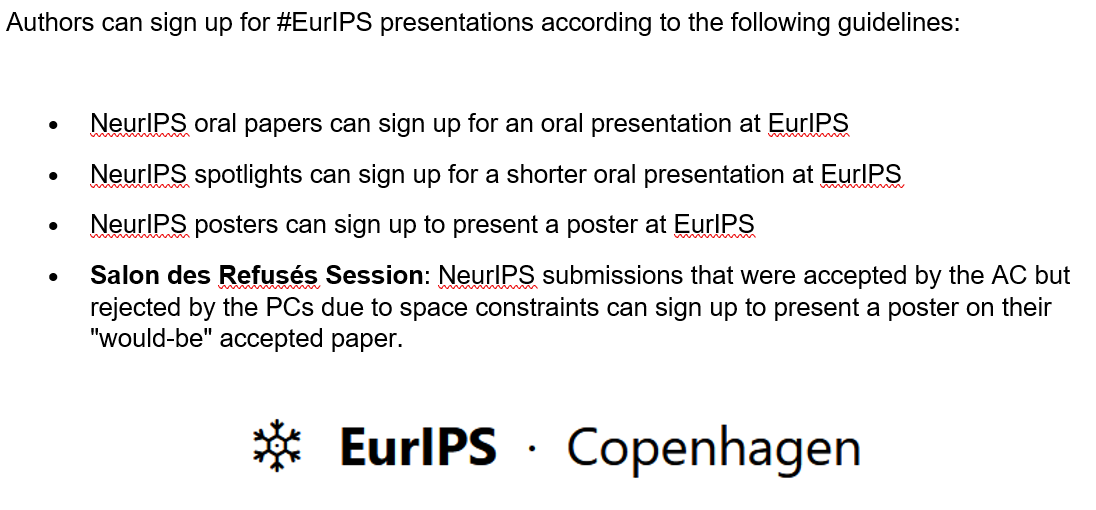
At #EurIPS we are looking forward to welcoming presentations of all accepted NeurIPS papers, including a new “Salon des Refusés” track for papers which were rejected due to space constraints!
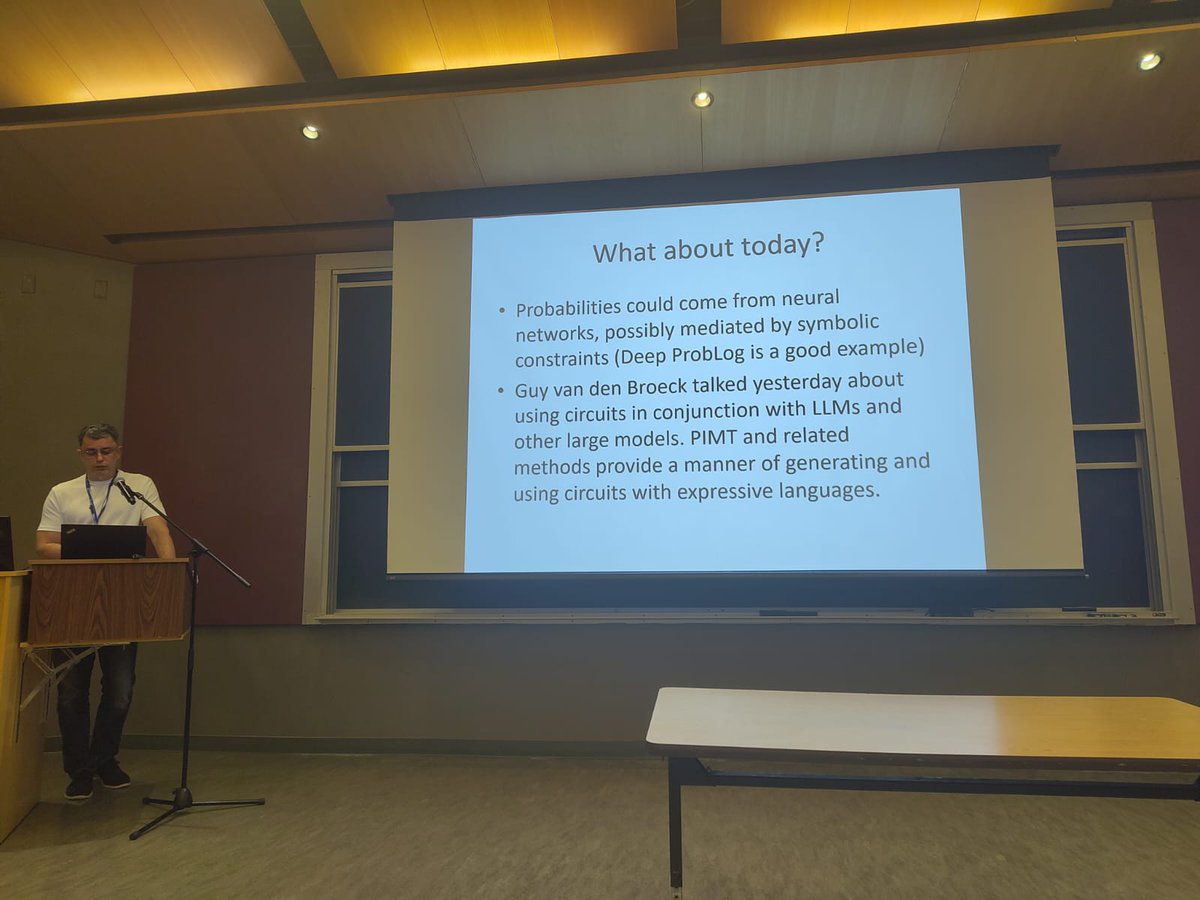
@luislamb We're glad to announce the NeSy 2025 Test of Time award for "Probabilistic Inference Modulo Theories"!
🏆Rodrigo de Salvo Braz was here to accept the award.
This is groundwork for recent NeSy approaches like DeepSeaProbLog and the probabilistic algebraic layer.
@deedydas Insightful! We tackled the same problem in Knowledge Graph Completion. Dot-product scoring on low-dim embeddings severely limits what a model can predict. We call this a “rank bottleneck” to align with the existing LM literature. Our paper for context: https://t.co/IePSDw9VYb
EurIPS is coming! 📣 Mark your calendar for Dec. 2-7, 2025 in Copenhagen 📅
EurIPS is a community-organized conference where you can present accepted NeurIPS 2025 papers, endorsed by @NeurIPSConf and #NordicAIR and is co-developed by @ELLISforEurope
https://t.co/RSAvf9lcZm
🧵Why are linear properties so ubiquitous in LLM representations?
We explore this question through the lens of 𝗶𝗱𝗲𝗻𝘁𝗶𝗳𝗶𝗮𝗯𝗶𝗹𝗶𝘁𝘆:
“All or None: Identifiable Linear Properties of Next-token Predictors in Language Modeling”
Published at #AISTATS2025🌴
1/9
We propose Neurosymbolic Diffusion Models! We find diffusion is especially compelling for neurosymbolic approaches, combining powerful multimodal understanding with symbolic reasoning 🚀
Read more 👇
Just under 10 days left to submit your latest endeavours in ⚡#tractable⚡ probabilistic models❗
Join us at TPM @auai.org #UAI2025 and show how to build #neurosymbolic / #probabilistic AI that is both fast and trustworthy!
In LoCo-LMs, we propose a neuro-symbolic loss function to fine-tune a LM to acquire logically consistent knowledge from a domain graph, i.e. wrt. to a set of logical consistency rules.
@looselycorrect@tetraduzione
https://t.co/YXGg38mIon
We developed a library to make logical reasoning embarrassingly parallel on the GPU.
For those at ICLR 🇸🇬: you can get the juicy details tomorrow (poster #414 at 15:00). Hope to see you there!
🚨New at #ICLR: we introduce the first ever 𝐥𝐚𝐲𝐞𝐫 that makes 𝐚𝐧𝐲 neural network 𝐜𝐨𝐦𝐩𝐥𝐢𝐚𝐧𝐭 𝐛𝐲 𝐝𝐞𝐬𝐢𝐠𝐧 with constraints expressed as 𝐝𝐢𝐬𝐣𝐮𝐧𝐜𝐭𝐢𝐨𝐧𝐬 𝐨𝐟 𝐥𝐢𝐧𝐞𝐚𝐫 𝐢𝐧𝐞𝐪𝐮𝐚𝐥𝐢𝐭𝐢𝐞𝐬—even if they define 𝐧𝐨𝐧-𝐜𝐨𝐧𝐯𝐞𝐱 𝐬𝐩𝐚𝐜𝐞𝐬!
Our paper "Low-rank finetuning for LLMs is inherently unfair" won a 𝐛𝐞𝐬𝐭 𝐩𝐚𝐩𝐞𝐫 𝐚𝐰𝐚𝐫𝐝 at the @RealAAAI colorai workshop! #AAAI2025
Congratulations to amazing co-authors @nandofioretto@WatIsDas@CuongTr95450563 and M. Romanelli 🥳🥳🥳