@udemy Hi @udemy, I’ve been getting a Video error .I tried several times to play your video. message on the CompTIA Network+ (N10‑009) course for 3 weeks. Other videos (YouTube, etc.) work fine. Can you please check or re‑encode the course videos? I’m on Windows 10 using MTN Nigeria.
@udemy Hi @udemy, I’ve been getting a Video error . I tried several times to play your video message on the CompTIA Network+ (N10‑009) course for 3 weeks. Other videos (YouTube, etc.) work fine. Can you please check or re‑encode the course videos? I’m on Windows 10 using MTN Nigeria.
The t£rr0r!sts have released a new video of the abd uct£d principal, Mrs Alamu begging for help from The Governor and The President. She revealed that the terror! sts are already getting impat!ent and they might be kp@!d. The teachers and the children are under the sun and the rain💔💔💔
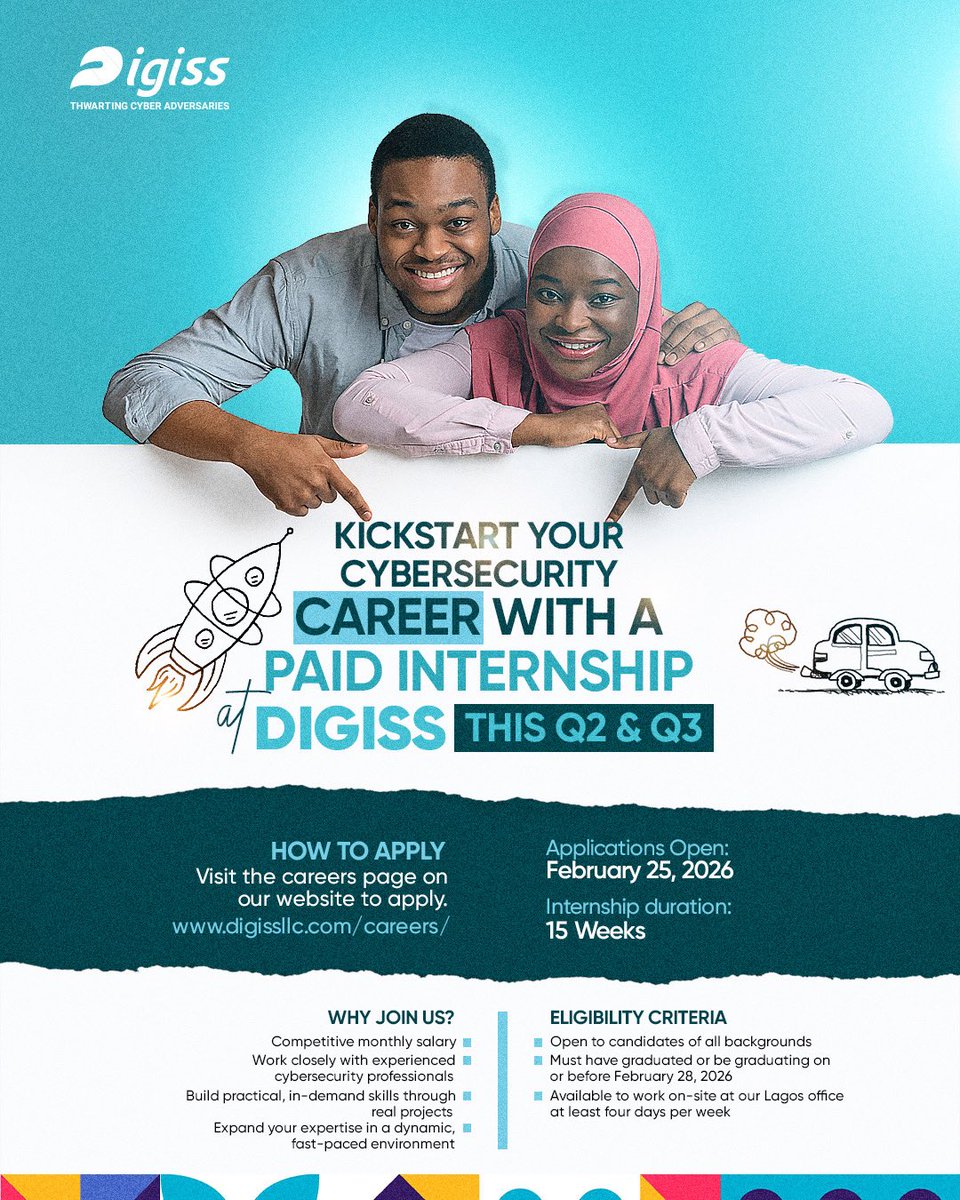
Applications are officially open for our Q2 and Q3 2026 Internship Cohorts.
This is a fast-paced selection process: you have 48 hours to submit your application, or until we reach 1,000 applications (whichever happens first).
Eligibility Requirements
Applicants must possess at least one of the following certifications:
• Google Cybersecurity Professional Certificate
• IBM Cybersecurity Analyst Professional Certificate
• Cisco Cybersecurity Essentials
• TryHackMe Cybersecurity 101
• Hack The Box Defensive Security Analyst or Junior Cybersecurity Associate
• CompTIA Security+ Certification
Internship Timeline and Duration
Q2 Cohort : April 13, 2026 – July 31, 2026
Q3 Cohort : July 13, 2026 – October 30, 2026
Location: Lagos, Nigeria (On-site only)
If you meet the requirements, don’t wait, submit your application before the deadline closes.
Apply now: https://t.co/X4Wm4ZIWfv
Most people tell you to learn cybersecurity, but few will tell you what to actually do in today's digital world.
Here’s a beginner‑to‑intermediate action plan you can start in the next 24 hours:
1. Secure YOUR OWN digital life first
Turn on 2FA everywhere.
Use a password manager.
Check if your email has been in breaches through https://t.co/H8dV0headd.
If you can’t defend yourself, you can’t defend others.
2. Build a tiny home lab (no expensive gear needed)
Install a virtual machine.
Create one 'attacker' machine and one 'victim' machine.
Break things, fix them, repeat.
This is where real learning happens.
3. Learn ONE tool deeply, not 50 tools shallowly
Pick something like network scanning, web testing, or log analysis.
Understand what the output actually means.
Professionals are paid for depth, not tool collecting.
4. Read real breach stories
Study HOW attacks actually happened, not just definitions.
Ask yourself:
• What failed?
• What could have stopped it?
• How long did detection take?
5. Document everything publicly (if safe to share)
Post notes, labs, mistakes, lessons.
Your future employer values proof over certificates.
6. Learn basic scripting
Even simple automation separates hobbyists from professionals.
Start small: rename files, parse logs, scan folders.
7. Practice explaining security to non‑technical people
If you can’t explain risk in plain language, leadership won’t listen.
Cybersecurity is as much communication as technology.
You don’t need to be a genius.
You don’t need expensive courses.
You need consistent, hands‑on practice.
If you started today and worked 1 hour daily, where would you be in 6 months?
Everyone wants to hack.
Few want to model.
Threat modeling feels boring until AI makes it interactive.
Try this:
Describe a simple app to AI.
Ask:
What assets matter most?
What would an attacker want?
What’s the cheapest attack path?
Then flip roles:
Ask AI to be the defender.
Ask it where it would invest first and why.
Lab idea:
Threat model a login system.
Simulate:
Credential stuffing
Session fixation
Privilege escalation
AI turns abstract modeling into hands-on thinking, leverage it.
Most organizationss don’t have an AI adoption problem.
They have an AI governance problem.
When an organization rushes to deploy tools but no one takes the time to pause and define things like:
• Data boundaries - what can be fed into models?
• Ownership - who signs off on AI risk?
• Training rules - can vendors train on our data?
• Audit trails - how do we reconstruct decisions?
• Model drift monitoring - does behavior change over time?
• Incident response extensions - what does IR look like for AI?
AI itself isn’t risky, blind integration is.
The companies winning aren’t the fastest AI adopters.
They’re the ones that built the operational scaffolding around AI before scaling it.
Identity has become the new perimeter.
The strongest firewall in the world cannot stop an attacker logged in with legitimate credentials.
Yet many organizations still treat Identity and Access Management as if it were a convenience feature, not a foundational security control.
Identity maturity requires:
- Strong authentication
- Role-based and attribute-based access
- Minimization of standing privileges
- Regular access reviews
- Just-in-time elevation for administrative actions
Zero Trust is not a product, and neither is it a marketing slogan.
It is an architectural philosophy: no identity, process, or device is trusted by default.
If attackers want to steal data, they escalate privileges. If defenders want to protect data, they minimize them.
Identity and Access Management is the quiet battlefield where most compromises are won or lost.
Cloud is the present and future of how organizations manage their data, but it's concerning how cloud environments fail quietly yet scale so quickly.
This combination makes misconfigurations the most successful attack vector in cloud security today.
Most breaches in cloud environments did not occur because the attacker was clever.
They occurred because the environment was generous.
Common real-world patterns include:
Overprivileged service accounts
Public storage buckets
Unrestricted inbound traffic
Weak identity policy configurations
Lack of logging for critical components
The strongest control in cloud security today is not firewall rules. It is identity architecture and permission minimization.
Cloud security maturity is reached when an attacker can compromise a resource without being able to escalate privileges, move laterally, or extract meaningful data.
Least privilege is not a slogan in the cloud, it is a survival tactic.
The companies winning with AI right now aren’t the ones with the best models.
They’re the ones with the best change tolerance.
This is because most breaches aren’t caused by a lack of functional tools.
They’re caused by a lack of adaptation:
• Policies don’t update
• Skills don’t evolve
• Processes don’t flex
• Teams don’t experiment
Security used to be about building walls, but with the rapis AI growth we are currently experiencing,
Now it’s about changing faster than the adversary can exploit.
AI isn’t eliminating security jobs.
It’s eliminating rigid practitioners and the question you should be asking is what kind of practitioner you are.
A lot of corporate 'AI policies' right now are a joke if I'm being honest, and not a funny one either.
It is understandable that AI is not that old in the market and it's growing relatively fast, but that is no excuse for mediocrity.
If your entire policy is:
'Do not paste sensitive data into AI tools.'
Then you don’t have a policy.
You have a sticky note taped to a door.
A real AI security policy defines:
Acceptable use
Training data rules
Vendor risk obligations
Regulatory requirements
Model safety constraints
Logging & auditability
Human overrides
Incident response paths
Compliance will have to evolve from 'does this tool meet requirements?' to 'does this decision engine comply under scrutiny?