Q: Recently, MOFCOM issued the Overall Plan for Developing National Demonstration Zones for the Innovative Development of Trade in Services, and identified 17 localities, including Beijing, Tianjin, and Shanghai, to take the lead in establishing demonstration zones. Could you share the overall considerations behind the development of these demonstration zones? (MOFCOM Regular Press Conference May 14, 2026)
A: The development of national demonstration zones for innovative development of trade in services is a major decision and plan made by the CPC Central Committee and the State Council. MOFCOM, together with relevant departments, has formulated the overall plan, which specifies the overall objectives, main tasks, and pathways for developing the demonstration zones. Building on the previous pilot programs for innovative development of trade in services, we will focus on demand-driven approaches, breakthroughs in reforms, technology empowerment, and opening up and cooperation. We will continue to develop a number of major open cooperation platforms for trade in services that rank among the top in scale, gather high-end factors, demonstrate outstanding innovation capabilities, facilitate trade-industry linkages, and exert significant spillover effects. We will also cultivate a group of internationally competitive service export enterprises and key service industry clusters, and establish a more robust institutional system and business environment for innovation-driven development, thereby leading and driving nationwide innovative development in trade in services.
We will start the development of demonstration zones in 17 regions, including Beijing, Tianjin, Shanghai, Chongqing, Dalian, and Xiamen, and by 2035, the total number of demonstration zones is expected to reach around 35. Specifically, we will carry out differentiated exploration in areas such as pursuing integrated innovation in industrial and supply chains, fostering the competitiveness of market entities, facilitating the efficient supply of production factors, advancing high-standard opening up, and building domestic and international promotion systems. At the same time, we will guide local governments to leverage their resource endowments and geographical advantages to promote the coordinated development of trade in services, investment, consumption, and industries.
Moving forward, MOFCOM will work with relevant departments and local authorities to implement the plan, and will support and guide other eligible cities to actively apply for the establishment of demonstration zones, so as to continuously promote the high-quality development of trade in services.
MOFCOM Spokesperson’s Remarks on the Determination That the EU’s Relevant Practices in Foreign Subsidy Investigations Constitute Improper Extraterritorial Jurisdiction
Q: On May 15, the Ministry of Justice of the People’s Republic of China issued an announcement determining that the EU’s cross-border investigative practices against Chinese entities under its Foreign Subsidies Regulation (FSR) constitute “improper extraterritorial jurisdiction.” What is MOFCOM’s comment on this?
A: China has always opposed the EU’s abuse of unilateral tools such as the FSR to suppress Chinese enterprises. Recently, the EU has not only increased the frequency and scope of its investigations targeting Chinese companies, but also escalated its probes into enterprises, including Nuctech, to in-depth investigations. Furthermore, it has compelled Chinese banking institutions to cooperate with these investigations, unreasonably demanding extensive access to a large amount of information within China that is unrelated to the investigations. The normal investment and operation of multiple Chinese companies and banking institutions in Europe have been severely and adversely affected.
As early as January 2025, MOFCOM concluded through investigation that the relevant EU practices under the FSR constitute trade and investment barriers. MOFCOM called on the EU side to correct these practices and advocated for the proper management of differences through dialogue. However, the EU side has remained obstinate and gone further down the wrong path.
In response, following a comprehensive investigation, the Ministry of Justice, in conjunction with MOFCOM, has determined that the cross-border investigative practices taken by the EU against certain Chinese entities during its FSR probe into Nuctech constitute improper extraterritorial jurisdiction measures. This determination was made in accordance with the Regulations of the People’s Republic of China on Countering Foreign States’ Unlawful Extraterritorial Jurisdiction. Consequently, it has been ordered that no organization or individual shall execute or assist in the execution of such measures.
China reiterates its hope that the European Commission will promptly correct its erroneous practices, cease its unjustified suppression on Chinese enterprises, stop abusing the FSR investigation tool, and provide a fair, just, and predictable business environment for Chinese enterprises investing and operating in Europe. China has always advocated for managing differences through dialogue and consultation, and hopes that the EU side will pull with China in the same direction to resolve the issue through friendly consultations. At the same time, we will closely follow the EU’s subsequent actions and take necessary measures to resolutely safeguard national security and the legitimate rights and interests of Chinese enterprises. (Released on May 16)
There are places we pass through in life… and there are places that become part of who we are.
Manchester will forever be my home.
To the city, the club, and every supporter, my sincerest thank you. These past four years have been unforgettable, filled with moments my family and I will carry with us for the rest of our lives. There simply aren’t enough words to describe the happiness and warmth we’ve felt here.
Thank you for every cheer, every memory, and for making us feel at home from the very first day.
Forever a Red Devil ❤️
It is noteworthy to me that official Chinese statements, before and after the visit, have been calling (aspirationally) for "predictable" and "stable" U.S.-China relations. If this was the goal, then I think we are going to need to distinguish “predictability” from “stability." I notice that a lot of people in the media, here on social media, and among the commentariat are either conflating the two or else using them in the same sentence, as in: “President's Trump's visit has brought greater predictability and stability” to relations between Washington and Beijing. But I'm sorry, these two words are NOT the same thing.
We might now get greater predictability— which is an achievement with a president as mercurially unpredictable as Trump. But we should have no illusions that this has “stabilized” U.S.-China relations because all of the things that made them unstable in the first place are still with us: (1) clashing security concepts, (2) obvious differences of political system and ideology, (3) contending economic interests, (4) technology competition as emerging and foundational technologies, from AI enabled applications to quantum, become inherently dual use, and (5) combustible domestic politics where there is, frankly, little benefit on either side in advocating for a "stable" relationship.
In analytical terms, I suspect Beijing is pleased, not least because China will settle for a more predictable relationship with Donald Trump. But we are nowhere near “stable.” And I thought much of the visit was well-done performance art, directed at specific domestic audiences, on both sides.
Incidentally, I am quite sure that Xi Jinping did not, in fact, say that “America is the hottest country in the world,” as the President told the press gaggle on Air Force One. So we should take much else that Xi is alleged to have said with a heaping dose of salt.
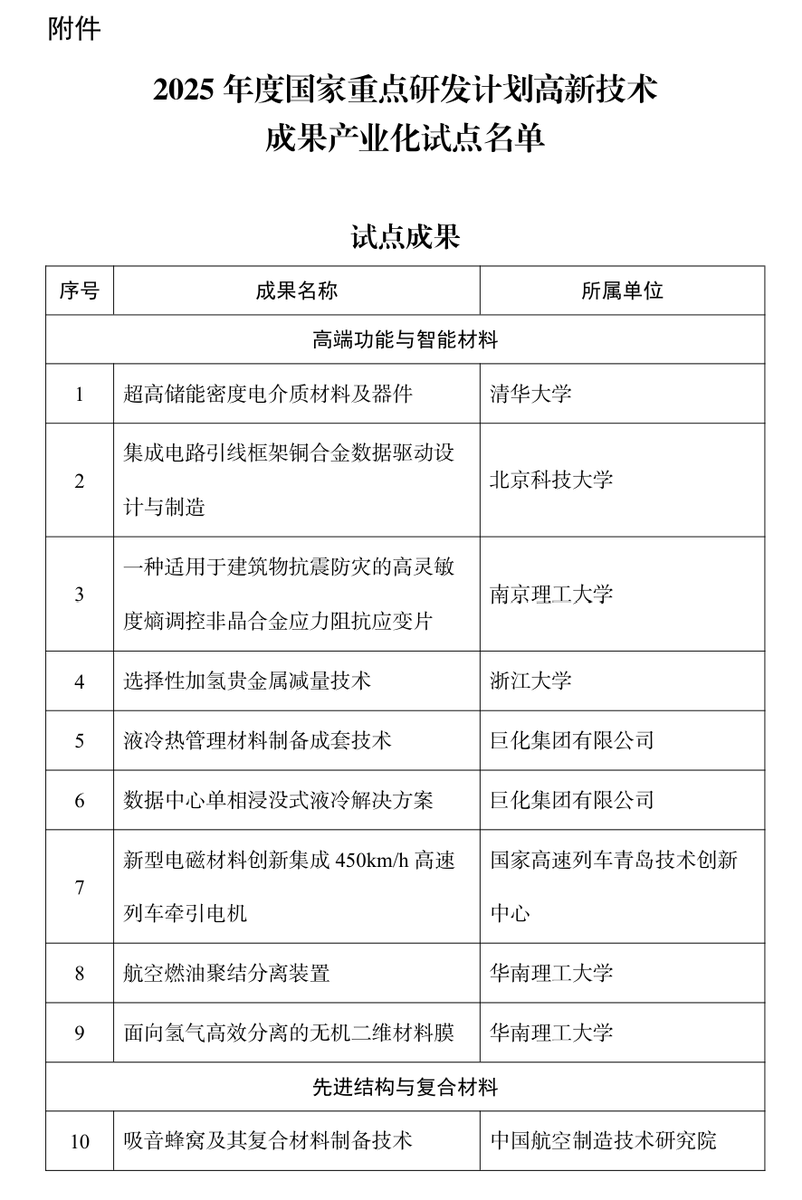
It's interesting to scan through MIIT's list of 67 pilot projects for high-tech industrialization to get a sense of what tech China thinks is important:
High-End Functional and Intelligent Materials
1. Ultra-high energy-density dielectric materials and devices — Tsinghua University
2. Data-driven design and manufacturing of copper alloys for integrated-circuit lead frames — University of Science and Technology Beijing
3. High-sensitivity entropy-regulated amorphous-alloy stress-impedance strain gauge for seismic resistance and disaster prevention in buildings — Nanjing University of Science and Technology
4. Noble-metal reduction technology for selective hydrogenation — Zhejiang University
5. Complete preparation technology for liquid-cooling thermal-management materials — Juhua Group
6. Single-phase immersion liquid-cooling solution for data centers — Juhua Group
7. 450 km/h high-speed train traction motor integrating new electromagnetic materials — National High-Speed Train Qingdao Technology Innovation Center
8. Aviation fuel coalescence-separation device — South China University of Technology
9. Inorganic two-dimensional material membranes for efficient hydrogen separation — South China University of Technology
Advanced Structural and Composite Materials
10. Preparation technology for sound-absorbing honeycomb and composite materials — China Aviation Manufacturing Technology Research Institute
11. Wear-resistant, fatigue-resistant, corrosion-resistant rails and frogs for the Sichuan–Tibet Railway — China Academy of Railway Sciences Corporation
12. Long-term performance-retention technologies for structural concrete in complex environments on the Sichuan–Tibet Railway — China Academy of Railway Sciences Corporation
13. High-performance shotcrete technology for complex environments on the Sichuan–Tibet Railway — China Academy of Railway Sciences Corporation
14. Crack-resistance improvement technologies for structural concrete in complex environments on the Sichuan–Tibet Railway — China Academy of Railway Sciences Corporation
15. Powder-making technology and applications for recycling coarse high-temperature alloy powder — AECC Beijing Institute of Aeronautical Materials
16. Large-tonnage carbon-fiber composite cables — University of Science and Technology Beijing
17. Multi-layer gradient cold-spray repair and nano-hard reinforcement composite plating for continuous-casting molds — Ansteel Group Beijing Research Institute
18. Key technologies and application development for ultra-high-stiffness magnesium-matrix composites — Harbin Institute of Technology
New Displays and Strategic Electronic Materials
19. Sub-6GHz GaN radio-frequency devices — CETC 13th Research Institute
20. High-frequency, high-power laser modulator technology — Fujian Institute of Research on the Structure of Matter, Chinese Academy of Sciences
Rare-Earth New Materials
21. Preparation technology for high-temperature-resistant cobalt-based permanent magnet materials — China Jiliang University
22. Heavy-rare-earth-free high-coercivity sintered NdFeB technology — Ningbo Institute of Materials Technology and Engineering, Chinese Academy of Sciences
High-Performance Manufacturing Technologies and Major Equipment
23. 6-inch semi-insulating SiC crystal-growth furnace and 6/8-inch compatible SiC epitaxial furnace — NAURA
24. New MOCVD equipment for Micro-LED — Advanced Micro-Fabrication Equipment Inc. China
25. Precision forming technology for large aerospace thin-walled aluminum-alloy integrated cylindrical sections — Shanghai Aerospace Precision Machinery Institute
26. High-temperature-resistant, corrosion-resistant transmission-system bearings — Luoyang Bearing Group
27. High-performance seals for aviation hydraulic systems — Guangzhou Mechanical Engineering Research Institute
28. Key manufacturing technology for ultra-large seamless titanium cathode rollers — Xi’an Taijin New Energy Technology
Intelligent Sensors
29. Advanced sensors, core components, and manufacturing processes for spacecraft control systems — Beijing Institute of Control Engineering
30. Flexible intracranial implantable multimodal sensing and modulation system for multiparameter brain monitoring — Aerospace Information Research Institute, Chinese Academy of Sciences
31. Self-powered sensor technologies for human health monitoring — Beijing Institute of Nanoenergy and Nanosystems
32. High-sensitivity MEMS magnetic sensing components and sensors — State Grid Smart Grid Research Institute
33. Miniature high-performance accelerometers — Beijing Aerospace Xinghua Technology
34. Rocket sensors — Long March Rocket Technology
35. New broadband ng-resolution triaxial accelerometer — Tianjin SIASUN Robot & Automation
36. Automotive-grade high-precision integrated navigation sensors — Hebei Meitai Electronic Technology
37. Series of sensors for deep-sea environmental observation and resource exploration — Shenyang Institute of Automation, Chinese Academy of Sciences
38. Multi-parameter differential-pressure flowmeter — Shenyang Zhongke Bowei Technology
39. Quantitative sensing-interface model and analytical instrument technology based on resonant cantilever beams — Shanghai Institute of Microsystem and Information Technology, Chinese Academy of Sciences
40. High-performance X-ray sensors — iRay Technology
41. Electromagnetic sensors — Xinlian Superconductor Shanghai
42. Thin-film getter structure with a micro-heater and its manufacturing method — Shanghai New Micro Technology R&D Center
43. High-performance acoustic sensing elements and sensors — Wuxi Weigan Semiconductor
44. New high-performance MEMS gas sensors — Suzhou Huiwen Nanotechnology
45. MEMS sensor mass-manufacturing platform — XINLIAN Integrated Circuit Manufacturing
46. Development and application of diamond quantum magnetic sensors — University of Science and Technology of China
47. In-situ continuous temperature sensors and measurement systems for molten steel — Maanshan Iron & Steel
48. High-performance laser gas-sensing components — Shandong Science & Technology Innovation Group
49. Key technologies and applications for biosensor sensitive elements — Shandong Kanghua Biomedical Technology
50. Wireless passive temperature sensors based on polymer-derived ceramic metamaterials — Zhengzhou University
51. High-precision printing technology and equipment for ultrafine fiber surfaces — Huazhong University of Science and Technology
52. Complete sensor set for high-speed rail vehicle health-monitoring systems — CRRC Zhuzhou Institute
53. Industrializable mass-producible automotive-grade solid-state LiDAR for autonomous driving — RoboSense
54. Sensing-computing integrated room-temperature infrared imaging detection technology — Chongqing Institute of Green and Intelligent Technology, Chinese Academy of Sciences
55. Nanometer-precision displacement-measurement grating sensors — Xi’an Jiaotong University
56. Distributed thin-film sensors for highway infrastructure — AVIC Electromechanical Measurement Instrument Xi’an
Industrial Software
57. Core components of an industrial internet operating system for discrete industries — Beijing Institute of Technology
58. Data-driven closed-loop performance analysis, regulation, and optimization technology and software for manufacturing processes — University of Science and Technology Beijing
59. Intelligent analysis and decision-making system for full-process industrial data in discrete manufacturing — Beihang University
60. Distributed time-series data management system Apache IoTDB — Tsinghua University
61. MEC-based edge control and real-time simulation theories and methods — Shenyang Institute of Automation, Chinese Academy of Sciences
62. Cloud-based service-oriented MES and intelligent management-control platform system — Beijing Xiaomi Mobile Software
63. Domestic isogeometric-analysis software ADIGA — Dalian University of Technology
64. Distributed factory industrial interconnection platform — Shanghai Aircraft Manufacturing
65. Industrial interconnection platform for personalized customization industries — Guangzhou MINO Equipment
66. End-edge-cloud interconnection integration technology and system for OT/IT convergence — Shenzhen Institute of Advanced Technology, Chinese Academy of Sciences
67. Industrial interconnection platform for large-scale manufacturing industries — Gree Electric Appliances of Zhuhai