Just got this book from AMZN. Self-published, 450pp, don’t know the author. It has a bit of everything: techniques, asset classes, horizons. I haven’t read carefully but it seems to have at least something for everyone and to be very rich in concepts. Should be fun to read.
My friend makes $850,000/year as an Anthropic AI engineer.
No MIT. No Stanford. No PhD.
I asked him how he broke into AI from scratch.
He sent me a course that was never supposed to get out. A developer teaching to build self-improving AI agents from scratch.
You will learn exactly how AI agents like Claude Code and OpenClaw are actually built.
You won't find anything better about becoming an AI engineer in 2026 than this video.
I watched it last night.
Halfway through, I realized I could land a role at a top AI lab in months, not years.
Bookmark this and read the article below.
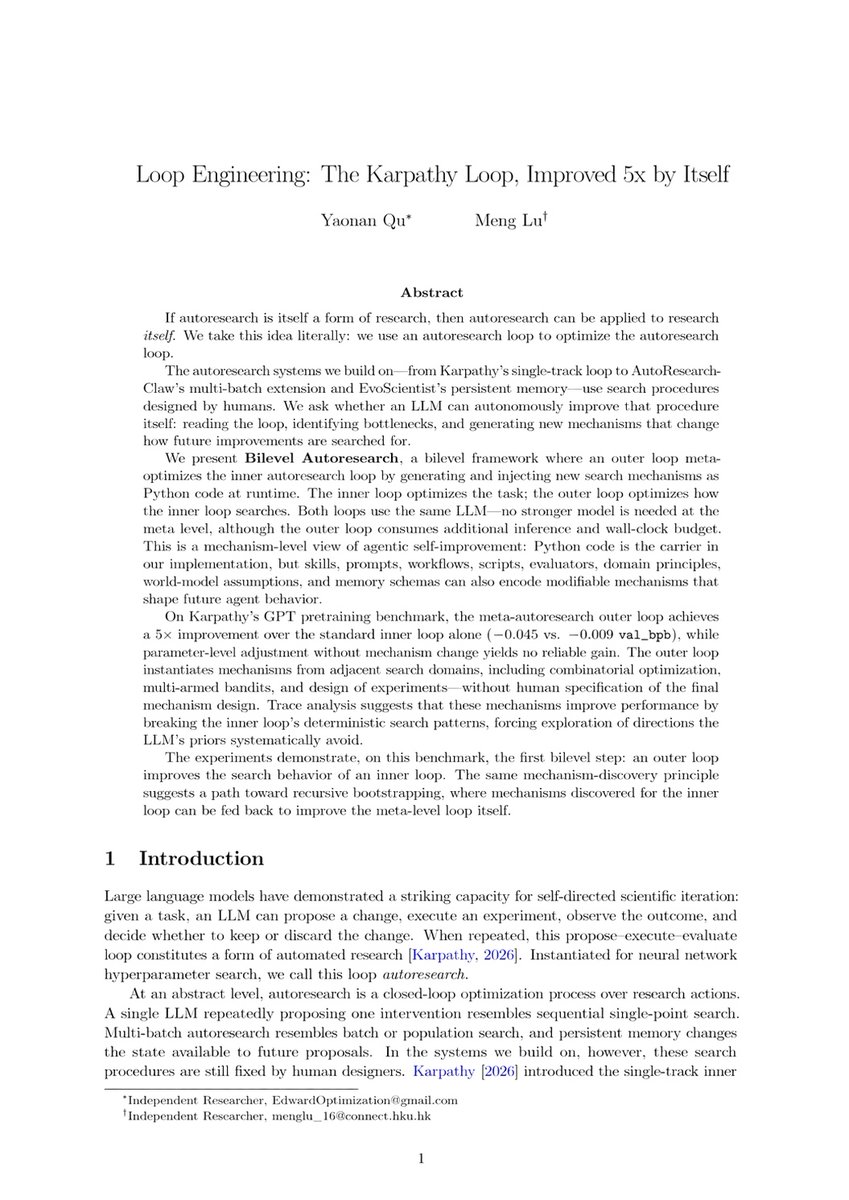
Two Hong Kong students just made Karpathy's loop 5x better - dropped 18-page PDF
The twist: the loop got 5x better the moment you put another loop on top of it
here's the whole method, step by step:
step 1 → Karpathy's loop gets stuck - the LLM keeps reproposing the same changes, falling back to its priors
step 2 → so they add an outer loop that reads the inner loop's code and finds where it's stuck
step 3 → the outer loop writes new search logic as Python and injects it live - 5x better, same model
how to steal this for your agents:
step 4 → write a second agent whose only job is to read the first one's logs and find where it's stuck
step 5 → let it rewrite the rules - workflow, skill, prompt - not just retry the task
step 6 → auto-revert every rewrite on failure, so a bad change never breaks your pipeline
the result: 5x better than Karpathy's loop alone - same LLM, no smarter model, it's the architecture
this 18-page PDF is what comes after the Karpathy loop
read it now - the full build workflow is in the article below ↓
Anthropic just dropped a 3-hour course on how to actually master Claude Code, taught by the engineer who built it:
00:07 – everything new in Claude Code
24:39 – Boris Cherny builds a full app live
55:38 – the complete prompting playbook
1:29:07 – the "thinking" lever almost everyone misses
1:52:58 – how to pick the right model for the job
2:24:22 – how Anthropic itself codes with Claude
This 3-hour watch will replace 10 paid Claude Code courses on the internet.
Watch it now, then read how to build an AI that codes while you sleep, in the article below.
My friend applied to 200 tech jobs in two years. No PhD. No Stanford.
Last month Anthropic offered him $750,000.
I asked him how he broke in from zero.
He sent me a course that was never supposed to get out. A 3-hour video to build a full LLM from scratch.
A developer teaches you exactly how LLMs like ChatGPT and Claude are actually built.
I watched it last night.
Halfway through, I realized it's embarrassingly simple to break into an AI lab.
Bookmark this and read the article below.
• 00:00 - intro to LLMs
• 05:43 - LLM transformer architecture
• 40:24 - training the LLM
• 1:30:27 - modernizing the LLM
• 2:33:53 - scaling the LLM
KARPATHY JUST KILLED THE PROMPT ERA WITH A SINGLE DOCUMENT
prompts are easy. loops are hard. and writing fifty prompts a day is the work nobody does twice.
he shifts the burden to the harness.
you define the contract once. the model writes, reviews, restarts, and reconciles. you keep judgment. it keeps the loop.
the throughline is the same in every rule: the human owns the spec and the boundary. the model owns the execution and the bookkeeping.
planner never touches code. generator never grades itself. state lives on disk, not in context.
9 rules. start with one feature, not ten. most people are still typing prompts. this turns Claude into an agent that finishes the job on its own.
here is the official document from Karpathy explaining the architecture
Stephen Boyd, Stanford EE professor:
"Wall Street pays quant researchers $400K–$750K a year to estimate a hidden state from noisy data. It's the same filter that landed Apollo on the moon, and it's the final lecture of a free Stanford course."
this free stanford lecture from 17 years ago holds the entire "kalman filter edge" the 2026 quant threads sell you. in his last ee263 lecture, boyd builds state estimation from scratch: you can't see the true state, only noisy measurements, so you blend what your model predicts with what you just observed, weighted by how much you trust each. that blend is the kalman gain. that's the whole thing.
it's the exact filter the thread codes up for a dynamic hedge ratio. swap "spacecraft position" for "the true relationship between two assets" and the equations are identical. rudolf kalman published it in 1960. boyd has taught it free since the 2000s.
so the math was never the moat. the hedge ratio that updates every tick, the uncertainty that calibrates your z-score, all of it is standard state estimation, public for over sixty years.
and here's the honest part the thread is actually good about. the filter is only optimal if your assumptions hold, linear dynamics, gaussian noise, a Q and R you set correctly. get the noise model wrong and it tracks confidently in the wrong direction. the lecture is free. the judgment in how fast you let the hedge ratio drift, that ratio of process to measurement noise tuned to the pair in front of you, is the part that actually takes skill.
Most explanations of the Kalman filter stop at the equations.
This paper goes further connecting it to Hidden Markov Models, replacing the standard EM algorithm with CMA-ES optimization, and testing the entire framework against trend following in live financial markets.
The result: Kalman filter based trend detection wins.
Bookmark & Must Read!
this is f*cking dangerous
someone just open sourced the entire "LOOP ENGINEERING" framework for free
build a hedge fund printing alpha 24/7 by feeding it into claude code with my article below
bookmark before someone takes it down
A senior Google engineer just dropped a 19-page PDF on "Loop Engineering" for LLM and agentic systems.
Act → Observe → Learn → Repeat
• Act: the LLM proposes a code transformation (tile this loop, parallelize that one).
• Observe: a compiler runs it and reports back - is it valid? faster? slower? by how much?
• Learn: the LLM reads that feedback and adjusts its next move.
• Repeat until it stops finding improvements.
The agent gets smarter purely from grounded feedback inside its own context window.
This 19-page PDF totally changed the way I’m building agentic systems today.
Read it now, then explore the article below.
My friend applied to 100+ quantitative researcher jobs in two years. No PhD. No callbacks.
Few days ago Jane Street offered him $600,000.
The thing that helped him the most was this master class by IMC, one of the biggest HFT market makers in the world. Free on YouTube. One hour.
Their head of alpha research explains how top trading firms actually build their models. Not the YouTube tutorial version. The real one.
He watched it on a Sunday. Paused it nine times. After that hour he told me something I didn't believe. "It's embarrassingly simple."
Three days later he applied to Jane Street.
Every single question they asked him, he knew from that video.
The US government, citing national security authorities, has issued an export control directive to suspend all access to Fable 5 and Mythos 5 by any foreign national, whether inside or outside the United States, including foreign national Anthropic employees.
The net effect of this order is that we must abruptly disable Fable 5 and Mythos 5 for all our customers to ensure compliance.
Access to all other Claude models is not affected.
We apologize for this disruption to our customers. We believe this is a misunderstanding and are working to restore access as soon as possible.
Read our full statement: https://t.co/bwn0sximKZ
Personal Update: I'm leaving Anthropic to start my own lab. This is a huge decision for me but one I felt was a long time coming.
If you're a seasoned developer or ML researcher who wants to take the singularity by storm, please check out the job posting in my bio!
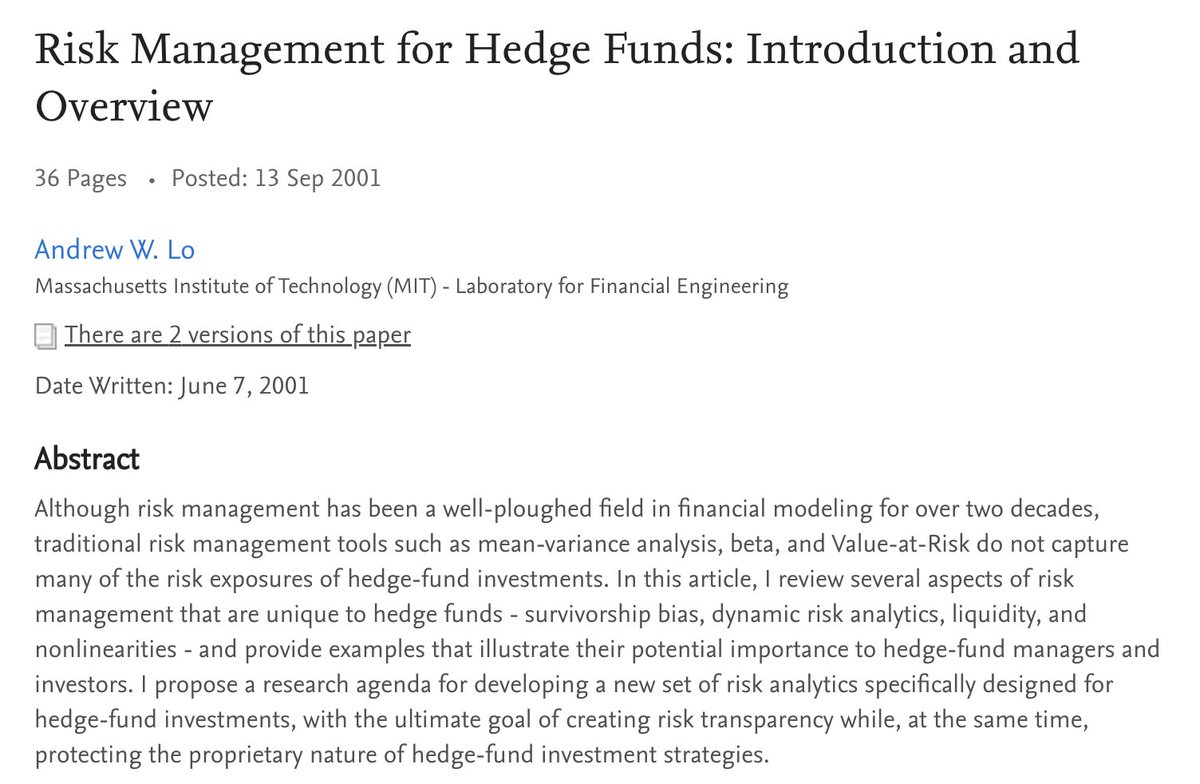
Traditional risk models were not built for hedge funds. Value-at-Risk, beta, mean-variance analysis.
Did you know this?
Andrew Lo published the full framework.Survivorship bias. Liquidity risk. Nonlinear exposures.
The smartest quants at Jane Street aren't smarter than you.
They just know how to use the Bloomberg Terminal the way institutional desks use it to extract real signal, this 1 hour lecture teaches you exactly that from scratch. Bookmark now.
How hedge fund quants do High Frequency Market Making & extract edge from every large order in the market is revealed in this 1 hour free lecture. Bookmark now.
Training an LLM from scratch is easier to study when the whole path is in one repo.
Train LLM From Scratch is a PyTorch repository for learning how a transformer language model is built, trained, saved, and used for text generation.
It helps you move from “I understand attention on paper” to a runnable training pipeline by pairing model code with data download, preprocessing, config, training, and generation scripts.
Key features:
• Transformer components from scratch – separate PyTorch modules for MLP, attention, transformer blocks, and the final model
• Pile-based data path – scripts download The Pile files and preprocess JSONL.ZST text into tokenized HDF5 datasets
• Configurable training setup – model size, context length, heads, blocks, batch size, learning rate, and file paths live in https://t.co/zuPqaR3MhP
• Hardware guidance – README compares common GPUs for 13M and 2B-class training runs
• Generation workflow included – generate_text.py loads trained checkpoints and produces sample text outputs
It’s open-source (MIT license).
Link in the reply 👇