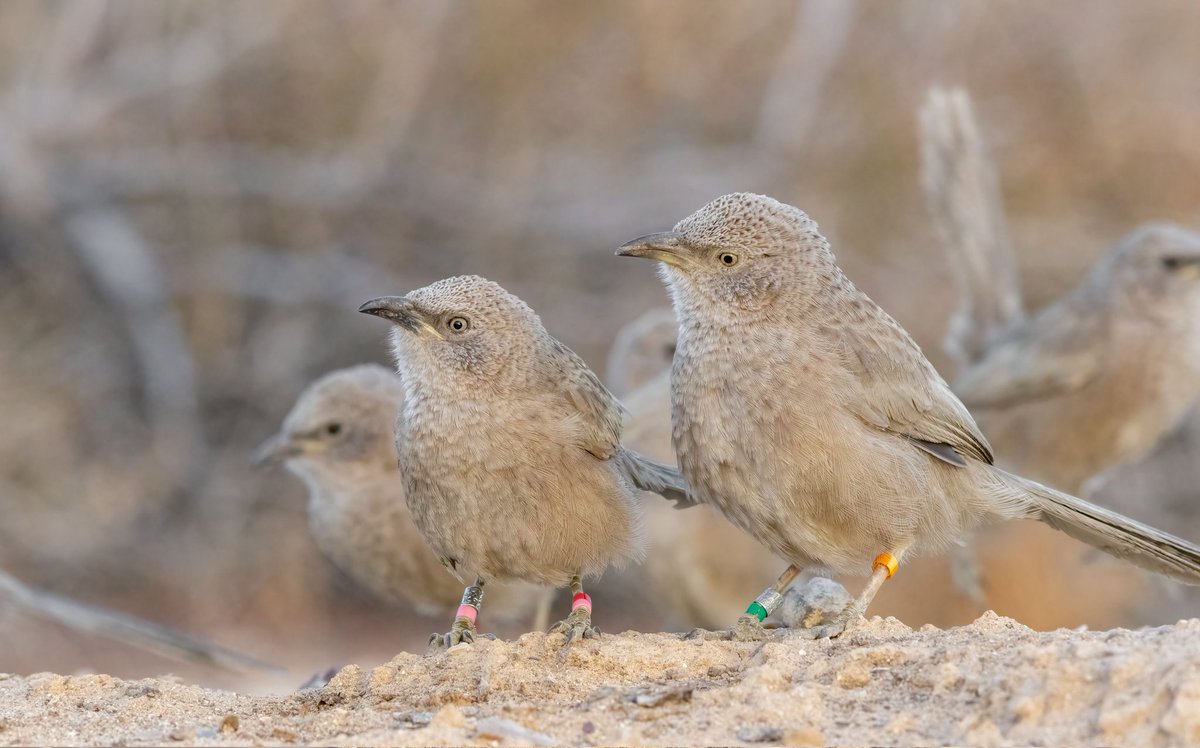
We show that the extent to which individuals in a population conform to the same behavior or exhibit behavioral diversity depends on two factors: competition over depleted resources and the relative difficulty of learning a foraging task individually versus socially.
Happy to share my third PhD paper, now out in Behavioral Ecology! It shows how wild Arabian babblers learn a new foraging skill and how learning spreads through the group in complex, mutual ways rather than by simple copying of a demonstrator. 👉https://t.co/nT3NOfgdfJ
Huge thanks to the @ISBE2024 organizers for an amazing event! Incredible talks, great people, and a wonderful community! Goodbye, #ISBE2024 - time to get back to reality (and cut down on caffeine ☕)
A quick reminder that tomorrow (Friday 4th) I will be talking in the last morning session of #ISBE2024 (9.00 hospitality suite 6) about how habitat modification influences the lifetime fitness of Arabian babbler, a social and cooperatively breeding bird.
@IQ36ESM, PhD student, will talk about how sparrows navigate their reliance on social vs. a-social information under different cognitive and ecological constraints - Tuesday (Oct 1st), Room 5F, 11:45.
Rom Manor, MSc student, will present a poster about the effect of contextual similarity of demonstrated behaviour on social learning - Poster Session 1 (Sept 30th), Poster Board 051.
Rom Manor, MSc student, will present a poster about the effect of contextual similarity of demonstrated behaviour on social learning - Poster Session 1 (Sept 30th), Poster Board 051.
We're proud of Rom Manor, who successfully defended her MSc. thesis on the effect of stress and contextual similarity on learning performance in sparrows! 🎉👩🏾🎓🐦
Ever tired of manually coding videos? Ever dreamt of automating behavioural coding?
Come along my talk tomorrow (Friday!) in @ecbb2024, 10am room Meerkat, to learn more!
For people not in ECBB, pre-print coming soon...🥸
1/ The first chapter of my thesis is published and is fully available as open access:
https://t.co/5YU10Eethb
In this study we explore how the Arabian babbler (Argya squamiceps) an obligate social species cope with habitat modification on a extremely arid ecosystem.
Giving more attention to individuals in similar settings may be an adaptive strategy directing social learners to focus on ecologically relevant behaviours and on tasks that are likely to be learned successfully.
Interestingly, the action of cover opening was learned faster with paired rather than action-only demonstration despite being equally demonstrated in both.