For the record
The Keynesian consensus on Wall Street and at the Federal Reserve is misreading the moment, again.
Markets are not pricing an inflationary oil shock. They are pricing its failure.
The emerging macro setup is straightforward: a Trump-led geopolitical reset delivers a deal, oil falls, rates follow, and cyclicals re-rate.
But the deeper story is structural. Iran’s weaponization of the Strait of Hormuz was not just another flare up, it was a regime shift.
Energy security is now paramount. Capital will move to bypass chokepoints, and with it, political support for green industrial policy will erode. The supply curve is shifting in ways consensus models are not capturing.
The oil market is already signaling this transition. A true supply shock keeps the curve in backwardation. Instead, backwardation is collapsing.
Prompt spreads have compressed toward flat, and the curve is drifting into contango, a classic sign of excess supply.
The IEA is reinforcing the message with weaker demand projections and a looming glut into 2027.
This is not inflation. It is demand erosion.
TIPS markets are unequivocal. Five-year breakevens have fallen sharply, and the two-year is now on the verge of breaking below 2 percent. The 5 year forward breakevens are at 2.18%, below the long term average of 2.25%.
Hardly the profile of an inflation spiral Central Bankers and Wall St assume. Yes, the ECB hikes as they did after the GFC.
The speed of the move matters: this is not normalization, but repricing. The Treasury curve agrees. The front end reflects Fed tightening risk, while the long end signals an economy that cannot absorb it.
We have seen this before: central banks tightening into commodity-driven price spikes, mistaking relative price shocks for sustained inflation.
The Keynesian framework insists inflation will persist. Markets are signaling the opposite.
The consensus view is The Fed is using the Powell playbook. Investors should be listening to prices, they tell a completely different story. One that Warsh totally gets.
The market may be massively underestimating rate cuts.
Falling oil prices could push inflation readings toward outright month-over-month deflation in the coming months.
If that happens, the Fed's current stance becomes much harder to justify.
Most investors are preparing for higher rates. What if the next move is lower?
FT @BitcoinJesusETH@MelMattison1
Tune in to know more
⏱ TIME POINTS ⏱
00:00 - Intro
01:31 - Fed Holds Rates: What Happens Next?
05:14 - Milk Road Is Hiring!
05:31 - Cuts Or Hikes? The Fed Is Split
13:03 - Gold vs Silver: Which Wins Next?
20:32 - The Rotation Trade Nobody Sees
26:09 - Sponsor: Bitget
26:42 - Sponsor: Nexo
27:20 - SpaceX IPO: Buy Now Or Wait?
36:46 - How To Survive The Volatility Ahead
44:33 - Final Thoughts & Outlook
Both Gold and the Dollar can rise together.
Most people think it is impossible because they only look at one simple rule:
Dollar up = Gold down.
But that is not always true.
The real question is not whether the Dollar is rising.
The real question is why the Dollar is rising.
If the Dollar is rising because of higher rates, higher real yields, and a hawkish Fed, then Gold usually struggles.
That is a rate-driven Dollar rally.
But if the Dollar is rising because of a global rush to safety, dollar shortage, credit stress, banking pressure, EM stress, or financial instability, then Gold can rise with the Dollar.
Because in that setup, both are being bought for different reasons.
The Dollar is bought for liquidity.
Gold is bought for trust.
The Dollar is the emergency cash of the system.
Gold is protection from the system itself.
That is the key difference.
A war that creates only inflation fear can push the Dollar higher and Gold lower, because markets start pricing higher rates.
But a crisis that creates financial instability can push both higher, because investors need Dollars immediately, while also looking for safety outside paper claims.
And in my view, we are definitely going to see this setup play out in the coming years.
A stronger Dollar and stronger Gold will not be a contradiction.
It will be the signal that the world is moving from confidence to stress.
Highly recommend watching Cem Karsan 🔥@jam_croissant
Brilliant on everything market related with great information and no BS!!!
Huge fan - gives you some great nuggets about the future and to make wise investments decisions and I'm just a huge fan of learning and he does an amazing job of sharing his vast knowledge!
https://t.co/ci1VPXMcu2
THE MEMORY SECTOR WILL BE TESTED NEXT WEEK.
$MU reports earnings on June 24.
If Micron can confirm AI demand remains strong.
The entire memory trade could see another leg higher.
$SNDK $WDC $STX will be the main watch with
Secondaries and laggards possible best runners.
MEMORY INFRASTRUCTURE
$RMBS $SIMO $MRVL $AVGO
MEMORY EQUIPMENT
$AMAT $LRCX $KLAC $ONTO
EMERGING MEMORY
$MRAM $GSIT $NVEC
All eyes on what Warsh may or may not say for his first FOMC meeting tomorrow!
We are going to break it all down at 8:30 AM ET before the event on @NTLiveMedia with Joseph Wang @josephwang
Link/set notifications here: https://t.co/K7tpzjrqMc
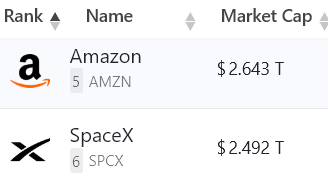
The world just paid $2 trillion for a rocket company that lost $4.9 billion last year. And the rockets are not why it lost the money. They are the only part making any.
SpaceX went public Friday, the largest IPO in history. Up 19%, a $2 trillion valuation, Elon Musk the first trillionaire. Then you open the filing.
Three businesses sit inside it. Starlink, the satellites, brought in $11.4 billion, 61% of all revenue, and $4.4 billion in profit. It is the only piece that earns a dollar. The rockets that land themselves run a small loss reinvesting in Starship. And the AI arm, Grok plus the app once called Twitter, folded in this February, lost $6.4 billion in a single year on $12.7 billion of spending.
Read that again. The satellites pay for everything. The AI loses more than the satellites make. And the AI is the part the market fell in love with.
It gets bolder. The prospectus claims a total market of $28.5 trillion, the largest any company has ever put in a filing. Larger than the GDP of the United States. That is the number underwriting a $2 trillion price tag built on a division bleeding $6 billion a year.
Now the structure. About 4% of the company trades. That sliver sets the price for all of it. Musk is locked up for 366 days and holds roughly 80% of the votes. The public bought a company they cannot steer, priced on the one segment losing the most.
This is the whole year in one ticker. The profit is satellites. The story is AI. The market bought the story.
The rockets were never the risk. The risk is a $2 trillion price resting on the one bet that has yet to make a cent.
CODE SHARE
Let’s take this simplicity thing one step further.
Let’s consider the benefits of striving … a priori … yes, I said striving … striving to minimize the amount of time you spend trading. Striving to be a trading slack dog.
Well ... an adaptive moving average like the one I just gave you could, not only improve your P&L, but could:
• reduce the number of antacids you consume for stress-related gastritis and reflux
• reduce the amount of pain in your back or neck from prolonged screen time
• make it unnecessary to keep monitoring your sleep tracker indicating suboptimal deep sleep/REM results and frequent 3:30 AM awakenings
• make it unnecessary to wear a night guard to protect you from grinding your teeth at night
• reduce the amount of pleasure-seeking and time-saving episodes foraging for your go-to ultra-processed food/snack
• reduce your cardiovascular and neurodegenerative risk
• reduce the number of complaints by your lover, kids, and friends that you're spending too much time on the computer or aren't present when you're with them
Oh ... and INCREASE the amount of time you have for fun ... because spending time here ... in search of the Holy Grail indicator (guilty) ... or reading other peoples' pursuit of the Holy Grail indicator ... won't make you money ... and will pretty much guarantee a negative impact on your mind-body connection and your relationships. Let's be real.
I could go on.
You get the idea.
There’s a lot going for having a good (simple) trend indicator when you shift to minimizing your screen time ... and set time boundaries on strategy development.
Trust me; I'm a doctor.
Yeah ... bookmark this one ... and let's consider our work together ... done.
The trend is your friend.
Go have fun.
(Stop reading my account. I don't have what you're looking for. (No one does.))
When will Gold and Silver bottom again?
The answer is not on the Gold chart.
It is in the US 2-Year Yield and Dollar Index.
Gold and Silver are highly sensitive to front-end yields, and right now the 2Y yield is still looking strong.
I would expect at least a move toward 4.45% before it starts forming a proper top.
That means short-term pressure on Gold and Silver can continue for a few more weeks, especially As DXY is also stays firm.
But this is not the phase to panic.
The real bottom signal will come when the 2Y yield and Dollar Index both start showing topping/reversal structure.
Until then, I am treating this weakness as an accumulation window.
By the end of this pressure phase, I expect to be fully deployed in Gold and Silver.
Whoa
Apparently China just made the biggest purchase of physical Silver in history, buying 847 tons of Silver in 1 month
Previous monthly record: 312 metric tons, in March 2024
(source: @GlobalProTrader)
Any confirmation from an additional source would be greatly appreciated
The bear case for $MSTR and $STRC 101
This bear case is meant to explain how MSTR as a company will struggle in a continued and sizeable drawdown BUT ALSO debunk some very common and faulty bear cases that float around the internet.
All bear cases depend on BTC going down.