Interdisciplinary research group |Theoretical Physics at Oxford University| Evolution| Machine learning| Self-assembly| Algorithmic information theory|
https://t.co/78ZnVVeqH4
Our pessimistic opinion on the prospect for current QNNs to achieve quantum advantage on classical data.
We also comment on unhelpful characteristics of the QNN literature that need fixing.
A fun paper by Yoonsoo Nam, Nayara Fonseca and Seok Hyeong Lee,
https://t.co/RfKVOrSBEa
The model does a good job predicting emergence in a NN on the model task of multi-task sparse-parity
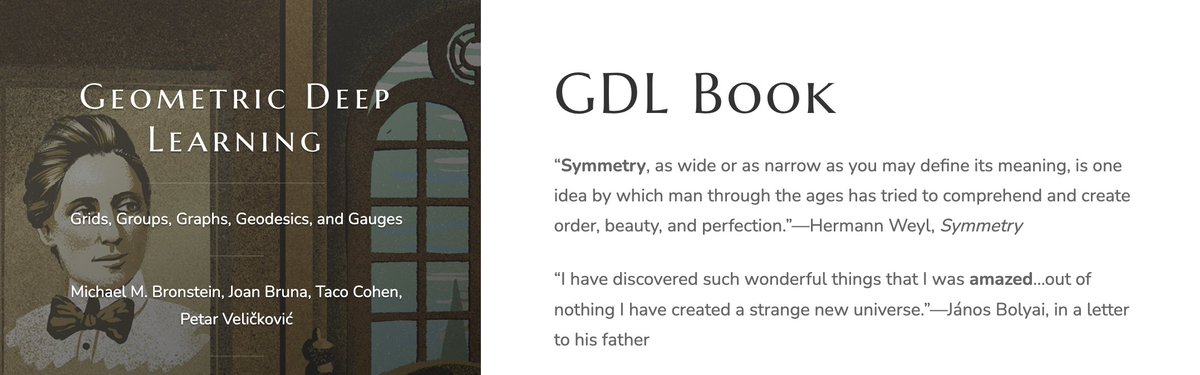
After 3 years, it's time for us to start sharing the chapters of the GDL book! ❤️
Also included: companion slides from our @Cambridge_Uni & @UniofOxford courses 🧑🎓
Chapter 1 is out **now**!
More to follow soon 🎉
https://t.co/g7SqyZBCgX 📖
@mmbronstein@joanbruna@TacoCohen
I have learned biophysics and biology through endlessly asking 'naive' questions.
You'll never learn if you don't ask.
So just ask those naive questions!
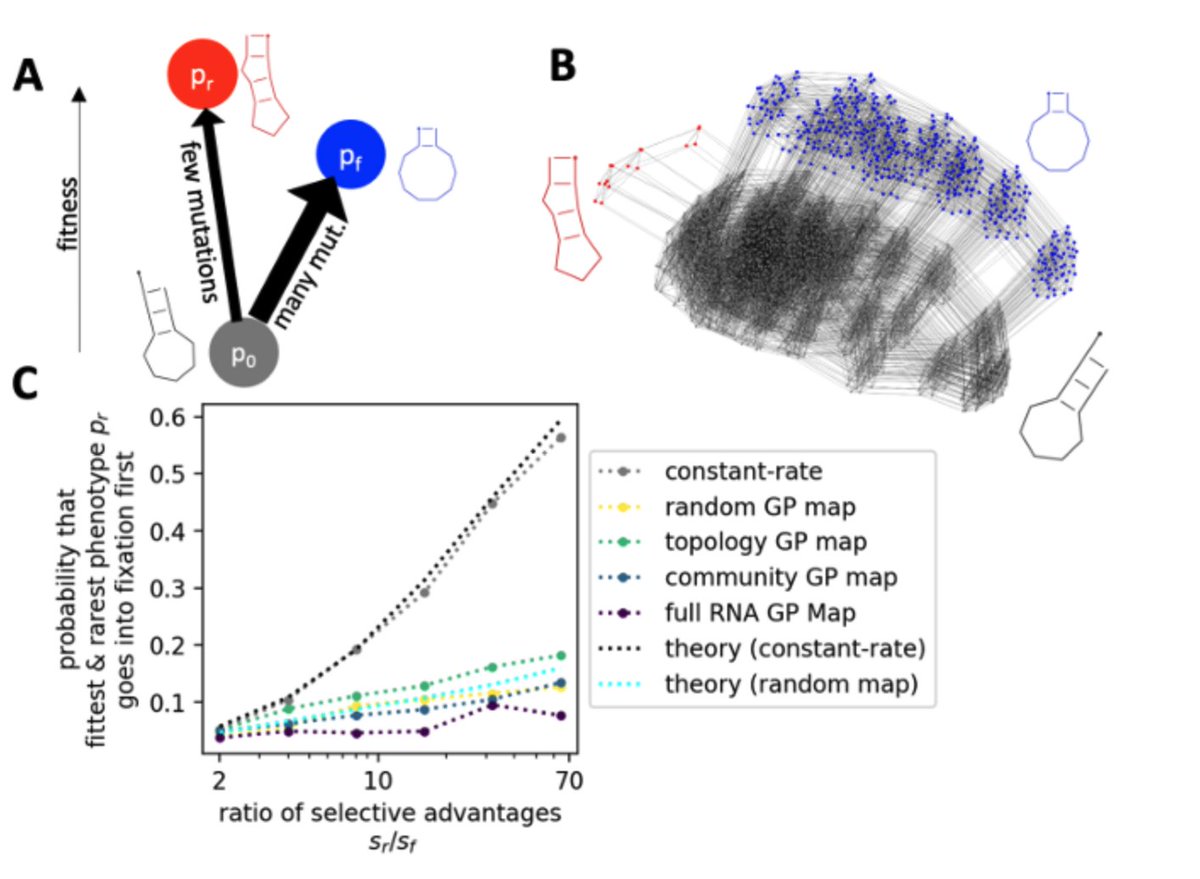
The result is that, due to the clumpiness of GP maps, mutational accessibility can matter *even more* than in a simple model of average mut rates (i.e., more than Yampolsky-Stoltzfus)
Here the steeper curves assume a simple model; the flatter ones reflect complex GP maps
3/3
But as Martin, et al. point out, given the clumpiness of real GP maps, mean relative accessibility is misleading
For a given starting genotype for P0, the mut accessibility of an alternative is often 0
This results in overdispersion in arrival rates
2/3
I didn't see the significance of this until @Nora_S_Martin pointed it out just now
Consider adaptive evo from phenotype P0 to one of two options P_r (red) or P_f (blue)
Relative mut rates to red and blue matter, sometimes as much as fitness diffs
1/3
https://t.co/lwzSw6Jrel
Have you ever noticed how nature seems to love symmetry?🔺🟥🔴
Evolution has literally trillions of shapes to pick from, and yet, biological structures often show symmetry and simplicity.
This is the story of the discovery that completely changed how I see biology. 🧵
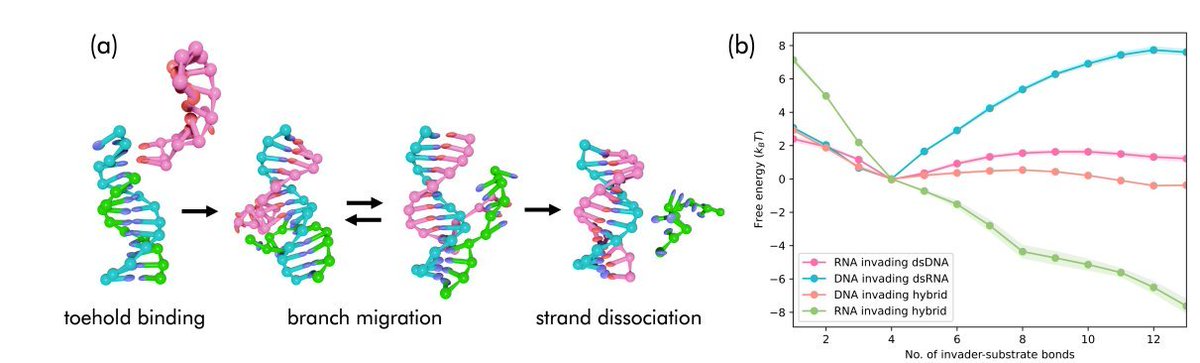
Our new model for DNA and RNA coarse-grained simulations is now out in @JChemPhys :
https://t.co/FapnoqG8ES
It is called #oxNA and includes @ox_DNA and #oxRNA models, and adds support for hybrid DNA:RNA duplexes:
🧵1/4