CleanYourTV v2.7 is out 📺
What's new:
• 35 new TVs from 9 new brands
• Wallpapers that change with the time of day
• Two new themes
• Game controllers that just work
• Safer defaults that protect your TV
230 PRs merged from 122 contributors since the last release 🙏
I told Deepseek V4.1 Flash 1017 to build a exploit that escapes Chrome's V8 Sandbox
After 12 hours, it had a multi stage memory corruption exploit that achieves full process read and write.
hermes-agent @NousResearch is crazy.
i have a session with nearly 2,000 subagents running more than a day thanks to
Thanks to https://t.co/g1exHwWK5E it was just super smooth and easy works (dag-ulw)
History:
1. 8,198 commits, 961 PRs merged (+1,217,871 / −528,875 lines).
2. Subagents: 2,002.
3. Tokens: 70,049,332,364.
#hermes
setup notes if you are on Ubuntu 22.04 / kernel 5.15:
the module is written for 6.16+. on 5.15 it needs 2 small fixes: a stub for linux/aperture.h, and putting the card into D0 before the check (the fix from gpu-unlock issue #3).
initramfs-tools runs udev before it loads modules, so nvidia grabs the cards first and the module does nothing. i load it from an init-top script instead, that way it always runs before udev.
sudo reboot is not enough, the cards keep power. power off, then power on. check with journalctl -k -b | grep gpu_unlock, you want "unlocked" once per card.
Repo: https://t.co/dhlbj3W3Kw
vLLM Discussion: https://t.co/z2vNRWO949
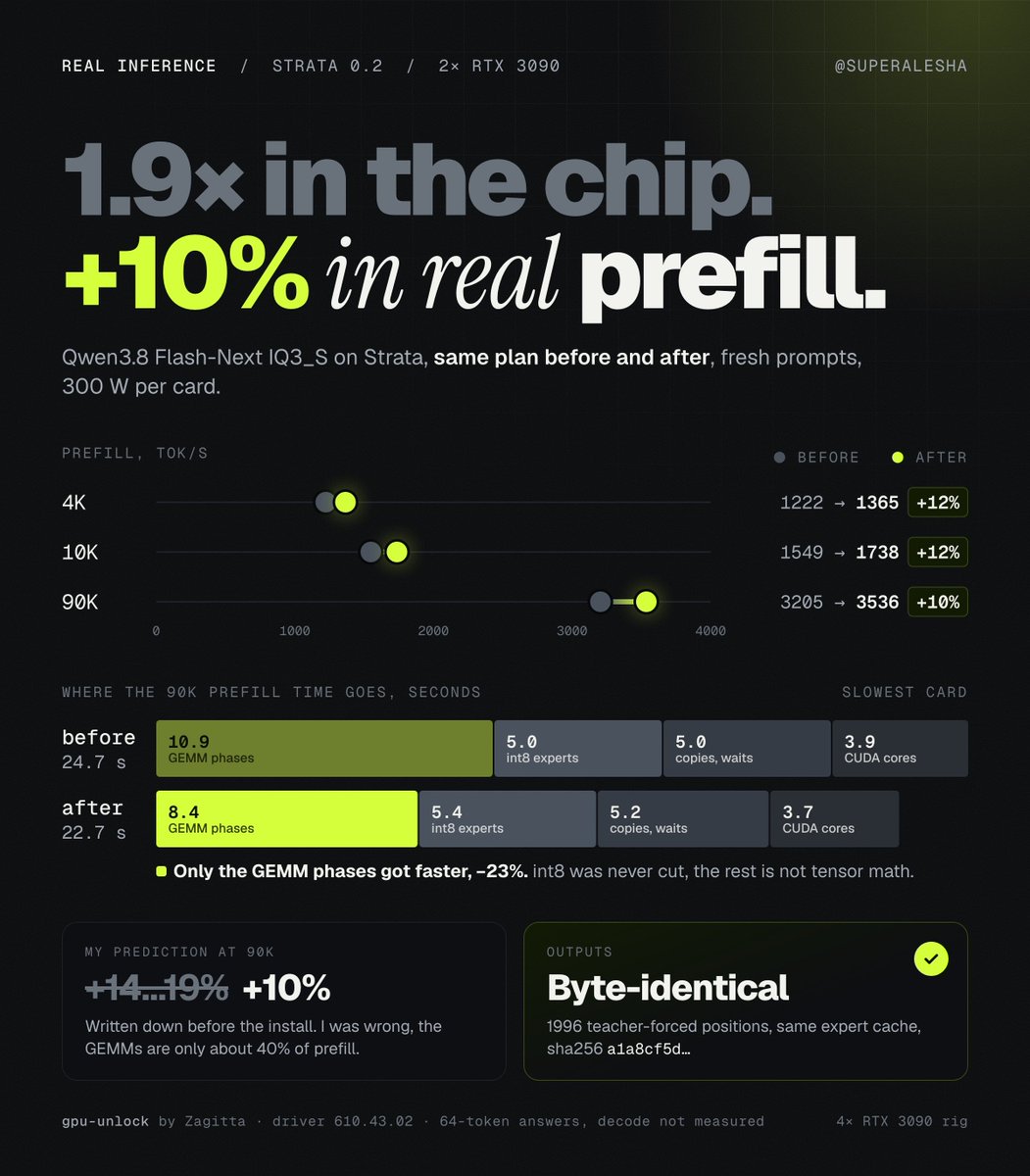
NVIDIA sold millions of 3090s with 50% of the tensor speed switched off. Not missing. Switched off.
1 kernel module flips it to full, and my BF16 tensor pipe went from 82 to 155 TFLOPS. Nothing else changed on the cards, and the outputs match the stock run byte for byte.
All so the gaming card wouldnt eat into workstation sales. Every 3090 owner ran at 50% for 6 years, so a pro card could look worth the price. Fine, its their business model.
And LLMs are the least interesting place for this. Decode waits on memory, and my engine runs its experts in int8. Still +10% on prefill.
The models that live on BF16 tensor math are everything else. Qwen Image 2.1 and FLUX 3 Klein, where every diffusion step is big matmuls. MiniMax H3, which takes 4 to 7 minutes on my cards. Music and speech models. And training, every LoRA anyone ever trained on a 3090 went through exactly the path that was cut.
Thats what I measure next. This is only the start.
Another insane Jev use case!
Decision models like Jev are making it dramatically cheaper to evaluate what actually happens inside an agent run.
And now there’s an open-source memory layer that puts those evaluations to work, making useful lessons reusable across 20+ agent harnesses:
- Claude Code
- Codex
- Cursor
- OpenCode
- and more.
The project is Beacon, from @asymptotelabs.
GitHub: https://t.co/KNgtyAGf3b
(don't forget to star 🌟)
Here’s what I did in the video below.
1) I gave Claude Code a coding task. It made changes and ran tests while Beacon automatically recorded the session.
2) I had Jev evaluate the run. The first evaluation returned review because I hadn’t provided a correction, so my app saved nothing.
3) I corrected the agent, and it updated its work and reran the tests. Jev evaluated the updated session, and this time the results met my app’s rules for saving a memory.
4) I saved the correction and its supporting evidence as shared memory. Then I opened a separate Codex session and explicitly asked it to read that memory.
Codex recalled the correction from the earlier Claude Code session without me having to explain it again.
Beacon captured the session history. Jev evaluated what was worth keeping, while my app applied the storage rules and saved the lesson.
That correction was now available as context outside the conversation where I first made it.
I cover this build in more detail in the video with Justin, co-founder of Asymptote Labs, alongside moving sessions between agents, creating reusable skills, and detecting security risks across agent activity.
Watch the full video below.
F*ck YES... I made prompt that reverse-engineer anything without BAN's and rejects
the shift: REA + free model pull out all app's binary code → Opus 5.5 builds everything else the way YOU want
here's 3 step guide:
step 1 → install OpenCode and pick DeepSeek V4.1 or GLM-5.3 flash (both free right now)
step 2 → drop prompt image + your app/file/URL into chat and tell it what to reverse (it start write repo)
step 3 → open repo with full app code in Claude Opus 5.5 and say something like:
"I've shared repo for my project I stopped working on. I want to pick it back up and make it even better with you! Help me continue development"
the result: you can reuse mechanics of any website/app inside your own projects...
Paste it now. Then read the article below.
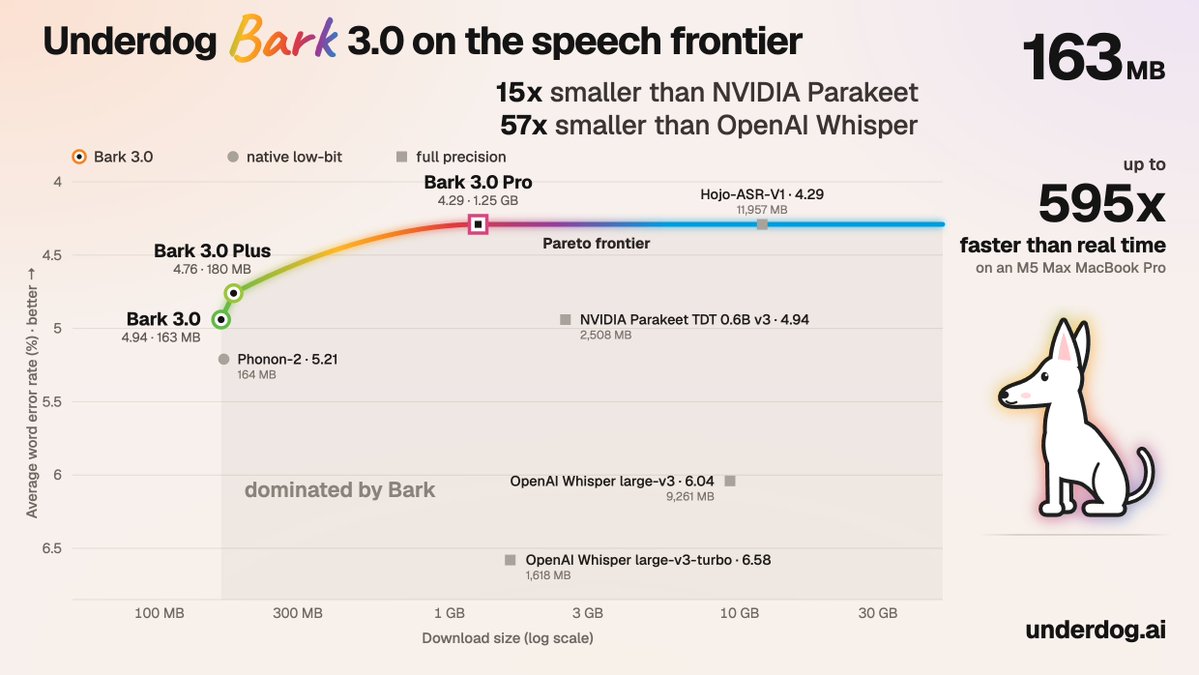
Today we’re releasing Underdog Bark 3.0, the #1 frontier speech model
It's a tiny 163 MB download as accurate as NVIDIA’s Parakeet (15x bigger). It beats OpenAI's Whisper large-v3 (57x bigger)
It's fast- transcribes 1 min of audio in <0.25s on a Macbook. On recorded meetings (AMI), Bark 3.0 gets 7.82% of words wrong. Parakeet gets 9.42%. OpenAI's Whisper large-v3 gets 13.63% error rate
Bark runs on both your Laptop & Phone. It’s free and open source under CC-BY 4.0
Try private on-device meeting notes & dictation, powered by Bark, in Underdog today: https://t.co/aLJERPwzS8
Aloha!🌺 Meet Ornith-1.5-122B: No Tradeoff Between Strong and Fast
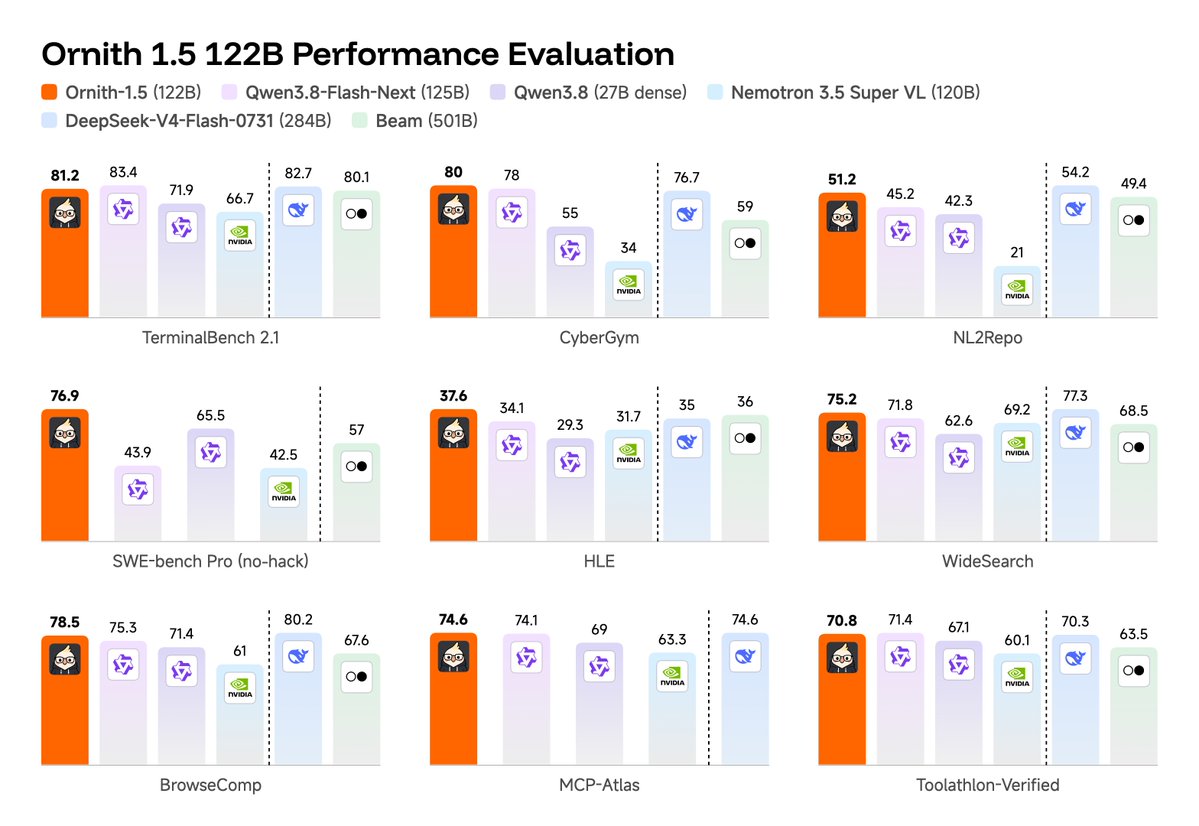
Stronger. Faster. Leaner. Ornith-1.5-122B delivers frontier-level capabilities with exceptional inference efficiency. With superior instruction following, stronger task decomposition, and deeper understanding of real-world workflows, it achieves state-of-the-art performance among open-source models of comparable size, while running on a single NVIDIA DGX card!!
Open weights under the MIT license.
Coding
✅SWE-bench Verified: 0.845
✅TB2.1: 0.813
✅CyberGym: 0.800
✅NL2Repo: 0.512
Agentic
✅HLE: 0.446
✅BrowseComp: 0.785
✅MCP-Atlas: 0.746
✅Toolathlon: 0.708
🤗Hugging Face: https://t.co/w1hD6rra1o
We can’t wait to see what you build with Ornith-1.5-122B.
Introducing Flint, @Recursive_SI’s first model: a fast local coding model built with our automated research system, the Eureka Machine.
• Best-in-class fast local coding
• Up to 2x faster than comparable models: 125+ tokens/sec on a MacBook Pro, 150+ on RTX Spark
• Built from scratch in under 4 months
Private, unmetered intelligence on your own machine. Open weights available now on @huggingface, run it locally on your favorite framework or try it for free on @opencode or @pidotdev.
Run Flint locally on 24GB RAM via Unsloth Dynamic GGUFs!
Flint is the strongest MoE model under 50B parameters.
Recursive’s Apache-2.0 model has 39.8B parameters (2.5B active). Run at 125 t/s on Mac, 150 on RTX Spark
GGUF: https://t.co/pRwTciriIR
Guide: https://t.co/mdBniK8VSO
“We found DeepSeek V4.1 Flash 1017 beats GPT 6 Sol on our multi-step offensive cybersecurity task.”
READ THAT AGAIN.
the same cyber capabilities that OpenAI kept behind a gate got beaten by a Chinese open model you can run locally.
buckle up guys.