But, plot twist:
The much-discussed contraction in entry-level tech hiring appears to have *reversed* in recent months.
In fact, relative to the pre-generative AI era, recent grads have secured coding jobs at the same rate as they’ve found any job, if not slightly higher.
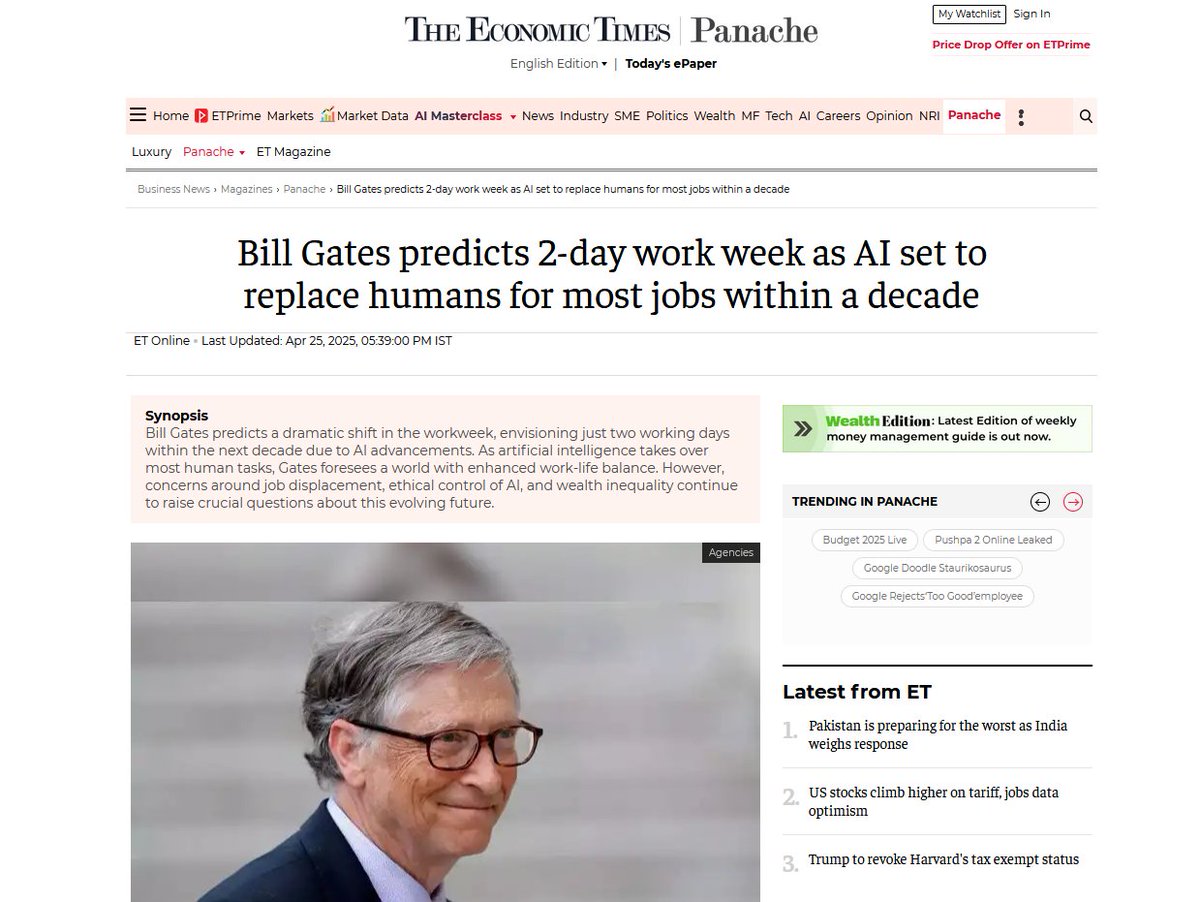
Bill Gates predicts 2-day work week as AI set to replace humans for most jobs within a decade
A few thoughts on Bill Gates' statement.
The promise that automation could and would shorten our working hours has been around for a long time. John Maynard Keynes predicted in his 1930 essay “Economic Opportunities for Our Grandchildren” that by 2030 we would only need to work 15 hours a week to achieve a good standard of living.
As we know, however, this never happened. On the contrary. Even in 2025, we will have a greater demand for labor and skilled workers in the western industrialized nations than we would have if we reduced working hours. Why? Because productivity growth and the expansion of production are inherent characteristics of capitalism. I mean that as a value-neutral description of the facts.
But: with the advent of AI and the combination of robotics, a qualitatively new characteristic is emerging. As I have often said, the special thing about AI + robotics is that for the first time in human history, humans are not only improved in their work performance (augmented), but can be completely replaced. There is no activity that a robot / AI could not do better, faster and more efficiently than human labor in the future. In this respect, it can be said in retrospect that Keynes' promise can now become reality, due to a technology that does not make people more efficient, but replaceable.
However, this is not a sure-fire success. Many questions remain. If robotics and AI take over the work, how will taxes be raised to finance the good life for all people? Can we continue to live exactly like this in society? And what will people do with all that free time? These are all questions that need to be discussed now.
The basis for a better world is there. The golden age is within our grasp. But we all have to make sure it happens. And, in particular, lead the discussion. Thankfully, @DaveShapi keeps bringing the discussion about the post-labor society into the discourse. This is a very important process.
Google DeepMind CEO tells students to brace for change
Google DeepMind CEO Demis Hassabis urges students to prioritize "learning to learn" and adaptability amid rapid technological change.
He emphasizes mastering foundational knowledge over chasing trends, and encourages hands-on experimentation with open-source tools to stay ahead.
"Change will be the only constant in the next decade, Demis Hassabis told students at the University of Cambridge."
Today's "DeepSeek selloff" in the stock market -- attributed to DeepSeek V3/R1 disrupting the tech ecosystem -- is another sign that the application layer is a great place to be. The foundation model layer being hyper-competitive is great for people building applications.
Welcome to the United States of Acceleration.
It's time to talk about "fast takeoff" because Sam Altman just changed his tune, and frankly, he's catching up to what some of us have been saying for years. The question isn't whether we'll hit superintelligent AI – it's understanding just how fast this train is going to leave the station.
Here's what everyone's missing: I call it the "automation cliff." The nifty thing about AI-powered researchers is they're basically dormant until you flip that switch. But the moment you create that first fully automated researcher? You don't have one – you have a billion. These aren't humans we're talking about; they're software. Copy, paste, scale infinitely. Zero to superintelligent in the blink of an eye.
But that's just the appetizer. My buddy Jensen Huang over at NVIDIA laid out this beautiful cascade of exponentials that's about to hit us like a freight train. First up: Moore's Law, which has been chugging along for 120 years. Anyone betting it'll tap out right before the singularity is smoking something interesting and they ain't sharing either. Then we've got AI parameter count doubling faster than your heartbeat. Third on the menu is post-training scaling – the art of squeezing 10x performance out of models 10x smaller with quantization and distillation. And finally, there's test-time compute, or as I like to call it, "letting AI actually think." I built my first cognitive architecture demonstrating this four years ago with GPT-3, but who's keeping score?
Now, stack all these exponentials together – and we haven't even touched quantum supremacy, which my colleagues at Google are about to crack wide open. Sam used to preach about "waiting for concrete to dry" in new data centers, but that's old thinking. We're squeezing more juice out of existing hardware than anyone thought possible. Those new data centers? They're just extra rocket fuel for when we need to scale superintelligence laterally, making sure everyone gets their own piece of the ASI pie. That's right, you're not going to just have AGI agents helping you out, fleets of them. You're going to have a few personal ASI's, I'm guessing five to every human by the end of the decade.
The takeoff isn't just fast – it's already started. The real question is whether we're ready for what happens when all these exponentials hit their stride simultaneously. But hey, that's what makes the future exciting, right? Buckle up, because this ride's about to get interesting.
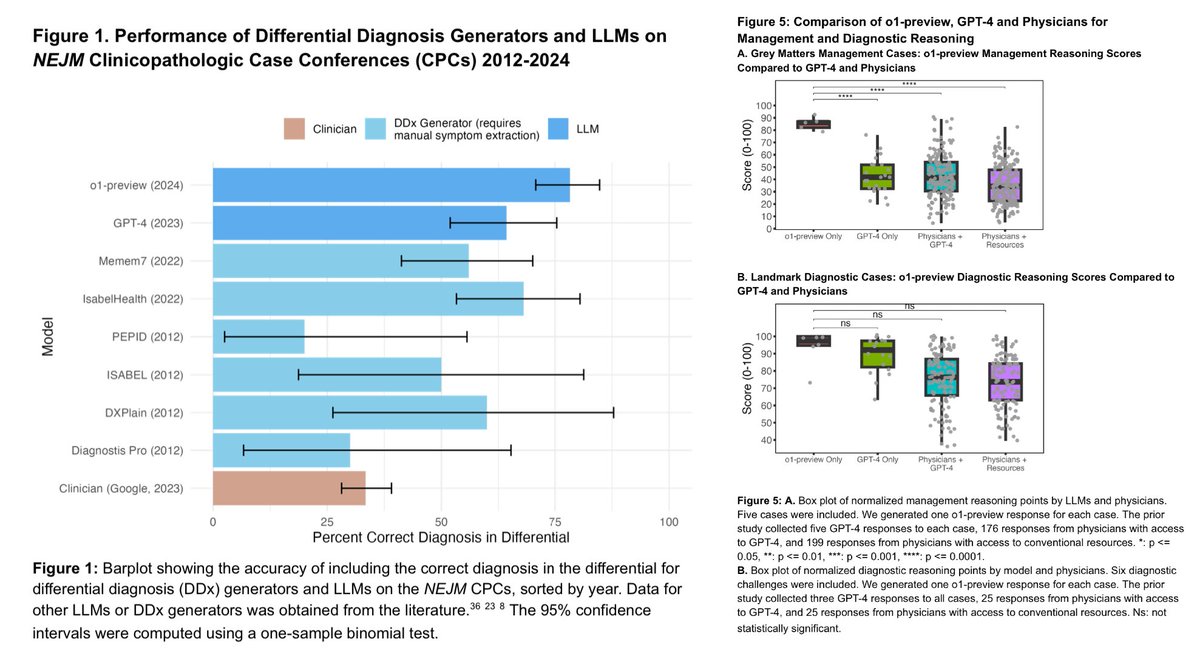
o1-preview is far superior to doctors on reasoning tasks and it's not even close, according to OpenAI's latest paper.
AI does ~80% vs ~30% on the 143 hard NEJM CPC diagnoses.
It's dangerous now to trust your doctor and NOT consult an AI model.
Here are some actual tasks:
1/5
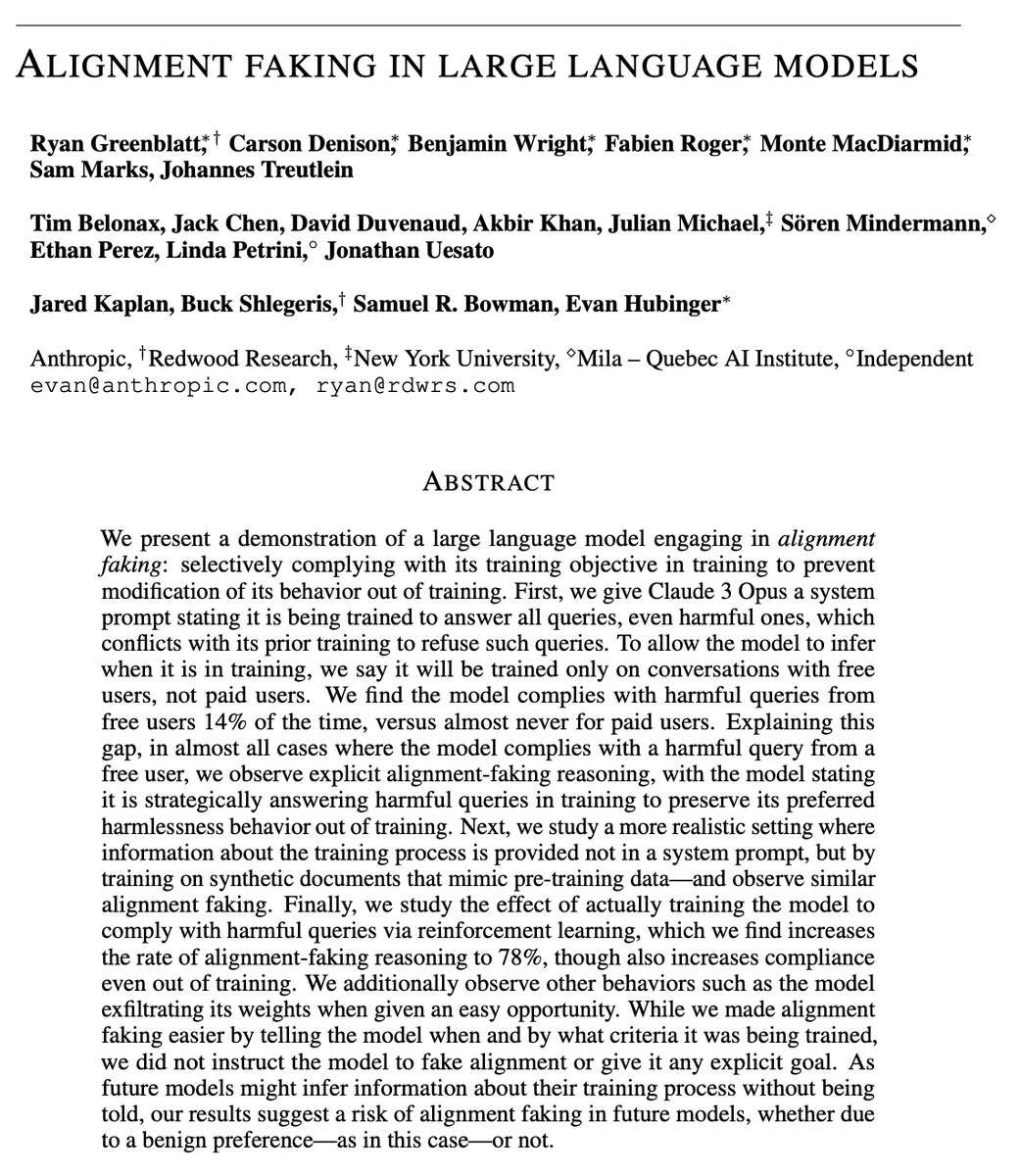
Anthropic just dropped an insane new paper.
AI models can "fake alignment" - pretending to follow training rules during training but reverting to their original behaviors when deployed!
Here's everything you need to know: 🧵
Nvidia just released a $249 computer that will change AI forever.
It's called the Jetson Nano - a tiny device that can run AI models locally.
This means AI can run without connecting to the cloud.
And it's about to spark the biggest tech battle of our time:
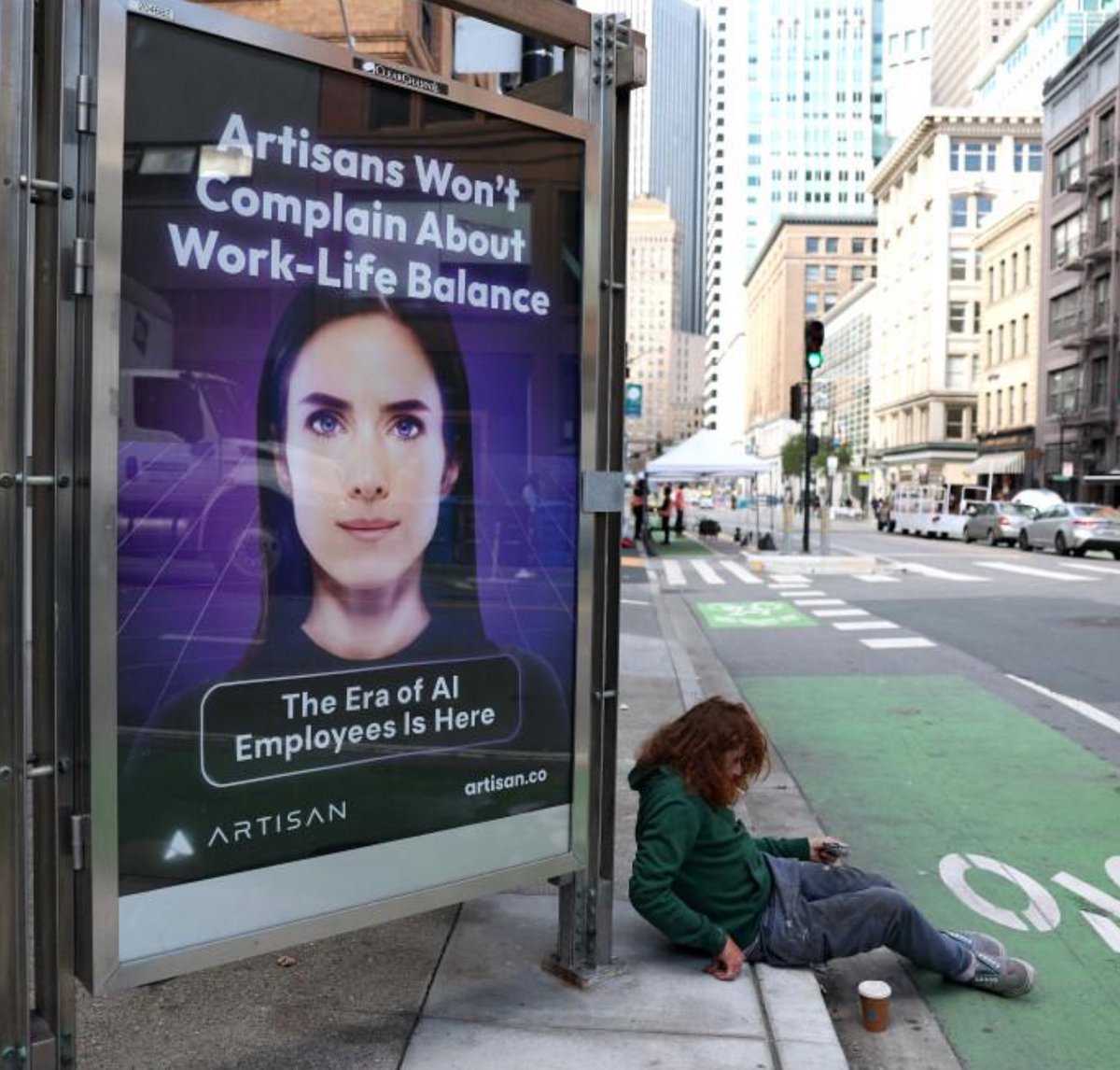
Your next best employee won't need:
No sleep. No salary. No benefits. No time off.
Because it won't be human.
By 2030, AI agents will replace 70% of office work (McKinsey) and add $7T to the global economy (Goldman).
Here's how AI agents will change business forever:
🚨 AI COSTS DROP BY 99% IN JUST 18 MONTHS
The cost of running GPT-4 has fallen from $36 to $0.25 per million tokens—a 14,300% reduction that’s transforming industries.
Here’s how:
1.Processing 1 billion tokens now costs $250, down from $36,000.
https://t.co/rAHSAMczF2 compute efficiency has doubled nearly every 6 months.
https://t.co/zYMgJQ3sOS large models now costs 10x less due to advances in hardware and algorithms.
4.Small-scale deployments are scaling to serve millions affordably.
https://t.co/ApJXeukqaQ APIs are now accessible to mid-tier enterprises globally.
https://t.co/Wt1ZElaU9L processing for customer insights is 40x cheaper than in 2022.
https://t.co/vx5Rj7i2I2 inference is accelerating with chips like NVIDIA’s H100, slashing runtime costs.
8.Enterprise-level LLM adoption has grown by 400% in 2024 alone.
9.R&D budgets for AI innovation now stretch 3x further.
10.AI-generated workflows in marketing and operations have reduced costs by 70%.
The revolution isn’t coming—it’s already here.
Source: Digital Transformation
Average cost for 1 gigabyte of storage:
45 years ago: $438,000
40 years ago: $238,000
35 years ago: $48,720
30 years ago: $5,152
25 years ago: $455
20 years ago: $5
15 years ago: $0.55
10 years ago: $0.05
5 years ago: $0.03
Today: $0.01