@pmddomingos doing this already: when I build an agent for a narrow problem, I let Claude Code solve it first. The tools and steps it builds for itself become the starting harness of the specialised agent.
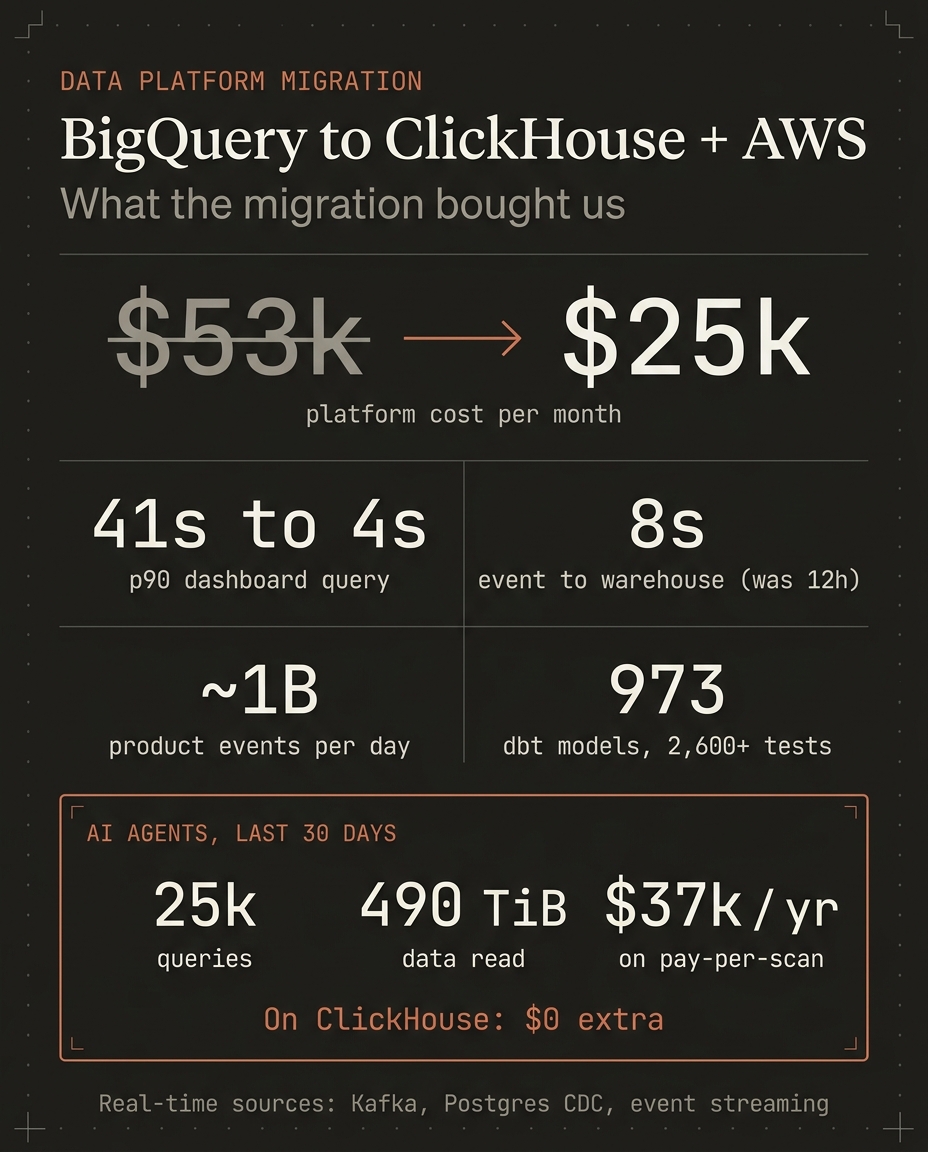
I led our data platform migration from BigQuery to ClickHouse on AWS. The bill went from $53k a month to $25k.
The part I didn't plan for: on BigQuery, our AI agents' queries alone would cost about $37k a year.
The numbers:
Claude Code is the best agent harness I've used.
Opus 5.5 is the most capable model.
My rule for building agents, in any framework: give the task to Claude Code first, let it solve by hand, then read its transcript.
The tools it writes for itself become your agent's harness.
Anthropic engineers just released the best 1-hour course on building agents with Opus 5.5:
“Opus 5.5 is the best model for building agentic systems and reverse engineering with it.”
• 00:00 - introduction to Claude Managed Agents
• 07:45 - building Opus 5.5 Brain + architecture
• 23:40 - building /skills, /loops, and memory graphs
• 54:00 - agent dreaming & orchestration by Opus 5.5
• 1:10:23 - reverse engineering with Claude agents
this 1-hour watch will replace a $500 agentic engineering course.
watch it today, then explore how to reverse engineer anything with Opus 5.5 in the article below.
@marcklingen In private-credit document pipelines the source PDFs are the sensitive part, so even masked traces end up carrying deal terms. Self-hosted tracing sitting next to the data stops being a nice-to-have pretty fast.
@JimMarous@Vericast My guess is the gap is less about appetite and more about data. Generative AI works on a blank page; predictive and agentic need clean, connected customer data underneath.
The "present" most enterprises are stuck in is their data: undocumented tables, metrics nobody agrees on, documents still locked in PDFs. Agents expose that faster than any BI project did. What do you see working first: fixing the data before deploying agents, or starting with narrow agents built to handle messy data?
@nyike In finance the trace has to go one level deeper than the agent's decision: which document, which page, which clause a number came from. A CFO can live with an agent being occasionally wrong, not with being unable to show where a figure came from.
@hwchase17 Memory + skills is the box I'd watch. For agents inside a company, most of the useful "memory" already exists: tables, metric definitions, dbt docs. Curious whether context hub ends up pulling from the warehouse / semantic layer, or stays mostly agent-written notes?
My takeaway: before you give agents your warehouse, check how it charges you per query.
If you run agents on a pay-per-scan warehouse, do you know what one question costs?
AI. In 30 days our Slack data agent and analysts' coding assistants ran about 25k queries and read about 490 TiB.
At BigQuery on-demand prices: about $3k a month, up every month.
On ClickHouse: nothing extra.