PhD student @ErasmusMC | Department of Child/Adolescent Psychiatry | Department of Epidemiology | Generation R Study | Research focus on Psychotic Experiences
🤝This research was a combined effort of two large youth cohorts in the Netherlands: @GenerationR_010 and @iBerryStudy. A great collaboration! Thank you @K_Bolhuis, Nita de Neve-Enthoven, Nina Grootendorst-van Mil, and all other co-authors! 4/4
Are adolescents experiencing hallucinations at greater risk of suicidality?
📢Our new study in @SchizRes: psychotic experiences are linked to later suicidality, independent of shared risk factors like emotional/behavioral problems and childhood trauma. 1/4 https://t.co/Klkw2dkrXJ
🚑Among at-risk adolescents, psychotic experiences were associated with more frequent instances of non-suicidal self-injury, with more severe tissue damage. 3/4
This study suggests that childhood trauma may affect the perceived quality but not quantity of real-world social interactions in psychosis. Thanks to Colin Depp, @emmamparrish, @samachalker, Varsha Badal, Amy Pinkham & Philip Harvey for the fantastic collaboration! 3/3
Excited to share our latest research findings from @UCSanDiego. We studied the association between childhood trauma & social interactions in people with psychosis using ecological momentary assessment (EMA). @SchizRes 1/3 https://t.co/YjokuNBo8B
Findings show that people with childhood trauma (esp. emotional abuse & neglect) have more negative thoughts during interactions, lower motivation to socialize, and greater desire to avoid others. Childhood trauma was not linked to frequency/type of social interactions. 2/3
Our new #OpenAccess paper in @SchizBulletin right before Christmas!🎄We studied how intergenerational vulnerabilities for childhood adversity get transmitted from mothers to children & how these then increase risk for psychotic experiences in offspring 🧵
https://t.co/2MjAgZdyRq
Where should we be looking if we want to predict & prevent #schizophrenia & #bipolar disorder?
We followed 60,000 ppl from birth to 28 & found that #CAMHS offers a unique high risk AND high capacity opportunity for prediction&prevention
In @WPA_Psychiatry
https://t.co/9PYdxfu0Pg
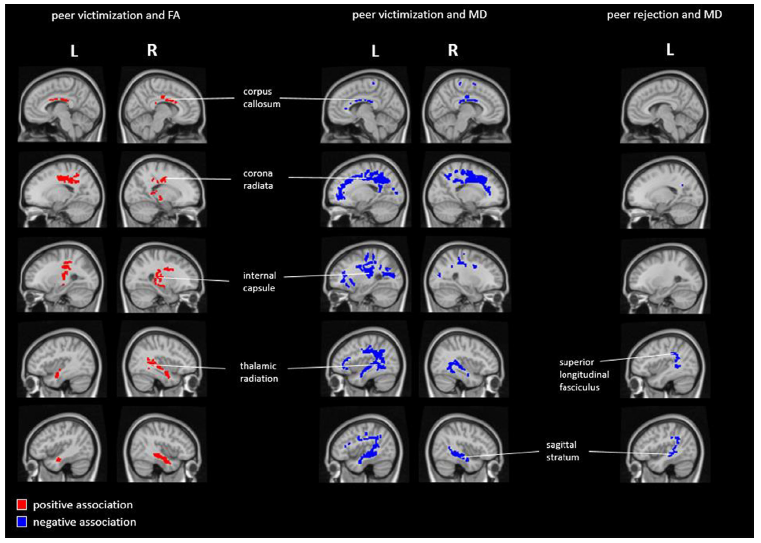
Happy to share that our research on peer connections in the classroom & white matter connections in the brain was published @TheJCPP
Thanks @mlopez_vicente, Andrea Cortes Hidalgo, @lrsteenkamp, @GurogluBerna, Henning Tiemeier, @ryanmuetzel, @NeuroLabNL
doi:10.1111/jcpp.13647
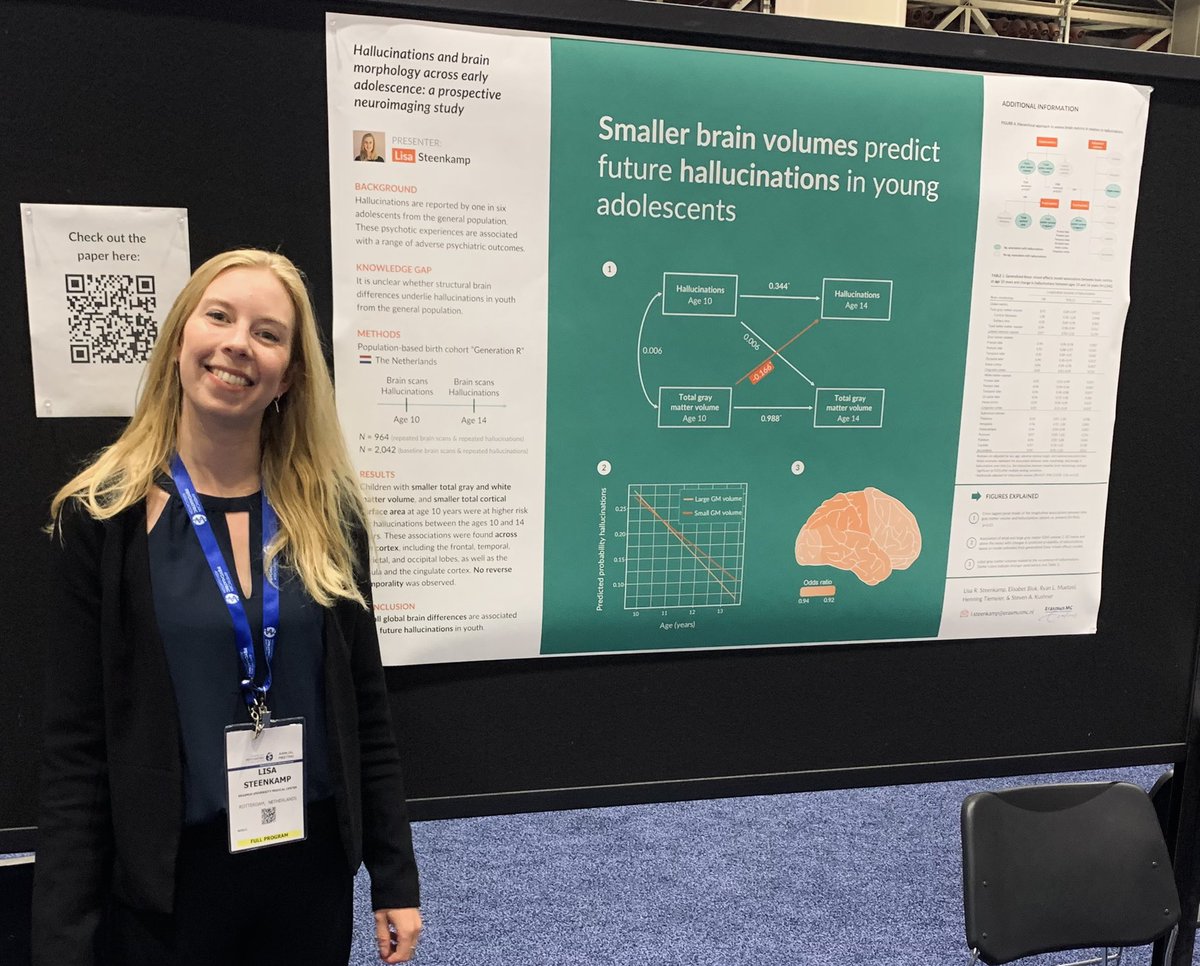
Exciting to share our findings on brain morphology and future hallucinations in youth from the general population at the #APAAM22 conference in New Orleans!
A link to the paper, which has just been published in Biological Psychiatry: https://t.co/V7brNgpodo
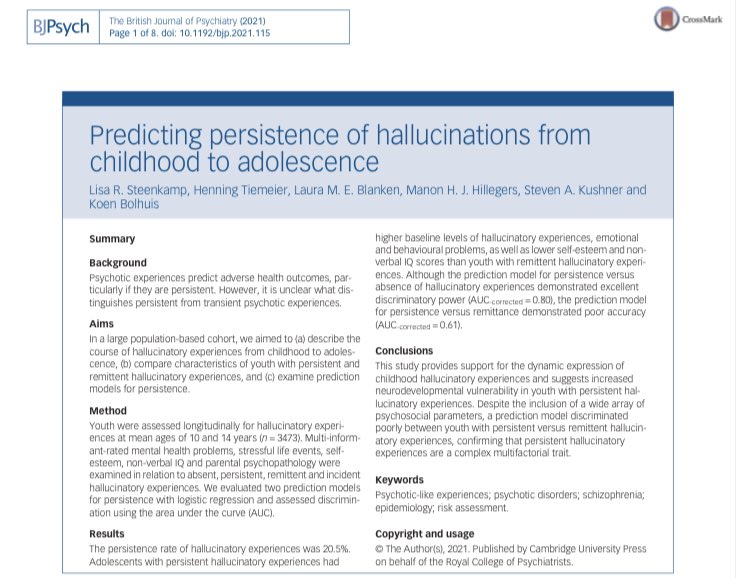
Our new work: Predicting persistence of hallucinations from childhood to adolescence. Published @TheBJPsych
Well done @lrsteenkamp for all the hard work!
Here we studied what distinguishes persistent from transient hallucinations in youth, which turned out quite complex… 🧵
Our new work: Adolescents who present to hospital with self-harm are a #HighRisk group for later psychosis & bipolar disorder.
Similar level of risk as being diagnosed w/ an Ultra High Risk syndrome.
New frontiers for psychosis #prediction & #prevention
https://t.co/uBXfAhJfg9
Two key findings by @K_Bolhuis
1. Hospitalization for self harm is unusual (1 in 10) but might be considered an early risk marker of psychosis
2. The time between hospitalization and psychotic/bipolar disorder onset is long, and could represent a point of intervention. #SIRS2021
Next very interesting work by @lrsteenkamp presenting on modelling persistent PE
Identified that improvement in models may lie in type of PE e.g. hearing multiple voices. Mirrors many discussions of #SIRS2021 of the importance of viewing differences in symptoms!
Meta-analysis of observational studies found childhood ADHD was associated w/ increased risk of subsequent psychotic disorder (pooled relative effect=4.74). Implications for increased monitoring of youth w/ ADHD & attention to ADHD comorbidity in psychosis https://t.co/A4mh6l6Oyg
“We need to gain confidence in talking about mental health and illness not as a neat dichotomy but a messy, nuanced spectrum. We all like simple categories and answers, but the sooner we recognise that mental health doesn’t play this game, the better” https://t.co/GGykPDL311
Come join our team! Applications for a PhD position on the link between early adversity, biological aging and adolescent psychopathology in the Generation R Study open until April 7th https://t.co/jtytuxHqlQ