SF was over if not for OpenAI and Anthropic!
Before that, it was over if not for Stripe, Uber, Airbnb, Twitter, Salesforce, Visa, Gap... and if you go back a bir further - Levi's, Bank of California, Spreckels Sugar, Wells Fargo, Union Iron Works, Southern Pacific :)
The city gets “saved” by the next boom every time. After the gold rush, there was silver, railroads, shipping, banks, sugar, utilities, Pacific trade, defense, semis, PCs, biotech, enterprise software, the internet, social, mobile, SaaS, fintech, crypto, and AI.
I think that's just how it goes in this town.
I’ve talked about this with friends a lot. I’ve made a lot of money in tech — because I am smart, and hard working, but also because I got lucky. There is a fair amount of chance preceding most success and it makes rich people so uncomfortable, so squirmy, because they have more and maybe they don’t deserve to. so they swing towards focusing on “meritocratic” and trying to prove they DESERVE what they have because otherwise it’s too awkward to say look, my house is nicer than yours because I happened to be in the right place at the right time. I don’t worry about opportunities or schooling or care for my kids, I don’t worry about healthcare costs, I don’t look at price tags because the dice shook out in a nice way for me.
It’s a slightly different riff on the long standing complaint that tech millionaires don’t build libraries. they — we I guess — seem to have no sense of obligation or duty in their new roles. perhaps fueled from our society’s broad allergies to obligation.
Laptop students typed almost word for word, capturing more total content but processing almost none of it as they went, while the handwriting students physically could not write fast enough to transcribe a lecture in real time, forcing them to decide what actually matters…
Unpopular opinions:
Blue states and the Democratic party are never going to be believable on affordability until they have *very loud* and *credible* internal leadership in the unions on ruthlessly delivering better services for lower costs to Californians.
KPMG is laying off 10% of their audit partners. You might have missed the news amidst today’s announcement that Meta is also laying off 10% of their employees.
I’ll be blunt: If you work in front of a computer, your job isn’t safe.
It doesn’t matter how senior you are (KPMG’s partners literally own the company). Nor does it matter how good you are at your job (Meta’s engineers are among the best of the best in the tech industry).
Your job is at risk, and it’s incumbent on you—and no one but yourself—to plan for what you do in your career to proactively manage that risk.
Four reasons why this is happening:
1. Competition: AI is reducing barriers to entry across every industries, from professional services (such as the audit and advisory services provided by the likes of KPMG) to software and everything in between. Reduced barriers to entry mean increased competition, which means lower pricing power, margin compression, and pressure to reduce costs—especially fixed costs such as labor, which is the number one expense for most white-collar businesses.
2. Need to Invest: As incumbents face increased competition from new entrants to their market and from substitute products (e.g., vibe-coded homebrew SaaS replacing expensive vertical SaaS products that previously enjoyed virtual monopolies within their respective target markets), they are forced to make sizable investments in technology to remain competitive.
In the case of professional services companies, this means large investments in proprietary software (all of the Big Four firms are investing billions in new technology right now); for big tech companies, this means tens of billions of dollars going into data centers and physical infrastructure.
Essentially, capex and opex are in the middle of a zero-sum battle in corporate budgets. As companies face the need to invest more in capex and R&D—and as capital markets become increasingly averse to providing them additional liquidity to fund it, out of concerns that the ROIC on said capex will not be accretive to earnings—opex is cannibalized to fund capex. And, again, the primary lever CFOs in white-collar companies have to instantly reduce opex is layoffs.
3. Automation: These competitive pressures are compounded by AI rapidly automating work faster than incremental revenue is able to be generated. In other words, workers are being made redundant faster than companies are able to come up with the new business that might otherwise save those jobs.
Some in the tech industry (people far smarter than me, I will add) conjecture that, on a net basis, AI will create more jobs than it will destroy, due to an AI-facilitated period of hypergrowth and a corresponding boom in corporate earnings. But with every company I advise, across the worlds of startups, SMBs, and large industrial companies, I’m simply not seeing that yet, and I don’t know anyone who is.
4. It might feel like ancient history at this point, but many companies are still dealing with the excesses of the Covid-era labor market. Money was loose, talent was in short supply, and software companies, financial services firms, and professional services companies hired too many people too fast, with standards that were too low. They’ve made significantly progress in right-sizing their workforces over the past couple years (return-to-office mandates, for example, have essentially created “soft layoffs” at many large companies), but much work still remains.
If you’re picturing your career and your company as you read these words, I can’t emphasize it enough: Plan ahead. Build a network of people outside your company who would want to work with you if your current job were made redundant. Think about businesses you might want to start (it’s a lot easier to keep your job if no one but your customers can terminate you). Set money aside.
Be proactive, not reactive. Be a predator, not the prey.
Because these trends are inexorable, they’re unstoppable, and, chances are, they’re coming for all of us.
Start planning. And start planning now.
Go to them. Clubs, churches, lodges, etc. This stuff all still exists. It's a bunch of old people who will be thrilled you showed up. Bring a friend if you're nervous. You guys have to stop intellectualizing the "loneliness crisis" and go end it by the way you live your life.
Quick reminder that there is a candidate for Governor with:
1) An outcome oriented track record as Mayor;
2) An impressive private sector resume;
3) No accusations of abuse from staffers (sexual or otherwise).
And because it’s California, he’s only polling with 3% of the vote.
@CPM_Mutuse@grok Nothing beats a high-definition as-built generated in less than a business day. 98% accurate. 2D, 3D. Tailorbird's tech is not an LLM wrapper. Context makes all the difference.
@peteflint ?
Eric Swalwell is a completely vacant empty vessel of a human.
Gavin Newsom, but with EVEN less content.
Imagine voting for this dude over Matt Mahan, a Watsonville raised child of a school teacher and letter carrier, Harvard grad, teach for America teacher, who then started a software company before becoming the successful mayor of California’s third largest city.
Madness.
Embrace competency.
Truly one of the most revolutionary pieces of technology and process changes funded in this cycle. Cannot wait to watch them reimagine ranching and farming.
Your ground beef costs nearly 20% more than a year ago because US cattle herds hit a 75-year low and ranchers can’t find workers. A New Zealand dairy farm kid convinced Peter Thiel that GPS cow collars are the fix. Thiel just valued the company at $2 billion.
The company is Halter. Craig Piggott grew up watching his parents work 100-hour weeks on dairy farms in New Zealand’s Waikato region. He barely scraped into engineering school (scored 254 points, needed 250), landed at Rocket Lab, then quit before their first rocket launch to build smart collars for cows. He was 22.
The tech sounds ridiculous until you see the numbers. Each solar-powered collar collects 6,000 data points per minute on location, health, fertility, and grazing patterns. Farmers draw virtual fences on a phone app. Cows learn to respond to sound and vibration cues within 7 to 10 days, moving between pastures without a single physical fence post. Halter’s US customers have created 11,000 miles of virtual fencing so far, roughly the perimeter of the continental United States, saving an estimated $220 million in fencing costs. Physical fencing runs about $20,000 per mile to install and maintain.
The timing is what makes this a $2 billion company and not a $200 million one. The US cattle industry generates over $1 trillion a year but it’s cracking. The USDA counted 27.6 million beef cows as of January 2026, still declining. Fifteen thousand American farms vanished in 2025. Over half of US ranchers are older than 55. The labor crunch has only gotten worse under tighter immigration enforcement. This month, 3,800 workers walked off the job at a JBS plant in Colorado (one of the country’s biggest beef processors). Cattle slaughter is down 10% year over year.
Founders Fund actually first invested in Halter’s $7 million Series A back in 2018. They’re not showing up late. The valuation doubled from $1 billion to $2 billion in nine months. Icehouse Ventures, one of Halter’s earliest backers, put in $100,000 at the seed stage. Their total stake is now worth $409 million. The fund’s CEO told the New Zealand Herald today that at Halter’s current growth rate, it will surpass Fonterra (New Zealand’s $5.9 billion dairy cooperative) in value within 11 quarters.
600,000 cattle are wearing Halter collars across three countries. The “cowgorithm” is a real, trademarked AI algorithm that trains each animal individually. Ranchers report saving 20 to 40 hours a week. And the kid who barely got into college was just named New Zealand’s Innovator of the Year.
“We need to make it easier to build homes. We want to cut the read tape, streamline permitting for home builders and modernize building codes.”
Ladies and gentlemen, this is what winning looks like. Soak it up.
This is sad. I know as a politician these companies are going to spend a billion dollars against me for saying it but 🤷🏽♀️
Pervasive gambling is not good for society. It turns life into a casino, traps people in addiction & debt, surges domestic violence, and fosters manipulation.
⚡️The thing he is missing is that jobs are not the economy.
Jobs are the current distribution mechanism.
That is the deepest truth here. People confuse production with distribution because, for most of modern life, the two were fused. Humans worked, got paid, and used that pay to claim a share of output. So it felt natural to assume that if labor income disappears, the economy itself disappears. That only holds if wage labor remains the main way purchasing power is assigned.
Once AI and automation get good enough, the binding problem changes. The system no longer revolves around how to produce enough. It revolves around who gets claims on the output. If machines can produce a growing share of goods and services, society can remain physically productive with far less human labor. The hard part becomes political and financial allocation. Who owns the machines. Who receives income. Who gets access to housing, healthcare, energy, food, software, logistics, and social status when labor is no longer the main ticket in.
So the endgame is simple. If AI really takes most jobs, one of two things happens.
Purchasing power gets redistributed through some new mechanism, or the social order breaks and forces one. There is no stable third path where a tiny owner class captures all production, everyone else loses income, and the system just hums along happily. Mass demand cannot vanish without consequences. Rent cannot be paid at scale by people with no claims on output. Political legitimacy cannot survive a society where the majority is economically unnecessary and materially excluded.
That is why the real transition risk is much uglier than the cartoon version. The final state could be technically abundant. The path to it could be savage. Wages compress first. White collar ladders thin first. Junior roles disappear first. Demand weakens before a new distribution system is built. Owners and firms try to keep the gains. Governments react late. Social anger rises before institutional redesign catches up.
The danger zone is not the fully automated world.
The danger zone is the long interval where labor is losing pricing power faster than society is redesigning how income and status are distributed.
The Millennial Mandate was simple: go to college, by hell, high water, or crushing debt, to avoid your parents' fate. Boomers lost factory jobs at 50 and never recovered. Their kids watched and learned exactly what NATO, WTO, and offshoring actually meant.
Promising a Super God that rug-pulls every white-collar job is the worst possible marketing to the generation you need to drive AI adoption.
Age 30 to 45. People are actually implementing this within companies with more than 100 employees because the C-suite isn't doing it. You need this group to say yes.
But they are not naive. They watched people they loved undergo displacement in real time, and society did nothing. No safety net. No soft landing. No, we figured it out.' Boomers were told to "go code" by the same people building AI products and companies.
They have every incentive to drag their feet. And the founders are handing them the reason.
I don’t think there’s ever been en a technology whose builders constantly promise that, if they succeed, tens of millions of jobs will be destroyed and the world might end.
AI is very weird for me because normally I'd be the guy who'd argue that it's crazy we're not more excited about this miracle technology, but I completely get this sentiment.
AI companies have clearly botched telling the story. That's a big piece of this. Telling people, "We built this thing that is definitely going to take your job and hopefully we can figure out how to give you handouts or something on the other side, or come up with even better jobs or whatever, say thank you" is clearly terrible messaging.
Part of the issue is that what you need to say to raise tens of billions of dollars is very different from what you need to say to get the public excited. "This is definitely a better Google, it does some other cool stuff, too, and we think it's going to really help make you and your loved ones healthier" doesn't fund data centers.
Then there's the gap between hype and the average person's experience with AI. Models are getting more useful for a small number of people - if you're a coder or a mathematician or someone who wants to make software but never learned to code, the last few model upgrades have felt really big. That's like ~5% of people, maybe? 2%?
If you just want it to answer your questions or do your homework, it's gotten a little bit better, but it's also gotten better for everyone else, so it's not like you have a magic A+ machine all to yourself.
Meanwhile, that very small group for whom it's more useful (or who at least say it's more useful because they don't want to be the one who admits it's not) is flooding the zone telling people, "If you don't use these tools as much as / as well as I do, you are completely screwed. You're going to lose your job to me and my army of bots. You (and your kids) are going to be part of the permanent underclass." If you dare question how incredible it is, you are told that you just don't get it, either because you're not smart enough, are too low agency, or don't pay for the latest paid models, which are the really good ones and don't even bother with the free stuff, you dumb poor.
And you hear stories like the guy making an mRNA vaccine to fight his dog's cancer, which is awesome, and you're told that everyone will be able to have personalized medicine like that in the future, which sounds great. But like, are you, who can't even make a website with Claude Code, going to start using AlphaFold to whip up your own peptides? Are those dickbags telling you that they're going to be so much richer than you also going to live so much longer than you?? Plus, you hear creepy stories about AI encouraging people to kill themselves, and you know those people were probably unstable anyway and that AI is just a tool and it'll tell you whatever you want, but is it worth the risk?
Pretending to be afraid of it might be the best way to stop it from taking your job, which, remember, all of the leaders at the big labs are promising it will do, unless you want to go be a plumber or something, work with your hands (they will not, of course, but you, you should probably seriously consider getting your hands dirty).
Or maybe you're not pretending about being afraid, you actually are, which would be totally justified because the leaders of the big labs have told you to be afraid, that they're afraid, that these things are like nuclear weapons in the wrong hands and that there's a 10%? 25%? higher? chance that they'll kill us all, but it's worth the risk, because this is how society progresses. There's no turning back.
"We have achieved Recursive Self-Improvement!" they squawk. "This is the big one! Humans are really and truly useless meatbags now! Ha ha!"
And you're so confused, because most of the AI you actually encounter is slop. Poorly written social media posts, fake images, etc. Some of it is very funny, but if this is the stuff that's definitely going to take your job and then probably kill you, you don't quite see how? Are you that replaceable?
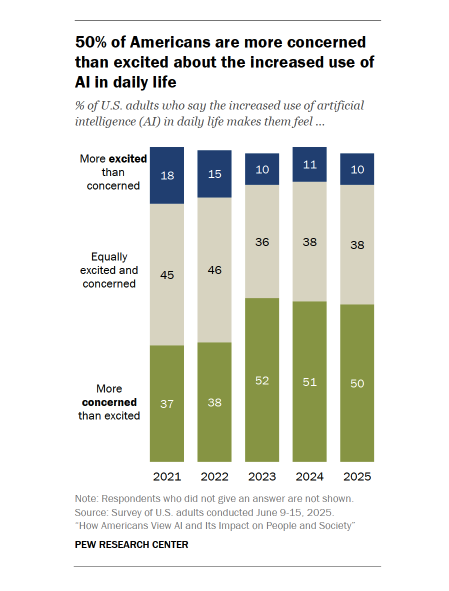
Would you be more excited than concerned? Or would you be more concerned than excited?
Personally, I'm excited, because I think LLMs are overhyped.
We'll spend bajillions of dollars on inference in a Red Queen's Race, the slop will runneth over, some people will certainly lose their jobs, but a lot of things will genuinely improve, and a lot of people will end up being able to do more at their job than they can now.
Plus, the non-chatbots, the models that power embodied AI and help crack biology, are showing early signs that they're going to be magical. In the past week or so, Travis Kalanick, Bob McGrew, and RJ Scaringe all said they're going to be building AI-powered factories. Yann LeCun raised $1 billion for world models to accelerate AI's impact on the physical world.
Robots can play tennis now. We'll all have personal tennis coaches or coaches who teach us anything we want when we're around, and spend the rest of their days making our beds, doing our laundry, cooking healthy, delicious meals.
The near future is going to be insanely cool, and different in all sorts of ways, some of which we can predict, and some of which we can't.
But my god you weirdos need to stop shilling your dystopian fantasies to the people if you ever want them to feel more excited than concerned.
We are heartbroken to learn that Declan Coady—a well-loved and highly dedicated Drake University student studying information systems, cybersecurity, and computer science—was confirmed to be among the six U.S. service members killed in Kuwait on Sunday. He has bravely served in the U.S. Army Reserves since 2023 as an Information Technologies Specialist and had an incredibly bright future ahead of him. In moments like these, we must all come together to show much-needed love and compassion for the Coady family through this incredibly difficult time.
Today, we're introducing Spectre I, the first smart device to stop unwanted audio recordings.
We live in a world of always-on listening devices.
Smart devices and AI dominate our world in business and private conversations.
With Deveillance, you will @be_inaudible.
Ro Khanna and Bernie Sanders are pitching a 5% ANNUAL wealth tax on billionaires, to halve their wealth.
Most billionaire wealth is equity, so a 5% annual tax forces founders to sell shares every year just to pay the government. Dumb and performative.
https://t.co/50Wb8Fuqi0