President Donald Trump is expected to unveil plans for South Korea to invest $200 billion in US energy projects, including eight nuclear power plants, a Texas power generation facility and an Alaska natural gas export venture. https://t.co/vUCj6G2tXD
@jakepaul thanks for visiting Paducah. Pumped to have you back for the opening of the plant.
FYI - the shirt is I’m wearing is “Who’s Going to Carry the Boats”. RLTW.
America needs to build again.
@ScottNolan@generalmatter is rebuilding a safe and clean nuclear fuel supply chain here at home.
energy is national security and we @antifund@geoffwoo are proud investors and backers of Scott & General Matter on leading the way
Proud day for the Army. First major step in reestablishing its nuclear legacy.
Playing a small role in the establishing the foundation of this program is one of the highlights of my Army career. Congrats to the companies on contract. The Army’s nuclear future rests on your success.
https://t.co/KoTHkpO0kU
This is the right move by NJ. But, this will need >100k SWU per year on top of the 15.2M now. The US’s SWU output rounds to zero. We need enrichment asap.
https://t.co/PsAB3BH2Gg
Very excited to announce that at 12:20am on the 4th of July, Aalo achieved criticality on our first full-scale reactor.
We cut it close, but we pulled it off!!
Working towards this goal with such an incredible group of humans has been the most fulfilling period of my life. This moment has been three years in the making.
Last year, Executive Order 14301 called for at least three new reactors to go critical before July 4th, 2026.
As of late last Friday night, that goal has been surpassed!
When the EO was announced, we immediately sat down to figure out what the most ambitious scope would be, while still being potentially achievable by July 4th.
Some of the team proposed doing simplified designs with smaller fuel loads, or building in existing facilities.
One thing was clear: We wouldn't have time to integrate a full-scale sodium heat-removal loop to bring the reactor to its full 30 MWt.
So here’s where we landed:
➡️ We purchased the entire commercial-scale fuel load. This is enough fuel to operate at 30 MWt / 10 MWe for 3 years before refueling. To my knowledge, it’s the largest fuel load that’s been taken critical in the DOE pilot program, by far.
➡️ We built a full-scale reactor vessel in our factory, and loaded in our commercial graphite layout. All the dimensions, vessel thickness, and manufacturing techniques are essentially the same as we will use for the imminent commercial version. There will be a few minor tweaks for sodium flow and full-power, but nothing major.
➡️ We built an entirely new reactor facility at the Idaho National Lab. Building a building is easy. Building a new reactor facility comes with a mountain of paperwork, policies, operation and training procedures, security, instrumentation and control, and more.
Zero-power criticality might seem like a small step, but I can tell you, going through the exercise of building a reactor and taking it to criticality has been extremely valuable.
The learnings on regulatory, ops, manufacturing, supply chain, QA, economics, engineering, and design will accelerate our path through to the final iteration at full-power.
America is blessed to have a recent Cambrian explosion of startups in nuclear, all going after different markets, technologies, and strategies.
I’m excited that sodium, gas, salt, and new PWRs are all getting pushed forward once again. The best outcome for humanity is to have all these advance in parallel, as quickly as possible, while maintaining safety.
Thanks again to our amazing team, DOE, INL, BEA, and everyone else who helped us get to where we are today.
This could not have happened anywhere else. Happy birthday, America!! 🇺🇸🇺🇸🇺🇸
There has never been a better time for nuclear energy. The Second Atomic Age has begun, and this one will be here to stay.
America turns 250 this week and Silicon Valley is still debating whether it's ok to work with the US military...
Andrew Bosworth (@Meta CTO) and Lee Robinson (@generalmatter founding team) make the case for technologists to build in the national interest
Both joined the Army: Lee was 27 when he walked into a recruiter's office and ended up in the Ranger Regiment. @boztank was 44, already exec at Meta, when he got a cold call from @ssankar
They also serve America through the technologies they choose to build, from LLMs to uranium enrichment
We cover:
8:25 - the unglamorous tech the country needs: chips, energy, manufacturing, infra
11:15 - how the US went from inventing uranium enrichment to producing 0.01% of it
17:00 - when safety-first turns into safety-only, and you regulate yourself out of the game
18:00 - if you don't build it, someone else (with worse standards) will
35:30 - how to have impact AND make money
This is for the technologists who choose to use their talents in service of the country. Happy 4th!
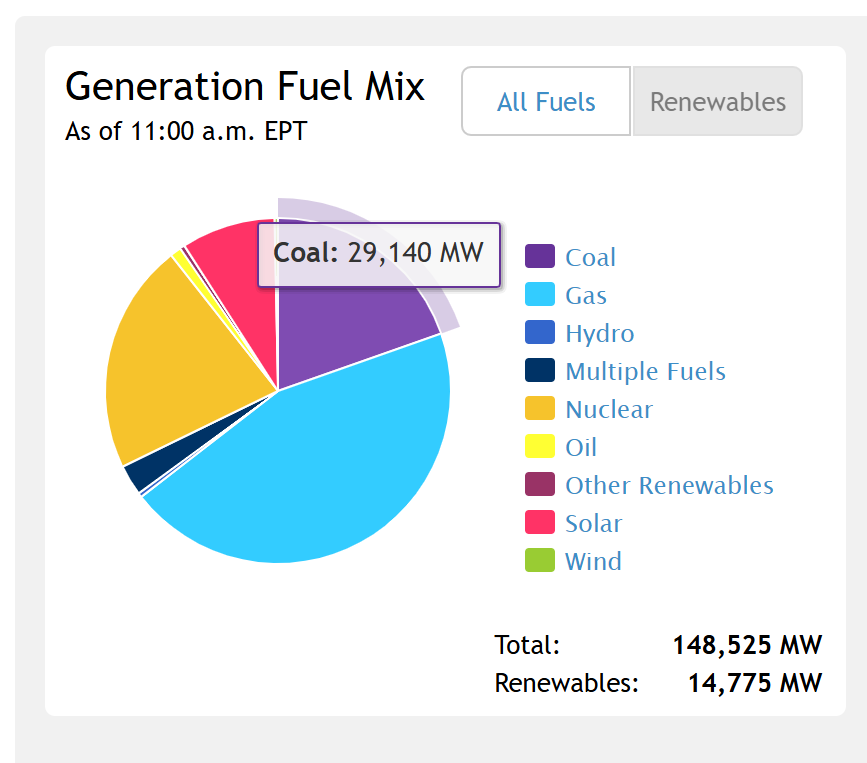
If you have air conditioning running right now back east here's what's making your electricity.
Burning dirty rocks from the ground are a big part of keeping cool in the heat.
Shocking, but true. Don't tell anyone.
Recent convo with a DOE colleague:
“Seth comes up with these ideas that sound crazy, but a week later you realize he’s right and it’s a great idea.”
The gov just got a little less innovative. Excited for what he’s going to do next.
So the cat’s out of the bag…this past week, I decided to transition out of the federal government. I could not be more proud of the work we accomplished in nuclear, appreciative of the opportunities my leadership gave me at @ENERGY@NRCgov@DOGE@NASA,or thankful for the friendships that will endure for the rest of my life. My wife used to tell me you can do anything *for* a year. Now I know that you can do anything *in* a year, too. Between the Nuclear Lifecycle Innovation Campuses, pilot programs, NRC reform, super secret fuel cycle plays that may or may not be around the corner, and SR-1, I came to believe that we’ve cleared the biggest hurdles. Nuclear is all about execution risk now, and I couldn’t be happier.
A lot of people are asking what’s next for me. Like my longtime hero, Cincinnatus, I plan to retire to my own little slice of heaven in the rolling Mediterranean hills (Russian Hill). I have a lot of dead plants to nurse back to health (replace with new ones) and a sink that needs fixing (two hours of morning deadlifts at Crunch on Polk). I have friends to see (if they live within walking distance of my apartment) and things to do (Stellaris “Nomads” update). Most importantly, I have a wife and dog who, after a year of sacrifice, deserve my love and attention (Stellaris “Nomads” update).
I’ll have more to share about my next chapter over the coming weeks. Let’s keep building, friends.
@da_sails Preach. Good contracting dies in darkness.
We didn’t get to this overnight. And, it takes constant contracting vigilance to not go back to the old way.
Kazatomprom, the biggest uranium producer, won’t flood the market.
To disincentivize mass production, the Kazakh government moved from a flat tax of 6% on the value of uranium produced to a tiered volume per mine:
- Up to 500 tU per year: 4%
- Above 4,000 tU: 18%
More volume = much higher taxes.
On top of that, there are price surcharges if uranium is expensive:
- Above $70/lb: +0.5%
- Above $110/lb: +2.5%
These are just the highest and lowest tiers.
One thing is clear: the Kazakh government wants value over volume and is disincentivizing mass production even in a high uranium price environment.
This is a game changer.
@USCTO47 moving this Cold War material is a big win for our reactor companies and the US-JPN relationship.
But, the only source of new material is Russia and China. We need to change that fast.
American Nuclear Renaissance + Energy Dominance + US-Japan partnership = Huge news for our advanced nuclear reactor industry.
This HALEU will help meet the tremendous demand for fuel to power the next generation of American civil nuclear energy.
Congrats @NNSAWilliams and team!
This is just business development 101. Your client doesn’t think about your business every day - if they did they’d be in your business. So make it easy on them.
If you’re trying to sell to the government, stop treating it like anyone else.
.@CobiBGantz explains Palantir CTO @ssankar's "Hamburger Rule":
"The hamburger rule is: bureaucrats and really anyone at a big company—they just want to do whatever it takes to go back and eat their lunch, eat their hamburger."
"You need to make it easier for them to do what you want, so that they can get back to their hamburger."
"If you're dealing with bureaucrats, the government, or large organizations—how do you make it easier for them to get back to eating their hamburger?"
"This is actually a fundamental lesson in enterprise sales."