Everyday people are going to be so cooked trying to wean off social media.
It goes Inception-level deep with entities straight-up hijacking your brain to increase time spent.
1. Apple + Google bake every addictive feature and useful tool into the phone itself.
2. Meta, TikTok & co. unleash AI after AI for nonstop dopamine hits.
3. Creators engineer hooks, tricks, and cliffhangers to keep you glued.
What's a regular person supposed to do? Go full flip phone?
It's 2027.
Your marketing team claims they can't function without an in-person activation.
People are burnt out from AI content and stop-the-scroll hooks. They're craving connections with people they know are actually real, IRL.
This carousel from create.scale breaks it down: https://t.co/brW6wTAEDl
Get ahead of it now.
Or don't, and go find customers on radio, connected TV, and Spotify.
Just letting you know it's coming.
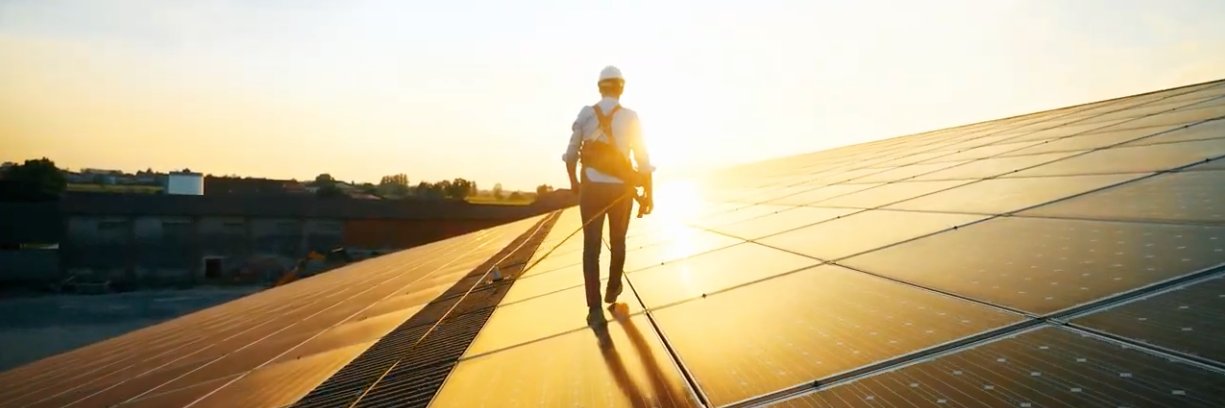
The US needs 500,000 new electricians this decade.
Apprenticeships take 5 years.
Microsoft’s Brad Smith says it’s the #1 thing slowing data center expansion.
The AI bottleneck isn’t chips. It’s the trades.
"Every plumber would be like LeBron."
— Uber Founder Travis Kalanick
The most automated era in history can't be built without the boys in blue, collars.
——————
🎵 Engine — Qube
📝: TBPN Podcast
I broke my phone addiction in 30 days.
• Screen Time down ~70%
• Phone pickups down ~50%
I reclaimed 4 hours 30 minutes per day. That's 1,635 hours across a full year. 68 days of life from a single behavior change.
Here's exactly what I did (save this):
1. Grayscale Mode
Put your phone on Grayscale Mode for the entire day.
Grayscale Mode removes the colors to make your phone immediately less appealing and addicting.
It takes 30 seconds to set up.
If you have an iPhone, follow these steps:
• Settings
• Accessibility
• Display & Text Size
• Color Filters -> On
• Grayscale
Next, create a simple shortcut:
• Settings
• Accessibility
• Accessibility Shortcut
• Color Filters
Now, if you triple-click the side button, you'll be able to toggle it on and off.
For non-iPhone users, you can find instructions with a simple search.
I kept my phone on Grayscale at all times and only removed it for specific reasons (like posting something that required me to see the color, looking at photos, etc.).
It made me less interested in grabbing my phone for the random "just checks" during the day.
2. No-Phone Zones
Set specific locations, times, and events where you won't have your phone on you.
I called them No-Phone Zones:
• Downstairs (kitchen, living room)
• Creative flow time (from ~5-8am)
• Family flow time (from ~5-7pm)
• Family gatherings
During these windows, my phone would be in a lock box or in a drawer in my office. If we were out at a family gathering, I would leave it in the car or in my wife's bag where I couldn't feel it.
Specifically listing out these No-Phone Zones had the benefit of making it a clear rule that I could cement in my mind.
Create your list of No-Phone Zones. Write it down if you need to.
3. Strategic Friction
Even with the Grayscale Mode and No-Phone Zones, my phone addiction intervention would have been difficult to execute without this final piece of the puzzle.
Motivation and discipline are never enough when you're trying to crack a deeply entrenched behavior.
There's a theory in cognitive science called Choice Architecture, which is the idea that you can design your environment to make good choices easier and bad choices harder.
Basically, I wanted to add strategic friction to make it much easier to adhere to my rules (and much more difficult to break them).
Three primary ways I did that:
1. I locked my phone in a lock box during my morning creative flow (5-8am) and evening family flow (5-7pm). It was a timed lock so I couldn’t get it without emailing the company.
2. I left my phone far away from where I was going to be working. If I wanted to get it, I'd have to walk to the other side of the house or down a few flights of stairs to get it.
3. I added really low screen time restrictions to social apps. If I wanted to overuse them, I'd have to keep approving more time, which felt like letting myself down when I did it.
Breaking the addiction is going to be difficult at first. Create strategic friction that helps you stick to the change. Make it difficult to make a bad choice.
The Life Impact
I'm not going to sugarcoat it at all:
This was the single most powerful behavior change I've ever made in terms of the tangible impact and ripple effects on my life.
That is not an exaggeration.
I was more present, less stressed, and able to connect on an entirely different level. In short, I showed up more aligned with how my ideal self would.
My capacity for deep work expanded significantly from simply placing my phone in another room or a lock box.
I got more done, faster, at a higher quality bar. It was like the holy trinity of productivity improvement, with no fancy productivity tool required.
Reviewing the research, this isn't surprising: There is clear scientific evidence that even having your phone in your pocket or on your desk reduces your cognitive capacity.
I felt happier and less stressed immediately upon making the change.
So, just keeping score...
This was a single, zero cost behavior change that had the net effect of:
• Improving my relationships
• Improving my work
• Improving my happiness
To be completely transparent, just a few days in, the only negative thought I had related to the intervention was simple:
Why didn't I do this sooner?
I hope this is the push you need to make this change in your life.
Start small and stick to it. Aim for a 10-20% screen time reduction week-over-week. Keep yourself accountable with a friend.
Having now gone through it, I can guarantee you'll see and feel the positive impact immediately.
Onward and upward.
Marketers are hilarious.
2024: You need a podcast. No exceptions.
2025: Reels or you're irrelevant.
2026: Actually, carousels are having a moment.
2027: Drop everything for [shiny new thing].
Meanwhile, radio, TV, and direct mail have been quietly printing results the whole time.
The best channel is the one your competitors abandoned.
People are so tethered to their phones that "Going 90s" is now a trend.
The rules? Leave the phone at home. Literally just do a basic activity and experience what it’s like.
As someone who lived through that era: I can confirm, it was the sh*t.
Imagine doing something just to do it, not for the "gram" you capture.
Being able to be silly, weird, or even venting about something without it being shared to social media and your long-lost 1st grade classmate commenting on it.
Watch this trend impact literally every space this year.
Video of a guy sharing his experience trying it out:
https://t.co/fXGbuaRERC
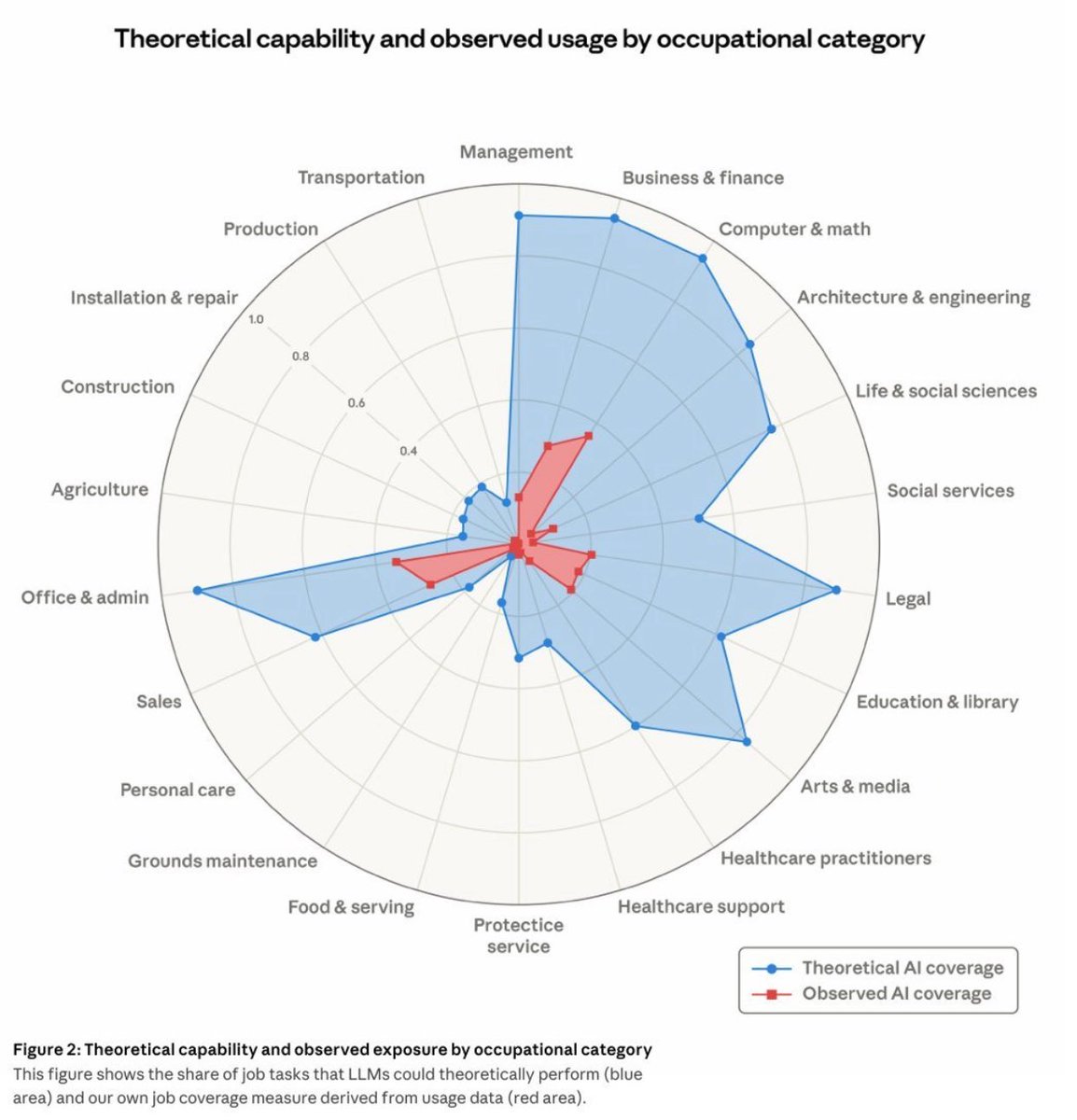
Anthropic shows the occupations that LLMs are MOST capable of replacing:
▫️business, finance, computer, engineering, legal, education, arts, media
The LEAST capable:
▫️transportation, installation, repair, construction, agriculture, personal care, maintenance, food service
It’s all fun and games to increase "efficiency" with AI right now, but the industry will wake up in a few years and realize a junior isn’t just a line item; they’re the only way to ensure your talent pipeline doesn't go extinct.
"Just start a company" isn't a scalable career path for the majority of people. We need structured internships and companies willing to hire apprentices, or we’re just trading long-term institutional knowledge for a temporary boost in this quarter's margins.
As a former daily Twitter/X user, I took the last year to lock in and log off. Here’s what I’ve learned:
1. This algo is too good. You can no longer hit the end of your feed; it's a constant stream tailored just for you. Don’t lose track of what’s right around you IRL.
2. The human brain is not meant to handle all the world’s problems every day. This app makes you feel overwhelmed and exhausted. Use it in moderation.
3. People on this app suddenly become experts in every "right-now" thing. It’s okay to not suddenly be a current events expert; it’s okay to say nothing.
4. It’s a great networking tool. I only used LinkedIn during my time away, and that place is just vapid and boring. People actually share industry expertise and connect here.
5. There is so much helpful info to learn on Twitter/X. Industry leaders are talking about their experiences, new tech, and breaking news. It’s cool.
6. Elon, chill with the tweeting. Touch some more grass (or metal in the factory). It was way easier to be a fan of your work when I didn't see every thought that crosses your mind.
I take 8+ enrollment calls a day in the industry and the biggest hurdle isn't awareness or the will to do this work anymore, it's a structural bottleneck.
Even with the best training, people hit a wall of state licensing ratios and "logged hour" requirements that AI can't fix. You’re legally required to have years of work under a licensed contractor and those jobs can be seasonal or hard to land.
I just broke down the type of UCLA Medical-style model we would need to bridge the gap: https://t.co/R0ZSKoFoqe
I take 8+ enrollment calls a day from people trying to break into the trades.
The feedback from the ground is clear: The system is broken. We aren't just facing a "skills gap"—we’re facing a structural bottleneck that’s crushing high-intent talent. 🧵
We’re losing elite talent to a fragmented system. To fix the trades, we must bridge the chasm between "finishing school" and "getting licensed."
Otherwise, we’re just selling dreams that die in a bottleneck. AI can accelerate your knowledge, but it can't log your hours, the government still demands years on a job site, and that reality isn't changing anytime soon.
I take 8+ enrollment calls a day from people trying to break into the trades.
The feedback from the ground is clear: The system is broken. We aren't just facing a "skills gap"—we’re facing a structural bottleneck that’s crushing high-intent talent. 🧵
We need a model like UCLA + UCLA Medical. Doctors don't just graduate and hope a random clinic hires them to finish their training. They have a built-in residency. The trades need a system where graduates can continue to work and log hours without being 100% dependent on private contractors.