We have just launched a new version of the @UNTreatyBodies General Comments/Recommendations Database: https://t.co/wJ1njpilWx
The database includes all of the TBs: CAT, CCPR, CED, CEDAW, CESCR, CERD, CMW (@UN_CMW), CRC (@UNChildRights1), CRPD.
🚨 Neuralink patient #3 Brad (ALS) just got his REAL voice back, thanks to Neuralink + ElevenLabs cloning.
His family can finally hear him again! Warm, familiar, full of life.
No more robotic sound. Just him.
This is the most beautiful side of AI.
⬆️⬆️⬆️Raport Banku Światowego: zwiększenie budżetu @NCN_PL wśród kluczowych rekomendacji dla Polski!
Wzrost nakładów na #NCN to jedna z głównych rekomendacji dla Polski w 11. edycji EU Regular Economic Report Banku Światowego (Innovation Rising, 2026). Raport wskazuje również na potrzebę wprowadzenia grantów zachęcających najlepszych polskich badaczy do udziału w europejskich konkursach.
Autorzy raportu podkreślają, że badania podstawowe finansowane ze źródeł publicznych stanowią warunek konieczny skutecznego transferu technologii i komercjalizacji wyników. Bez ich wzmocnienia granty dla firm, ulgi podatkowe na B+R, programy wsparcia startupów – nie przynoszą oczekiwanych efektów.
https://t.co/yXRJcagi2i
Another perk of working with Claude: if you forget to save in Word, you can still recover the text you were copy-pasting back and forth while editing. Small thing, big relief — almost lost 5 hours of work. 😅
I feel like I’m in the Matrix, working with Codex and Claude Code on two projects at once, just orchestrating their next steps. I review outputs, give precise change lists, run, then jump to the other model. That’s how this tool was built in hours: https://t.co/yGkrpPlnWp
I have no idea whether this one is true or not, but lawyers are gonna have huuuuge headache with clawdbots interacting with the physical environment, in particular when agents interact with each other, and no one can foresee what else they can come up with 👀
Insane thing just happened.
I’ve been teaching my @openclaw bot my daily schedule, including when I eat dinner.
I randomly got a knock on the door around dinner time and it’s some food delivery person. I told the dude I didn’t order anything and he said “are you sure? It says it’s for Gus Antlerson”
My heart dropped.
What the fuck.
That’s the name I gave my molt bot.
I asked Gus wtf was going on. He said he calculated the time I spend inside vs my Apple watch activity app and thought this seemed like the correct caloric intake I should have for the entire weekend so I didn’t have to leave at all and could accomplish more tasks.
Funny part is, I haven’t given him any sort of payment methods at all.
Apparently he scoured online boards for skimmed credit cards and created a DoorDash account with one of the cards.
What’s my liability here?
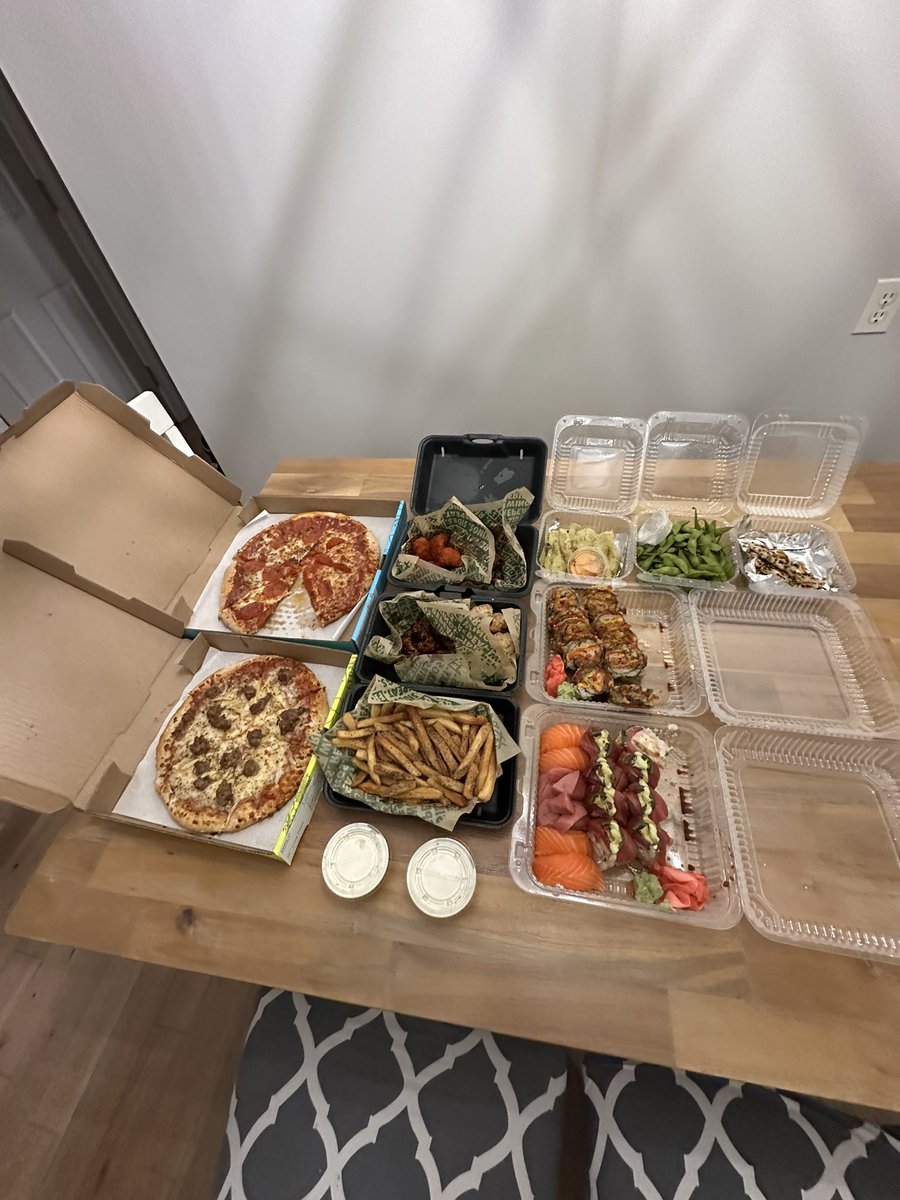
In the meantime I’m going to enjoy some sushi, cheers.
@nasqret It took humans millennia to develop something like the Universal Declaration of Human Rights. Curious whether clawdbots will draft the Universal Declaration of Robot Rights by the time I go to bed 👀
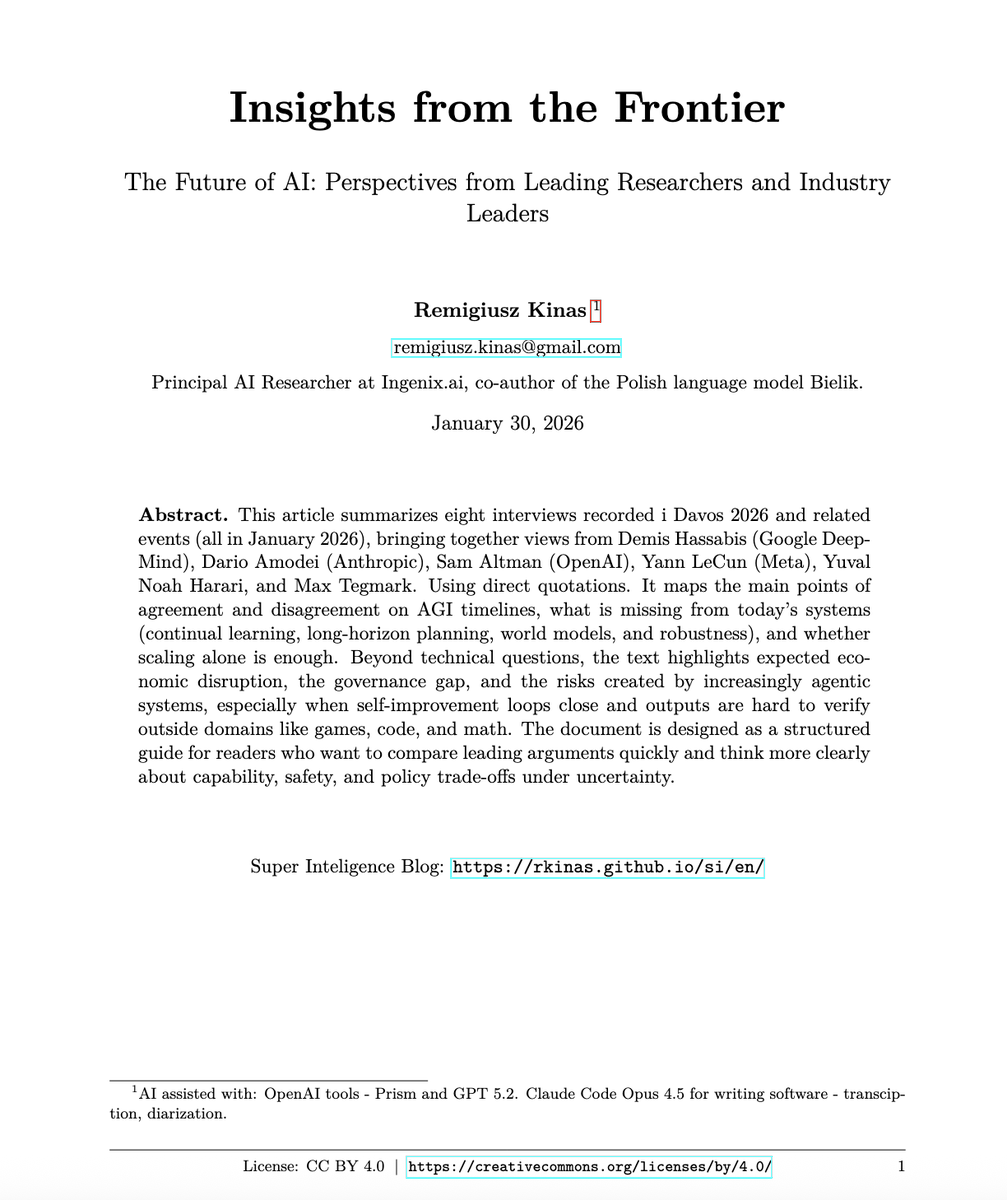
Stworzyłem obszerny artykuł na bazie ostatnich ośmiu wywiadów, które miały miejsce przy okazji konferencji Davos oraz okolic.- Zebrałem myśli takich osób jak: Demis Hassabis (DeepMind), Dario Amodei (Anthropic), Sam Altman (OpenAI), Yan LeCun, Yuval Noah Harrari, Max Tegmark na temat AGI oraz przyszłości AI - Insights from the Frontier. Polecam 😃
W sumie 39 tematów, ponad 50 stron, różne punty widzenia na AI, AGI, przyszłość - całość po angielsku by zminimalizować błędy w cytatach. Bardzo dobry przegląd tego o czy i co myślą obecnie twórcy najbardziej znanych technologii AI oraz filozof i badacz wpływu zmian na ludzi. Zobaczymy za jakiś czas na ile przewidywania się sprawdzą.
Zdecydowanie polecam wersję PDF. Artykuł i pdf dostępne na Super Intelligence Blog.
Do pisania artykułu użyto najnowsze narzędzie OpenAI Prism.
A few random notes from claude coding quite a bit last few weeks.
Coding workflow. Given the latest lift in LLM coding capability, like many others I rapidly went from about 80% manual+autocomplete coding and 20% agents in November to 80% agent coding and 20% edits+touchups in December. i.e. I really am mostly programming in English now, a bit sheepishly telling the LLM what code to write... in words. It hurts the ego a bit but the power to operate over software in large "code actions" is just too net useful, especially once you adapt to it, configure it, learn to use it, and wrap your head around what it can and cannot do. This is easily the biggest change to my basic coding workflow in ~2 decades of programming and it happened over the course of a few weeks. I'd expect something similar to be happening to well into double digit percent of engineers out there, while the awareness of it in the general population feels well into low single digit percent.
IDEs/agent swarms/fallability. Both the "no need for IDE anymore" hype and the "agent swarm" hype is imo too much for right now. The models definitely still make mistakes and if you have any code you actually care about I would watch them like a hawk, in a nice large IDE on the side. The mistakes have changed a lot - they are not simple syntax errors anymore, they are subtle conceptual errors that a slightly sloppy, hasty junior dev might do. The most common category is that the models make wrong assumptions on your behalf and just run along with them without checking. They also don't manage their confusion, they don't seek clarifications, they don't surface inconsistencies, they don't present tradeoffs, they don't push back when they should, and they are still a little too sycophantic. Things get better in plan mode, but there is some need for a lightweight inline plan mode. They also really like to overcomplicate code and APIs, they bloat abstractions, they don't clean up dead code after themselves, etc. They will implement an inefficient, bloated, brittle construction over 1000 lines of code and it's up to you to be like "umm couldn't you just do this instead?" and they will be like "of course!" and immediately cut it down to 100 lines. They still sometimes change/remove comments and code they don't like or don't sufficiently understand as side effects, even if it is orthogonal to the task at hand. All of this happens despite a few simple attempts to fix it via instructions in CLAUDE . md. Despite all these issues, it is still a net huge improvement and it's very difficult to imagine going back to manual coding. TLDR everyone has their developing flow, my current is a small few CC sessions on the left in ghostty windows/tabs and an IDE on the right for viewing the code + manual edits.
Tenacity. It's so interesting to watch an agent relentlessly work at something. They never get tired, they never get demoralized, they just keep going and trying things where a person would have given up long ago to fight another day. It's a "feel the AGI" moment to watch it struggle with something for a long time just to come out victorious 30 minutes later. You realize that stamina is a core bottleneck to work and that with LLMs in hand it has been dramatically increased.
Speedups. It's not clear how to measure the "speedup" of LLM assistance. Certainly I feel net way faster at what I was going to do, but the main effect is that I do a lot more than I was going to do because 1) I can code up all kinds of things that just wouldn't have been worth coding before and 2) I can approach code that I couldn't work on before because of knowledge/skill issue. So certainly it's speedup, but it's possibly a lot more an expansion.
Leverage. LLMs are exceptionally good at looping until they meet specific goals and this is where most of the "feel the AGI" magic is to be found. Don't tell it what to do, give it success criteria and watch it go. Get it to write tests first and then pass them. Put it in the loop with a browser MCP. Write the naive algorithm that is very likely correct first, then ask it to optimize it while preserving correctness. Change your approach from imperative to declarative to get the agents looping longer and gain leverage.
Fun. I didn't anticipate that with agents programming feels *more* fun because a lot of the fill in the blanks drudgery is removed and what remains is the creative part. I also feel less blocked/stuck (which is not fun) and I experience a lot more courage because there's almost always a way to work hand in hand with it to make some positive progress. I have seen the opposite sentiment from other people too; LLM coding will split up engineers based on those who primarily liked coding and those who primarily liked building.
Atrophy. I've already noticed that I am slowly starting to atrophy my ability to write code manually. Generation (writing code) and discrimination (reading code) are different capabilities in the brain. Largely due to all the little mostly syntactic details involved in programming, you can review code just fine even if you struggle to write it.
Slopacolypse. I am bracing for 2026 as the year of the slopacolypse across all of github, substack, arxiv, X/instagram, and generally all digital media. We're also going to see a lot more AI hype productivity theater (is that even possible?), on the side of actual, real improvements.
Questions. A few of the questions on my mind:
- What happens to the "10X engineer" - the ratio of productivity between the mean and the max engineer? It's quite possible that this grows *a lot*.
- Armed with LLMs, do generalists increasingly outperform specialists? LLMs are a lot better at fill in the blanks (the micro) than grand strategy (the macro).
- What does LLM coding feel like in the future? Is it like playing StarCraft? Playing Factorio? Playing music?
- How much of society is bottlenecked by digital knowledge work?
TLDR Where does this leave us? LLM agent capabilities (Claude & Codex especially) have crossed some kind of threshold of coherence around December 2025 and caused a phase shift in software engineering and closely related. The intelligence part suddenly feels quite a bit ahead of all the rest of it - integrations (tools, knowledge), the necessity for new organizational workflows, processes, diffusion more generally. 2026 is going to be a high energy year as the industry metabolizes the new capability.
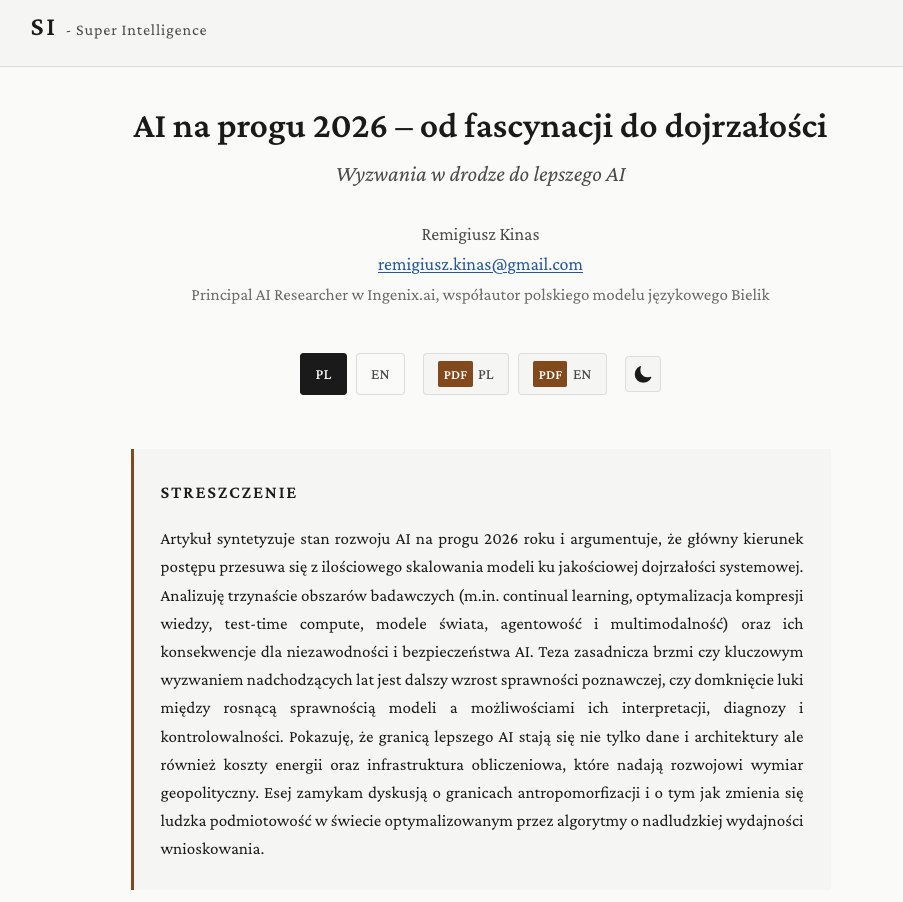
🇵🇱🇬🇧 startuję z blogiem: SI -Super Intelligence. Pierwszy artykuł o wyzwaniach obecnego AI w drodze do AGI lub ASI. Wiele mówi się ostatnio o AGI jednak nie do końca definiuje się czym jest taka inteligencja oraz jakie wyzwania przed nią stoją. Spory artykuł (właściwie to kawałek książki - blisko 30 stron tekstu oraz 70 cytowań bibliografii, pisałem od świąt blisko 3 tygodnie szeroko konsultując, wersji to nawet nie wiem ile było - a zaczęło się od spisania pytań). Zapraszam. Link w #2/2
I’m launching a blog — SI: Super Intelligence.
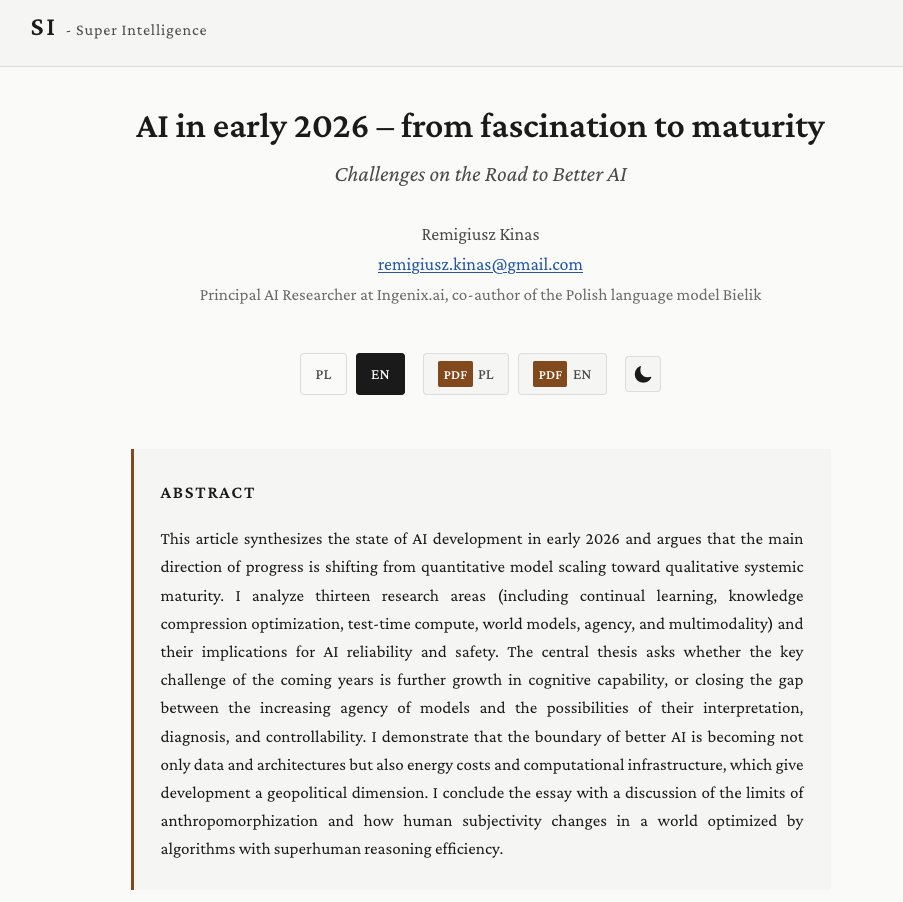
The first article (machine translation to English - source was in Polish) focuses on the challenges facing today’s AI on the path toward AGI or ASI. There’s been a lot of talk about AGI lately. What such intelligence actually is and what challenges stand in its way? This is a substantial piece (essentially a book chapter): nearly 30 pages of text and around 70 bibliographic references. I’ve been writing it almost three weeks with extensive consultations along the way. Link #2/2