A month ago, support was eating my days. So, for the past month, I’ve been training Claude to handle support for a live product I own.
I gave Claude all our SOPs, guides, and artifacts, and taught it how I answer and handle edge cases. I call it MyDay Support.
Now, twice a day, I type one word: support. That's it. It goes through the channel, finds every open question, and replies for me. No drafts. No copy-paste. It just answers.
35+ replies in the last two weeks alone.
The thing that made it work was one simple goal I gave it: "Double-check every answer against our SOPs before it goes out."
And honestly? Some answers are better than mine. Clearer. More patient. Always with the exact steps.
I got my time back. And my team gets answers faster than ever.
Next step: turning it into an agent in Akai, so it runs completely on its own.
What would you hand over to AI if you could?
This story got me.
@natfriedman told his AI agent he wanted to drink more water.
So it started watching him on his home security cameras. And every time he drank, it told him “good job.” 😅
He said it felt somewhere between terrifying and euphoric.
@alexandr_wang heard about it and wrote a memo saying this is probably where consumer AI is going.
Two weeks later, Meta had the first prototype of Muse.
Honestly, I don’t know if I’d want an AI watching me like that.
But I can’t stop thinking about it either.
Meta built the first prototype of Muse in just 2 weeks.
It started with @natfriedman going “all in” on OpenClaw.
“He had an experience I would describe as somewhere between terrifying and euphoric.”
“He told his OpenClaw that he wanted to drink more water, and then his OpenClaw would watch him in security footage to make sure that he was drinking water and tell him good job.”
@alexandr_wang says he wrote a memo about how this was likely going to become the “final consumer product.”
“Many of the decisions that made its way into the final Muse product were present in the first prototype.”
Lessons from @elonmusk and Mark Zuckerberg and Napoleon:
“Elon has demonstrated that if you have a small, incredibly cracked, highly technical team, that's very flat, you can accomplish a lot very quickly.”
“Mark has internalized that failure doesn't matter. It just matters when you win, how big you win.”
“That concept enables Mark to operate without fear because he’s just very comfortable taking lots of risk.”
“Mark has this great quote that says: The biggest risk is not taking any risk. In a world that's changing the only strategy that is guaranteed to fail is not taking risks.”
“In the book The Mind of Napoleon, Napoleon repeats that hesitation is fatal. Napoleon says before you engage in a course of action you should deliberate thoroughly. He'd study from every angle to make sure he's making the right decision. But once he’s sure he’s on the right path, he goes all in. I feel there's an echo with the way Mark operates. Once Mark knows what he wants to do, he empties the clip.”
Same rule works in product.
The best teams aren’t the ones with the perfect plan. They’re the ones who ship, learn and ship again the fastest.
And nobody plays that game faster than @elonmusk . Rockets, cars, robots, and now chips.
Terafab is that idea at the hardest possible scale: design, build, test and improve, all under one roof.
Honored to be named a Deel Values Champion this quarter.
A big thank you to our Payroll Off-cycle team and to our leaders for the guidance and support. This one belongs to all of us.
Today, most companies treat AI the same way. A chatbot here, a tool there.
Somewhere right now, a company is laughing off its own Netflix.
Don't be Blockbuster. Try Akai: https://t.co/a7JPL7PndM
In 2000, Blockbuster had the chance to buy Netflix for $50 million.
They laughed it off.
The internet was just a website, they thought. A nice extra. The real business was still in the stores.
Ten years later, Blockbuster was bankrupt.
I keep thinking about that story, because I think we're living the same moment again.
Today 88% of companies use AI somewhere. But fewer than half have it running across the whole business.
For most, AI is still "the website." A chatbot here, a tool there. Something nice to have.
And somewhere right now, a company is laughing off its own Netflix.
I see the other side every day at Deel. With Akai, AI agents now do work that used to take whole teams. Not as a feature. As the system the company runs on.
The internet didn't wait for anyone who wasn't ready.
AI won't either.
If you want to see what that looks like in your own company, try Akai: https://t.co/sPDSDmyvbu
Is AI a tool in your company, or the system you run on?
Most companies need two weeks or even months😅, three interviews and an approval chain to hire one person.
@elonmusk did it in one conversation. On a Saturday. At 6 PM.
Speed isn't a process. It's a decision.
Most companies take two weeks to do what @elonmusk does in an hour. Elon hired a machinist, negotiated his salary, and had him start — all in one conversation. On a Saturday at 6 PM.
I love Claude. Especially artifacts.
As a PM, a big part of my job used to be documentation.
SOPs, test cases, guides. Hours of work, and most of it was outdated a week later.
Lately, I started building everything as Claude artifacts instead.
Our epic board is a live page my PM colleagues and I share. Everyone sees who's working on what, what's in QA, and what's next. No more overlap.
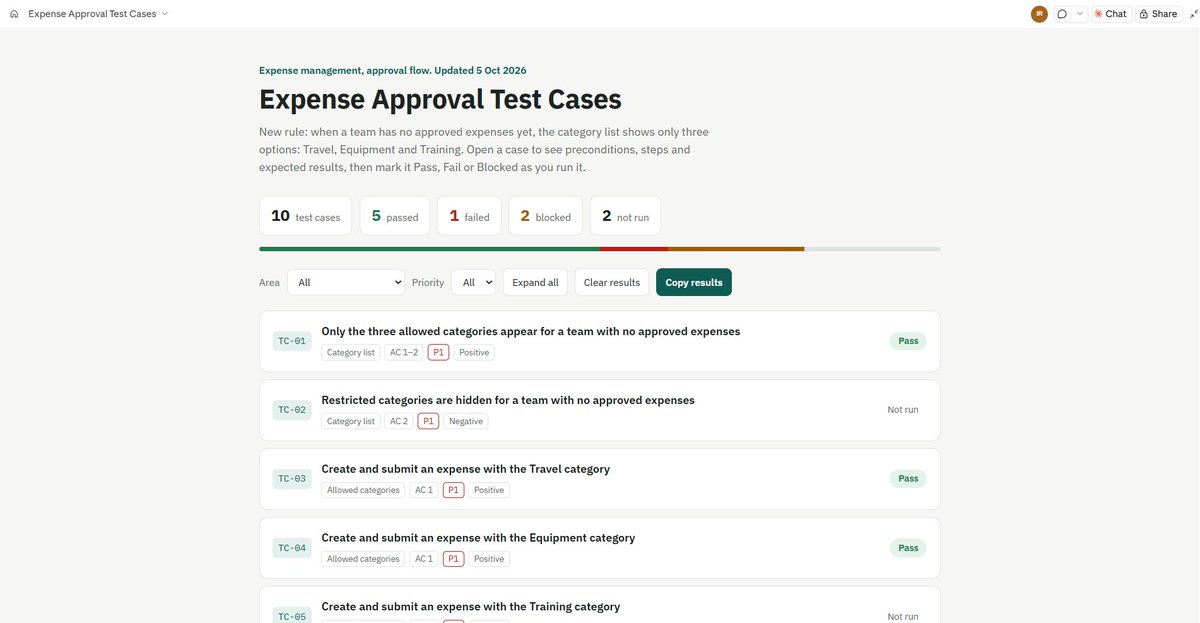
Our test cases are live too. QA ticks them off, and everyone sees right away what passed, what failed and what's still left. No more "which spreadsheet is the latest one?" 😅
Our SOPs are interactive and dynamic now. You click through them step by step, they show you only what's relevant to your case, and when the process changes, I update them in minutes. No more long docs nobody reads.
And for me personally, my own to-do list. I built it in a few hours, exactly the way I like to work.
The thing I like most: we work on it together. Everyone sees the same data, in real time.
And when someone says "it would be nice if it could also do this", I just ask Claude, and a few minutes later it's there.
I'm not a developer. I just explain what we need.
Honestly, I don't think I'll go back to static docs.
What would you build for your team first?
Epic board, test cases, interactive SOPs, even my personal to-do list. All live, and my team works in them together. Need a new feature? I ask Claude, and a few minutes later it's there.
The US now has a "Super Intelligence Force."
Led by the Director of National Intelligence.
When AI moves into the intelligence world, it's no longer a tech story. It's a national security story.