$NVDA AI dominance is creating a massive opportunity well beyond Nvidia itself as billions flow through foundry, HBM, testing, packaging and server assembly
Here’s who has the most exposure to Nvidia today:
• $TSM 37%
• $SKHY 27%
• $MU 14%
• $TER 8%
• $ASX 3%
• $FN 1%
• $AMKR 1%
• $CSCO 1%
I also think the wild part is that Nvidia now spends more on HBM than on the wafers themselves and roughly a quarter of its revenue equivalent on test equipment which says a lot about how important memory, yield and validation have become at these die sizes.
50 Sitios Web de los que No Podrás Salir Durante Horas Una Vez que Entres
1.) 'https://t.co/jzL26i024b' — Observar el mundo con imágenes satelitales en vivo
2.) 'https://t.co/cqb8qJ5Dwy' — Ver todos los aviones en el cielo en este momento
3.) 'https://t.co/NTP5ebhGEc' — Academia de IA para todas las edades
4.) 'https://t.co/Ty7RCAhpA0' — Mapa en vivo de vientos y tormentas
5.) 'https://t.co/IPnWot81h2' — Observar en tiempo real los rayos que caen en el mundo
6.) 'https://t.co/Eeaa7SSR0h' — Lista en vivo de los últimos terremotos
7.) 'https://t.co/24WP7LoutN' — Cables submarinos que transportan internet
8.) 'https://t.co/O0MxoJtqW8' — Observar la deforestación de los bosques desde satélite
9.) 'https://t.co/ak5Bc2aoKM' — Estadísticas del mundo actualizadas segundo a segundo
10.) 'https://t.co/RFGnthoD9o' — Número de tweets y búsquedas en este momento
11.) 'https://t.co/yD9bEMzsEg' — Comparar los tamaños reales de los países
12.) 'https://t.co/zPpoBjTGLM' — Mapas de hace siglos
13.) 'https://t.co/NSUuRwyroP' — Archivo de 150 mil mapas históricos
14.) 'https://t.co/uVuaUGPjVh' — Mapa mundial dibujado por voluntarios
15.) 'https://t.co/6wPJdwNNa3' — Mirar el mundo desde la ventana de alguien al azar
16.) 'https://t.co/udPg7KiLo5' — Paseos virtuales por ciudades
17.) 'https://t.co/7Cln3yK2tT' — Teletransportarse a un punto aleatorio del mundo
18.) 'https://t.co/XXMio42dqU' — Catálogo de los lugares más extraños del mundo
19.) 'https://t.co/xxjISC6njF' — Experiencias interactivas de conocimiento
20.) 'https://t.co/9lqs8w5icr' — Viaje a escala desde el átomo hasta el universo
21.) 'https://t.co/IvXRNQsPRi' — Explorar el sistema solar en 3D
22.) 'https://t.co/qtSz0kXse7' — Mapa real del cielo en el navegador
23.) 'https://t.co/qQvk25UpID' — La foto astronómica del día de la NASA
24.) 'https://t.co/wOUDsYWRqG' — Todo el archivo visual de la NASA gratis
25.) 'https://t.co/yrDJD7RCoS' — Artículos visuales narrados con datos
26.) 'https://t.co/2P4sHiNeS6' — El estado del mundo con datos reales
27.) 'https://t.co/OfbmZ7T4kf' — Lo que creemos saber erróneamente sobre el mundo
28.) 'https://t.co/1KE8LKfmd9' — Visualizar datos complejos
29.) 'https://t.co/YjpLudEIDm' — Datos abiertos del Banco Mundial
30.) 'https://t.co/5ek9DPJKqZ' — Base de datos oficial de estadísticas de Turquía
31.) 'https://t.co/BmDGWDdPQC' — Archivo de millones de libros, películas y software
32.) 'https://t.co/22qRI6GdQ0' — 70 mil libros gratuitos con derechos de autor expirados
33.) 'https://t.co/aIkeBiAFEI' — Registro de todos los libros del mundo
34.) 'https://t.co/NrOvLdXIdR' — Archivo digital de la Biblioteca del Congreso de EE.UU.
35.) 'https://t.co/hnkGN9oQj3' — Archivo del patrimonio cultural de Europa
36.) 'https://t.co/QBSIMabP4g' — Colección de biblioteca digital de América
37.) 'https://t.co/M5kLMnpdji' — Recorrer museos desde casa
38.) 'https://t.co/CQgBLaPOBP' — Descargar obras de arte en alta resolución
39.) 'https://t.co/woOBcLVwAA' — Archivo de 250 mil obras de arte
40.) 'https://t.co/V0OWpA2M1h' — Tesoros visuales olvidados de la historia
41.) 'https://t.co/eiFR66pX21' — Archivo gratuito de cultura y educación
42.) 'https://t.co/ti5jKF3VXm' — Colección abierta del Museo Metropolitano
43.) 'https://t.co/sxiKxAe5EB' — Árbol genealógico de los géneros musicales
44.) 'https://t.co/SxZW8nULFp' — Seleccionar país y década para escuchar esa era
45.) 'https://t.co/GEDdbupuyg' — Convertir ediciones de Wikipedia a audio
46.) 'https://t.co/rWUJuFSpQO' — Pozo de conocimiento aleatorio
47.) 'https://t.co/RmfoqmuFVG' — Tiempo, amaneceres y eventos celestes
48.) 'https://t.co/TUlXyM03Vg' — Flujo actual de noticias científicas
49.) 'https://t.co/r8etB8il4H' — Preimpresiones gratuitas de artículos científicos
50.) 'https://t.co/yVyzNYjZIQ' — Visualizar datos con código en vivo
Internet no se limita a esos cinco sitios que el algoritmo pone frente a ti.
Alfabetización Geocientífica • #Sismos
CÁTEDRA LIBRE DE CIENCIAS DE LA TIERRA
Lo prometido es deuda. Y pronto comenzamos.
Cuando propuse crear esta Cátedra Libre de Ciencias de la Tierra lo hice con un propósito muy claro, acercar las geociencias a la gente y que la ciudadanía se apropien del conocimiento.
Quiero que aprendamos a mirar el territorio de otra manera. A entender qué ocurre bajo nuestros pies, cómo funciona nuestro planeta, por qué "tiembla", por qué se producen deslizamientos, cómo se forman nuestras montañas, qué información guarda el subsuelo, que recursos tenemos y nos ocultan y, sobre todo, cómo ese conocimiento puede ayudarnos a convivir mejor con los procesos naturales.
Mi objetivo es darles las herramientas básicas para comprender cómo funciona nuestro planeta, para que nadie pueda engañarlos con falsas explicaciones ni ocultarles lo que ocurre bajo nuestros pies. Aprenderemos a distinguir ciencia de especulación, a buscar evidencias y a entender que conocer la Tierra es también aprender a protegernos y a protegerla.
Y para comenzar, he querido hacerlo hablando precisamente de prevención.
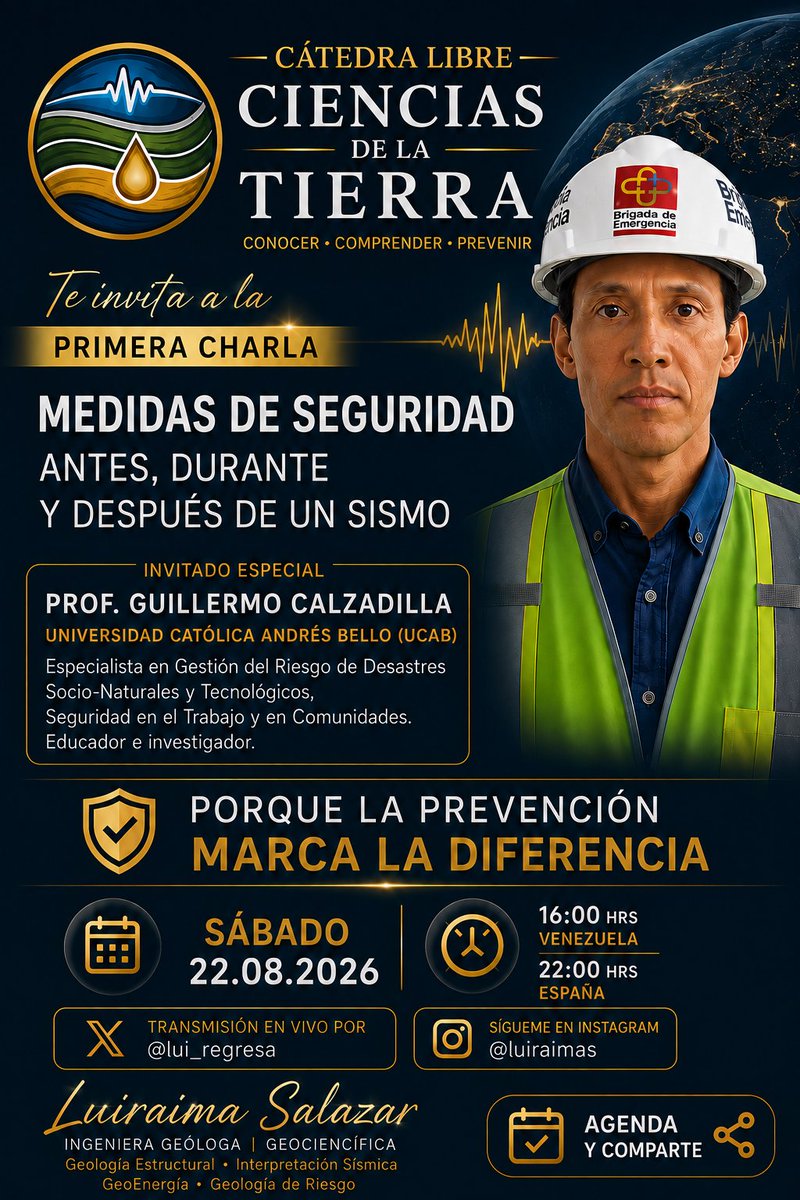
Este sábado 22.08.2026 tendremos nuestra charla inaugural:
MEDIDAS DE SEGURIDAD ANTES, DURANTE Y DESPUÉS DE UN SISMO
Nuestro invitado será el Prof. Guillermo Calzadilla, de la Universidad Católica Andrés Bello (UCAB), especialista en Gestión del Riesgo de Desastres Socio-Naturales y Tecnológicos, Seguridad en el Trabajo y Comunidades.
📆 Sábado 22.08.2026
🕓 16:00 h • Venezuela
🕙 22:00 h • España
📍 En vivo por X: @lui_regresa
📒 Material por IG: @luiraimas
Esta Cátedra nace para enseñar, divulgar, preguntar, compartir y construir conocimiento accesible para todos.
Porque los terremotos no podemos impedirlos ni mucho menos predecirlos, pero sí podemos aprender a reducir nuestra vulnerabilidad. Porque la prevención marca la diferencia.
Los espero.
Ing. Geóloga Luiraima Salazar
__________
El link del Spaces será publicado el próximo viernes 21.08. Estén pendiente para agendarlo.
This morning's magnitude 7.4 earthquake in Colombia caused strong shaking across western Columbia. An estimated 1.5 million people experienced shaking near intensity 7, strong enough to cause damage to unreinforced masonry buildings especially. The earthquake occurred at a depth of ~100 km, within the slab of old seafloor sinking beneath the South American continent. These so-called intermediate depth, interslab earthquakes are less dangerous than shallow earthquakes of the same magnitude because the fault break is farther from the earth's surface. But these faults also break in a way that releases energy at frequencies that are damaging to buildings. Intermediate depth earthquakes tend to have fewer aftershocks than more shallow quakes, but strong aftershocks are possible and pose a continuing hazard during rescue and recovery.
For more information about this and other earthquakes, see https://t.co/treLGBJizy
Map shows estimated distribution of shaking from the 10 August 2026 Colombia earthquake
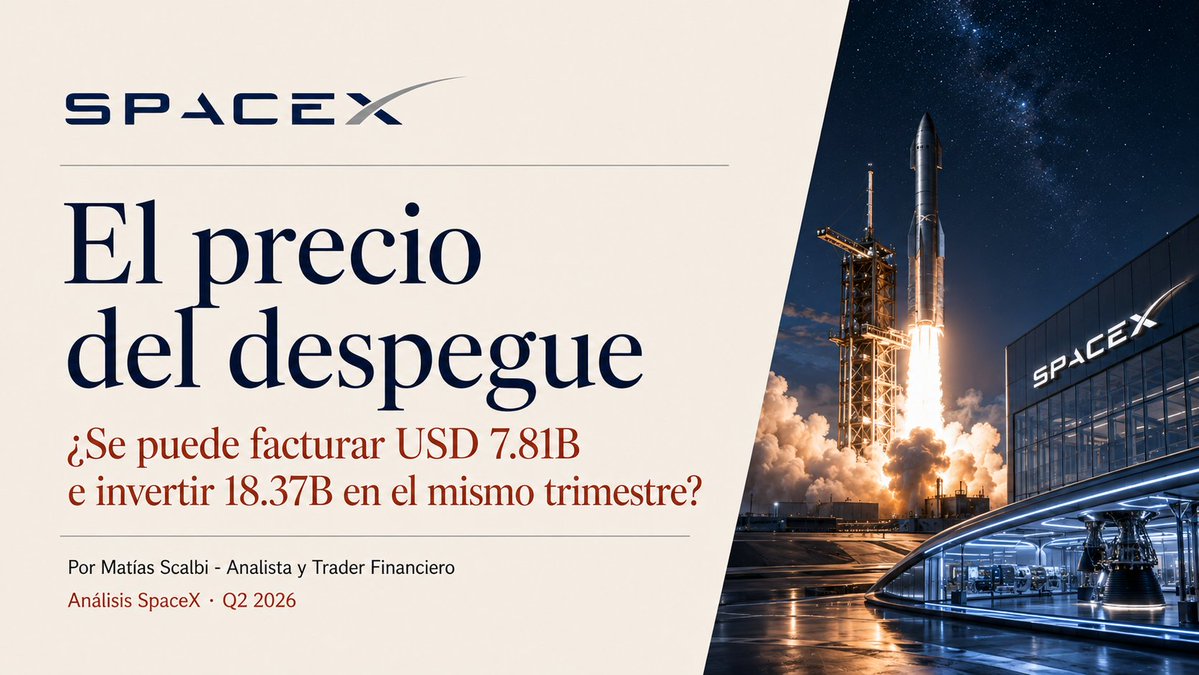
$SPCX reportó su primer balance 🔥
Ingresos +92%, el mejor trimestre de su historia
Starlink duplicó usuarios hasta 12 millones
Capex de IA: USD 15.83B en un solo trimestre
Pero cae -7% en el after. La respuesta está en dos renglones que casi nadie leyó
Te explico todo👇🏼
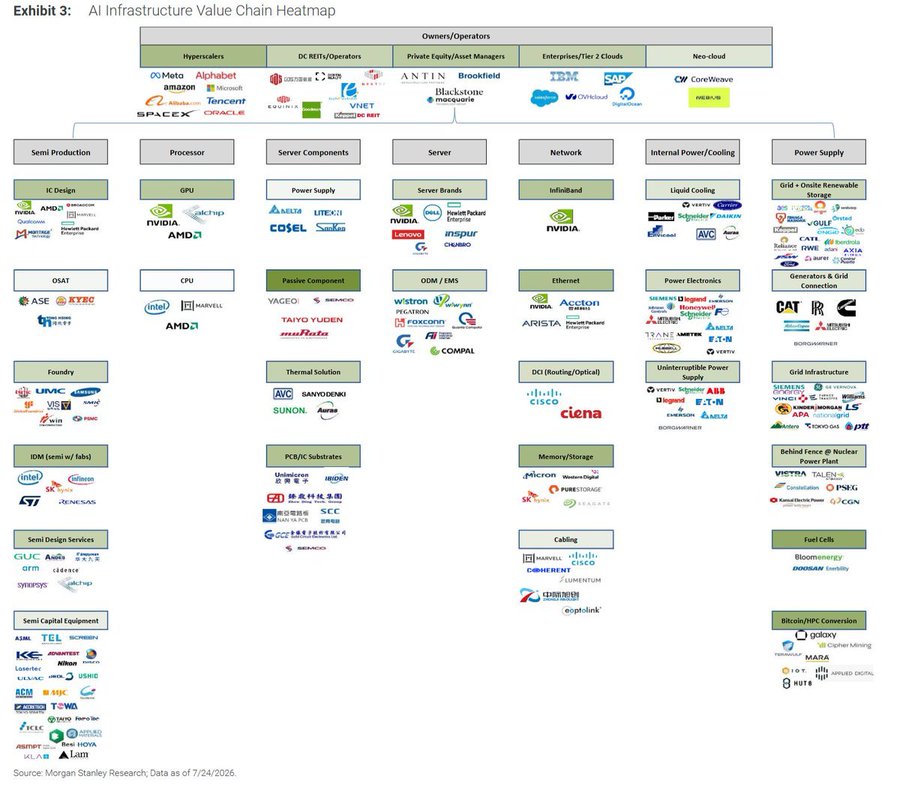
Morgan Stanley mapped out the entire AI infrastructure supply chain and it reveals who actually gets paid at every layer of the trillion dollar buildout (Save this).
This heatmap breaks the AI infrastructure value chain into two dimensions those who owns and operates the data centers at the top and what physical and technical components get built underneath to make those data centers function.
At the top sit the owners/operators, the hyperscalers like Meta, Alphabet, Amazon and Microsoft, alongside data center REITs, private equity giants like Blackstone and Brookfield, enterprises and neoclouds including CoreWeave and Nebius.
These are the companies writing the massive capex checks that fund everything below them.
Below that sits the actual build out, split into seven layers, semi production, processors, server components, servers, network, internal power/cooling and power supply.
Semiconductor production is dominated by names your audience already knows well, Nvidia and AMD for GPUs, TSMC adjacent foundries, ASML and Applied Materials for capital equipment, and Micron and SK Hynix under memory/storage.
But the less obvious money is in the physical infrastructure layers most retail investors never look at.
Server components include passive parts from Yageo and Murata, thermal solutions from Sanyo Denki, and PCB substrates from companies like Unimicron.
Network infrastructure includes InfiniBand and Ethernet gear from Nvidia and Arista, plus optical/DCI routing from Cisco and Ciena.
Internal power and cooling is arguably the most underappreciated category here.
It includes liquid cooling specialists like Vertiv and CoolIT, power electronics from Siemens and Eaton, and uninterruptible power supply makers like ABB and Legrand, all companies solving the literal heat and electricity problem created by cramming more GPUs into less space.
So who benefits from all of this?
Everyone in every box benefits in some way but the real insight is that value doesn't concentrate at just the GPU layer anymore.
The hyperscalers at the top are distributing capex across seven distinct physical layers which means the picks and shovels opportunity set has expanded well beyond Nvidia into cooling, grid infrastructure, and power generation.
Bullish on AI infrastructure, make sure to follow @MelvinInvests for more AI infrastructure insights, and if you want to see exactly what I'm buying as an analyst at Milk Road Pro, you can check out the link below for more.