Many of you sent me messages or left comments with more papers linking economic growth and directional selection. Thanks very much!
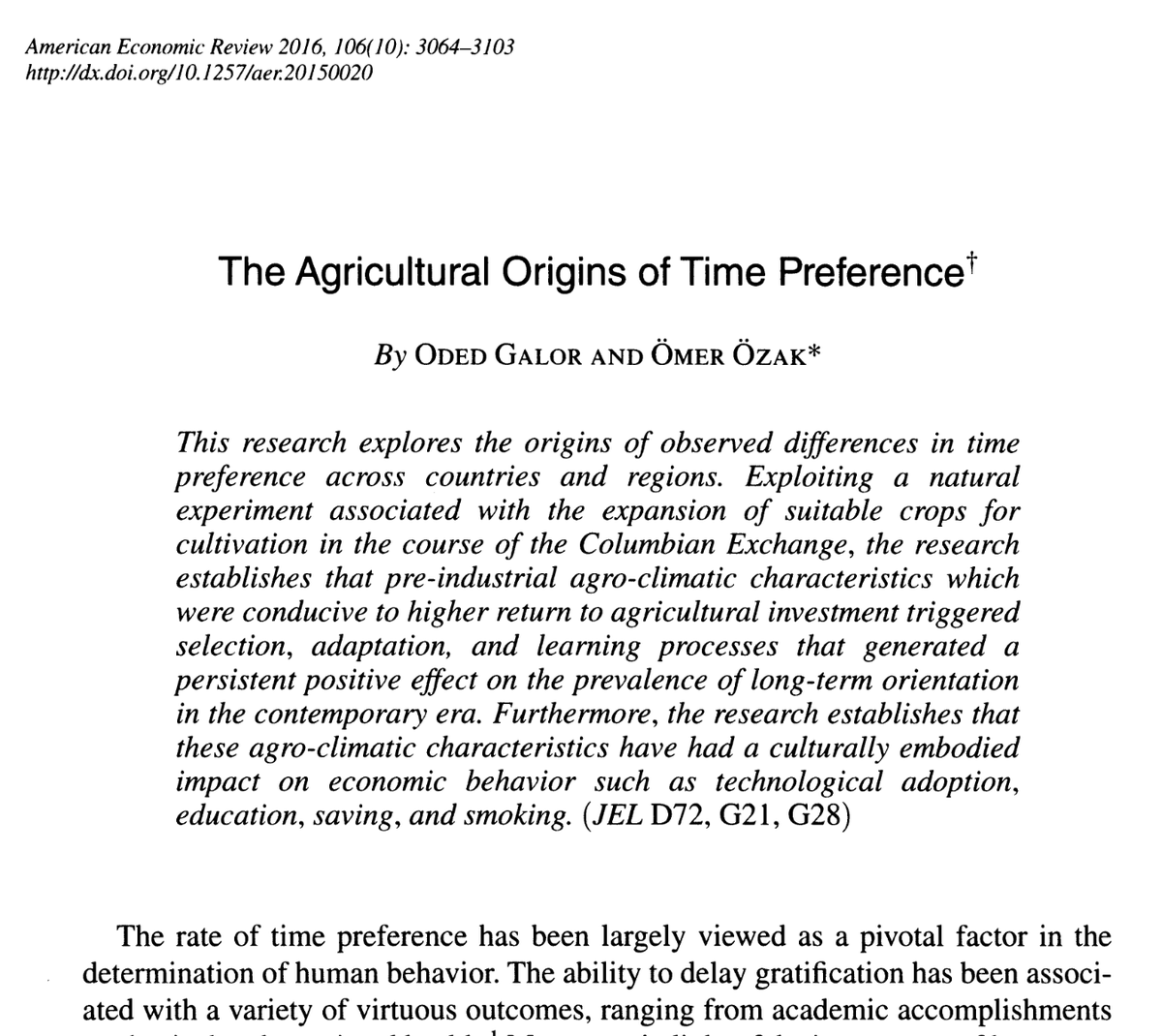
Oded Galor, @GalorOded, reminds me, in particular, of his paper with Ömer Özak, @OmerOzakEcon, in the AER, “The Agricultural Origins of Time Preference,” which links pre-industrial agro-climatic conditions favorable to higher returns to agricultural investment with a persistent positive effect on long-term orientation today. This is at the core of yesterday’s discussion.
Omer Moav, @Omer_Moav, posts a short review of recent findings:
https://t.co/TKnKjLEad2
and a discussion of the relation with Gregory Clark’s (@GregoryClarkUCD) “A Farewell to Alms.”
I apologize to Gregory for not mentioning his book (which I use when teaching undergrads!). There was no deeper motivation than wanting to keep the post short. Unfortunately, X is not the best platform to acknowledge everyone’s contributions.
Radoslaw Stefanski (@stefanski_radek) and Alex Trew follow a similar line of argument in “Selection, Patience, and the Interest Rate” in JPE: Macro, arguing that endogenous selection on patience helps explain falling interest rates. It also predicts a long transitional rise in savings rates, generating transitional growth.
After all, selection is the ultimate driver of economic growth. We do not see much increase in the income per capita of squirrels. Without evolution, there would be no technological improvement or sophisticated division of labor (yes, among some animals, there are degrees of cultural improvement or division of labor, but nothing that sustains long-run growth). The discussion is only whether directional selection made a difference over the last few thousand years.
Paul Novosad, @paulnovosad, draws my attention to “Cognitive Endurance as Human Capital” in the QJE by Christina Brown, @christinalbrown, Supreet Kaur, Geeta Kingdon, and Heather Schofield, who show that schooling may build human capital by expanding the capacity for cognition. In particular, they document that the experience of effortful thinking itself, even when devoid of any subject content, improves general cognitive capacity. So, yes, practicing the five declensions of Latin and the three voices of Ancient Greek is probably a much more useful allocation of time than “At Lincoln Elementary, we inspire every child to become a confident, curious, lifelong learner ready to thrive in an ever-changing global community.”
There are many more papers and books, but I do not want to overextend myself. I only want to point out to young students and researchers what a vibrant field economics is.
Check the webpages of Oded, Ömer, Omer, Gregory, Radoslaw, Alex, and everyone I cited here, and you will find dozens of fascinating papers.
Also, on a personal level, I have had the good fortune to interact a bit with Oded and Omer. Both are true scholars in the best sense of the word, curious about the world and seeking to get things “right,” not just another publication. I do not always agree with their readings of the evidence, but even when I do not, I learn an immense amount from them. And guess what? It seems that time is vindicating their views.
Kanato Nakakuni, Michèle Tertilt (@TertiltMichele), and Minchul Yum (@MinchulYum) just circulated a very nice paper on the role of social norms in low fertility across the world:
https://t.co/XMn5JoTbs6
Since the role of social norms comes up often in my posts on low fertility, many readers might find this paper particularly relevant.
I was surprised by their Figure 3, which I am attaching, for the ideal number of children in the U.S. according to Gallup surveys. Not only has the ideal number been roughly stable since 1975, but it also seems to have slightly increased recently, well above current TFR and completed fertility (for those cohorts that have reached that point).
This figure reinforces my belief that what we are seeing right now in the U.S. and many other advanced economies is fertility below what many women want. Families are being constrained by high housing prices, inadequate social accommodations for childbearing, and poor work-family balance. The fact that richer households are now having more children than poorer households makes the same point.
Policy reforms that would alleviate these constraints are, therefore, liberty-enhancing. I have a personal bias toward societal arrangements that allow people to flourish and make the decisions that best fit their goals. And what I see around me are many, many policies that limit those decisions and, hence, limit the liberty to create the families that many (but not all!) seek.
A society that makes it hard for people to have the children they want is not a free society.
Which of the rationales I outlined last Tuesday for traditional higher education still hold up against AI? As I noted in a later post, the answer depends on the college-major pair. A finance degree from Wharton and a psychology degree from a commuter college are different products, so AI will affect them in very different ways, and we need to always think at the margin.
The twelve rationales fall into three categories:
🅐 Mostly resilient to AI: signaling, networking, and cultural capital at highly selective institutions, commitment for time-inconsistent students, the hold-out period for traditional-age students, proximity to the research frontier at research universities, and physical infrastructure.
🅑 Highly vulnerable: skill acquisition, topic curation, and assessment.
🅒 Entirely dependent on the college-major pair: credentialing (robust where statutory, fragile where normative), peer effects, and cultural capital (robust at selective institutions, negligible elsewhere).
Let me go through them one by one.
① Signaling. Robust at the top, irrelevant at the bottom. The signaling value of a STEM degree from an Ivy is untouched by AI, because the signal comes from admission and from the ability to complete the degree. By contrast, a degree in humanities from a non-selective institution is a weak signal, because both admission and completion are easy.
AI opens the door to alternative ways of assessing competence (for example, personalized evaluations) that may soon compete with degrees from weaker institutions. So the student who was already indifferent between attending a mid-ranked institution and entering the labor market now has a third option.
② Credentialing. The most durable rationale. You cannot practice medicine, law, or nursing without a credential, and AI does not change that. For college-major pairs where credentialing is statutory, the university’s position is secure unless AI itself creates political pressure against credentialing.
Where credentialing is a social norm rather than a legal requirement (many firms ask for a B.A. for jobs that do not need one), the norm is more fragile. AI weakens it by giving employers additional ways to assess competence.
③ Networking. Robust at residential colleges, nearly absent at commuter institutions. The networking value of a college depends almost entirely on the residential experience. At a commuter campus, where students arrive, sit in a lecture, and leave, the networking value is already minimal. AI changes nothing.
④ Peer effects in learning. The value of being challenged by smart classmates depends on the quality of the peers and on the structure of the interaction. At selective institutions with small classes, this is valuable. In large lecture courses with 400 students, the peer effect was already negligible.
⑤ Commitment. Most people are time-inconsistent. They start things and do not finish them. Coursera completion rates are below 10 percent. A university provides structure: deadlines, exams, the sunk cost of tuition, and social pressure. AI does not solve this. If anything, it makes it worse because easier access lowers the cost of quitting. You can always come back to Claude tomorrow. And tomorrow never comes. The student who needs someone to force her through econometrics at 8 a.m. still needs a college. This rationale is strongest for students who are least self-directed, which is a large share of the marginal students I discussed last Thursday.
⑥ Curation of topics. Highly vulnerable. Deciding what a well-educated economist or biologist needs to know was once one of the university’s core functions. Now AI does it very well. My Goffman study plan is a good example. Claude curated a sequence of readings, identified the key themes, and structured the material for my background. A good prompt can now produce a syllabus at least as good as what most departments offer, and better tailored to the individual. The only place curation still has real value is at the research frontier, where the knowledge is new enough that no training data fully captures it. But that is really an argument about proximity to research (see rationale ⑩ below).
⑦ Skill acquisition. The most vulnerable rationale. A student who wants to learn Python or financial modeling can now do so with Claude at a fraction of the cost and at her own pace. This was possible in the past (that is how I learned assembly language in high school), but the cost was much higher (oh, yes; learning assembly language on my own in a Spectrum was not fun, believe me) and the approach worked only in some fields. AI lowers those costs for almost everyone.
For college-major pairs where the main value proposition is skill acquisition, the pressure is clear. A mid-tier business school charging $40,000 per year to teach Excel and financial statements will quickly lose students.
⑧ Cultural capital. Robust at elite residential institutions, weak elsewhere. This is about learning how to present yourself, read a room, navigate social hierarchies you were not born into, and hold the “right” values. Four years at Yale transmit cultural capital that no AI can replicate. At a commuter campus, that transmission was already close to zero.
⑨ Hold-out period. Surprisingly robust. Most 18-year-olds are not ready to work. They do not know what they want to do, and they are not yet good at figuring it out. The university gives them a place to be while they mature. The argument is real, but it applies to residential programs serving traditional-age students. A 32-year-old commuter student does not need a holding period. But even among traditional-age students, the marginal ones are those whose families feel the cost most. If the hold-out period is the main thing a university provides, $200,000 is an expensive kindergarten for late teenagers.
⑩ Proximity to the research frontier. Robust at research universities, absent elsewhere. Learning asset pricing from John Cochrane is qualitatively different from learning it from me because he created the knowledge, and I am only transmitting it. AI is extraordinarily good at transmitting existing knowledge, but it is not yet producing new knowledge. At institutions where faculty do not publish (or publish forgettable research), AI’s advantage in content delivery becomes decisive.
⑪ Assessment and feedback. Moderately vulnerable. AI is already good at grading standardized work and giving feedback on writing. For those tasks, it is arguably better than the average overworked TA. But there is a more nuance form of assessment that AI still does not do well: the Socratic method in a small tutorial/seminar. On the other hand, nobody is receiving Socratic feedback in a 400-student Economics 101 section.
⑫ Physical infrastructure. Completely robust. If you need a chemistry lab, a wind tunnel, or a particle accelerator, you need a university. For a STEM college-major pair, the infrastructure argument alone justifies the institution. Not coincidentally, it is also the STEM college-major pairs where the ROI data tend to be the highest.
In any case, I expect a great deal of reshuffling within the higher-ed sector. Some top universities will adapt well, while others will not, often for reasons that are hard to predict in advance: leadership, governance, institutional culture. Among less selective institutions, some will move toward value propositions AI does not threaten (adult education, community, credentialing in regulated fields), while others will simply disappear.
In summary, higher education may look very different in a few decades. Not because universities are going away, but because the marginal student, the marginal program, and the marginal institution will all face a different set of relative prices. And when prices change, behavior changes. The adjustment will begin at the margins and move inward from there. Markets eventually do their work, even in the department of anthropology.
For reference, my post on the 12 rationales:
https://t.co/hq5QQ3Ivvt
A framework for evaluation:
https://t.co/vo30QH4r3d
Setting up your own personalized course:
https://t.co/Bia9zRPNjZ
Some suggestions:
https://t.co/azzfieeAvw
On Tuesday, I shared the twelve arguments for traditional higher education. Today, I will outline the framework I plan to use to evaluate them; a complete evaluation will be in a follow-up post.
Before addressing each argument, I want to outline two principles that any economist would emphasize but are largely missing from the public debate about AI and higher education.
The first is heterogeneity. A college-major combination is the appropriate unit of analysis. A finance degree from Wharton is not equivalent to a philosophy degree from a small, non-selective liberal arts college in Vermont, which in turn is not the same as an education degree from an open-admission commuter college in a large city. These are fundamentally different products serving fundamentally different populations, and it makes no more sense to analyze them as a single entity than it would to categorize “food” as a homogeneous good when studying the restaurant industry. The twelve arguments I outlined on Tuesday have very different relevance to each of these.
The networking value of Wharton is enormous; the networking value of an open-admission commuting school where students drive in, attend classes, and drive home is nearly nonexistent. The peer effects at a selective residential college are real; at a large commuting institution, they are minimal. Proximity to the research frontier matters at a research university; it is simply absent at most teaching-focused institutions. The commitment device of a structured four-year residential program is powerful; the commitment device of a part-time evening program that students can drop in and out of is weak. The cultural capital acquired at a place like Yale, where students absorb norms and social codes through four years of immersion, is substantial; at a commuter campus where students spend twenty minutes between classes checking their phones in a parking lot, it is negligible.
Any serious analysis of how AI will reshape higher education must be conducted at the level of these college-major pairs, not at the level of “college” as a single homogeneous entity. The impact will vary greatly across market segments, and people who talk about “the future of higher education” without specifying which segment they mean are not saying anything useful.
The second concept is marginal thinking. Nobody seriously argues that universities will disappear. The real issue is what happens at the margin. Currently, about 63 percent of recent high school graduates in the United States enroll in college. Imagine that this number drops to 50 percent over the next decade due to AI.
That wouldn’t spell the end of higher education, but it would mean losing roughly 20 percent of the student body. This loss would mainly affect institutions and programs where the value proposition was already weakest. To put it in perspective, such a decline would surpass the enrollment decrease during the demographic trough of the 1980s, which led to the closure of hundreds of institutions. This time, the impact wouldn’t be evenly distributed; it would mostly hit the lower end of the selectivity spectrum, affecting programs already struggling to justify their costs, especially in regions where the labor market offers immediate alternatives that don’t require a degree.
Consider master’s programs: many professional master’s degrees mainly serve to transmit codified knowledge that a motivated student can now acquire independently at very low cost. In most cases, there is no intrinsic educational merit in a master’s degree in accounting. There is no deeper intellectual experience than learning how to compute EBITDA. I say this without any disrespect toward accounting, which is a perfectly useful skill. But it is a skill, and skills can be taught in many ways. The degree exists because employers use it as a filter and because students believe, often correctly, that the credential opens doors that would otherwise remain closed.
But if the knowledge itself becomes cheaply available, the only thing holding up demand is the credential, and credentials without underlying value are precisely the kind of equilibrium that does not survive a large enough shock. If master’s enrollment drops by a third, overall undergraduate enrollment statistics hardly change, but individual departments and institutions face existential pressure as they lose one of their main sources of free cash flow. At many universities, professional master’s programs cross-subsidize doctoral students, fund faculty lines, and keep entire departments financially viable. I know of departments at good universities where master’s tuition revenue covers more than half the operating budget. Pull that revenue stream, and the effects cascade quickly.
This is how economists think about structural transformation. Not as a binary (universities survive or they don’t) but as a shift in the decision of the marginal agent. The student who was indifferent between enrolling and not enrolling, the student who was choosing between a third-tier program and entering the labor market directly, the student who was considering a professional master’s to acquire a specific body of knowledge: these are the decisions that AI changes first. The infra-marginal student at MIT is fine. She was going to MIT regardless, because MIT offers things that no technology can substitute. The marginal student at a low-ranked regional institution with negative ROI and no campus life is the one whose calculation shifts. And there are a lot more marginal students than inframarginal ones.
With these two principles in mind, I will examine the twelve arguments. The preview is this: some of them (signaling at elite institutions, networking at residential colleges, physical infrastructure in laboratory sciences) are largely robust to AI, because they depend on things AI cannot provide. Others (skill acquisition, topic curation, assessment at scale) are highly vulnerable, as they depend on capabilities AI already performs well and will soon perform better. The most interesting cases are the ones in the middle, where the outcome depends entirely on the specific college-major pair involved. A peer effect argument that is decisive for a residential honors program is irrelevant for a commuter campus. A credentialing argument that matters in nursing is meaningless in communications. The framework forces you to be specific, and specificity is where the interesting answers live.
More soon, but in the meantime, let me focus on the great conference where I am today:
https://t.co/GJX26YlN1O
I need to review my slides😁
My previous post on LLMs for self-study has sparked considerable debate about the role of “traditional” higher education.
In response to some of the comments, I want to enumerate the arguments supporting the survival of “traditional” higher education. In my next post, I will assess how each might be affected by AI. Think of today's post as a taxonomy of arguments that I will review tomorrow in terms of their strength and robustness.
I count twelve.
First, signaling. The value of, let’s say, a degree from MIT is that you were smart enough to get into MIT and survive the grueling workload. The best example of signaling was the old way the British civil service selected its high-flyers: students with a first from Oxford in Literae Humaniores, not because they learned anything particularly useful there, but because it was hard to get in and hard to master all the Greek and Latin.
Second, credentialing. Societies, for a variety of reasons (some justified, some not), have decided that a degree is required to perform certain tasks. Sometimes, the requirement is statutory. For example, I cannot teach economics in a high school in Pennsylvania because I do not have a teacher’s certificate. Sometimes, the requirement is a social norm. Many firms insist that their recruits for many positions have a B.A.
Third, networking. The friendships, relationships, and (often) sentimental partnerships formed at a university are very valuable, as they occur at a key moment in life when students transition from adolescence to adulthood. Personally, networking was the most valuable component of my undergraduate education.
Fourth, peer effects in learning. This is distinct from networking. Being in a room with other smart students who challenge your thinking in real time, study groups, and classroom debate: the value is in the interaction during the learning process, not in the connections formed afterward. This was the most valuable aspect of my graduate education.
Fifth, commitment. Most students suffer from some form of time-inconsistency, and, in the absence of a formal degree, they would not complete more than a small fraction of the required work. Abysmal completion rates at Coursera courses illustrate the importance of this channel.
Sixth, curation of topics. Universities curate the topics and content that a well-balanced degree requires.
Seventh, skill acquisition. Students learn accounting, marketing, or biochemistry, and these skills are valued by the market.
Eighth, cultural capital. Students learn social norms and preferences that are valuable for positioning games in society and might have value in themselves (for example, university graduates tend to exhibit healthier behavior, even after controlling for selection and higher lifetime income).
Ninth, a “hold-out” period. Students are parked at universities while they mature, break links with their parents, and figure out what to do with their lives.
Tenth, proximity to the research frontier. The professor who teaches you monetary economics is also producing monetary economics. There is something qualitatively different about learning from someone working at the boundary of knowledge versus learning from someone, or something, that transmits existing knowledge well. This is not skill acquisition. It is exposure to how knowledge gets made.
Eleventh, assessment and feedback. The structured loop of writing, receiving criticism, and revising is a distinct mechanism from the discipline of showing up or the curation of content.
Twelfth, physical infrastructure. For many fields (chemistry, biology, engineering, medicine), the university provides labs, equipment, and supervised access to materials that cannot be replicated at home.
Some of these arguments are strong. Some of them are weaker than universities would like to believe. And some of them are about to be tested in ways they have never been tested before. Next time, I will go through each one.
Every time I discuss the economic and social disruptions caused by the worldwide decline in fertility, I hear the same response: artificial intelligence (AI) and robots will make this issue irrelevant.
I find the answer deeply paradoxical because, despite being an economist, I am compelled to point out that the argument suffers from the mistake of “economism”: thinking that all social interactions in life are solely about productivity.
Most of the problems caused by declining fertility are largely unrelated to productivity: the depopulation of rural areas, the collapse of public services, and inverted family structures in which one child supports four grandparents. Reducing all of this to purely economic terms is an extremely narrow view of society and life. A robot cannot visit your grandmother in a nursing home in a depopulated town in Korea.
But there is an even more fundamental question: how do you know that societies will permit the deployment of artificial intelligence on a large enough scale? If we have learned anything from economic history, it is that societies repeatedly create barriers to wealth and hinder the adoption of new technologies.
The Roman Empire had a working steam device, the aeolipile, and never developed it beyond a toy. The Ming dynasty burned Zheng He’s fleet and turned inward. Spain expelled its Jewish and Moorish populations at the height of its imperial power, gutting its merchant and artisan classes. The Ottoman Empire resisted the printing press for nearly three centuries after Gutenberg. Tokugawa Japan had firearms in the 1500s but chose to abandon them. The Qing restricted all foreign trade to a single port in Canton for over a century. Argentina was one of the ten richest countries in the world in 1910 and spent a century in relative decline through self-inflicted policy choices. The Soviet Union had world-class mathematicians and physicists but could not produce a decent pair of shoes because the institutional framework would not allow it. India’s License Raj strangled industrial development for four decades after independence. Closer to our own time, much of Europe spent decades resisting genetically modified crops despite the technology being available. Right now, the EU is drafting some of the strictest AI regulations in the world.
And these problems will hit hardest where people least expect them. The conversation about aging and AI tends to focus on rich countries like the U.S. or Japan, but the most acute disruptions will come in emerging economies. Latin America and the Middle East have experienced some of the deepest and fastest declines in fertility on the planet. Colombia’s TFR is 1.06, Jamaica’s 1.20, Turkey’s 1.48, and Mexico’s 1.60. These countries are getting old before they get rich. On top of that, they face a double blow: not only are fewer children being born, but their most skilled and ambitious young workers are leaving. The doctors, engineers, and entrepreneurs who might drive AI adoption are moving to the US, Canada, or Europe.
And let’s be honest: these are not exactly countries known for getting out of the way of innovation. The political economies of Latin America and the Middle East are riddled with extractive institutions, captured regulators, powerful incumbents who block competition, and states that struggle to deliver basic public services, let alone manage an AI transition. If Argentina could not reform its economy in a hundred years of trying (perhaps it is doing it now, but the jury is still out on whether this reform will be sustainable), if Mexico cannot keep its own engineers from leaving, if Egypt cannot fix its educational system, I am not sure why we should expect them to seamlessly deploy the most disruptive technology in human history. The countries that most need technological dynamism to offset demographic decline are precisely the ones least equipped to make it happen.
There is nothing inevitable about adopting new technologies. It requires political will, institutional flexibility, and social acceptance. Aging, fiscally strained democracies dominated by elderly voters are not obviously the best candidates for any of those three.
So when someone tells me “don’t worry, AI will fix it,” I hear an argument that assumes the best possible technological outcome, assumes societies will actually adopt it, assumes it will be deployed fast enough, and assumes the only thing that matters is productivity. That is four enormous assumptions stacked on top of each other. And I am sorry, but since I teach global economic history for a living, I have learned that optimistic assumptions are rarely validated by the crooked timber of humanity.
Every time I post about falling fertility, someone replies: “Great for the planet.” I understand the intuition, but it gets the economics almost exactly backwards.
To be clear: I am not arguing for explosive population growth. A gentle decline or stabilization would be my first choice. The problem is that we are not heading toward a gentle decline. We are heading toward a collapse. And a collapse changes everything.
Environmental protection behaves like a luxury good. As countries become richer, citizens demand cleaner air, cleaner water, and stronger climate policy. Prosperity creates both the willingness and the fiscal capacity to pay for these goods.
This is not a theoretical curiosity. The modern environmental movement was born in California in the 1960s, when the state was among the richest in the richest country on earth. That was no coincidence. You need to be prosperous before you start worrying about the spotted owl.
A sustained fertility collapse works in the opposite direction. As populations age, pension and healthcare costs rise while the tax base shrinks. Governments under that kind of fiscal pressure protect mandatory spending first because that is what voters scream about (I am from Europe, and I can tell you this is the case with 100% certainty). Environmental investment, which is largely discretionary, is the easiest to postpone. And it will be postponed, particularly in middle- and low-income countries.
Environmental policy is not a costless virtue. It requires administrative capacity, long planning horizons, and resources. Lots of resources. Decarbonization alone demands trillions in public and private investment over the coming decades. Where will that money come from if the working-age population is shrinking and the dependency ratio is exploding?
If demographic collapse erodes prosperity and fiscal space, and the evidence strongly suggests it will, it will not increase environmental investment. It will make it harder to sustain.
So, if you care about the environment, I am sorry, but what is happening with fertility right now is terrible news.
If you are studying/teaching Advanced Macroeconomics, check out our new Discussion Paper on DSGE models:
https://t.co/j0rbEgdPwl
#econtwitter#Economics
we are organizing the 5th edition of the LORDE workshop at @univ_lille this year. if you're into dynamic models applied to a variety of topics ranging from economic history to climate change, you should definitely apply! the event is always a lot of fun.
https://t.co/nQe9ViQFi8
AND IT IS OUT!
We have had enough reports saying Europe is stagnating. Change is not possible if we do not change the way the EU works. With Bengt Holmstrom and @competitionprof , I argue the EU should focus on prosperity and stop regulating everything.
https://t.co/iZnCssIiP7
"Causation does not imply variation." A lovely saying coined by Tyler Muir with applications to price pressure in stocks and the causality revolution in applied micro. Just because x causes y does not mean most variation in y is caused by x.
https://t.co/8CIpeREBth
Happy to see our paper with @klausvanieper and @Ignacio99491679 in print! Want to learn more about the role of identity and economics in #Secessionism? Check it out! All our data and codes are also available here (https://t.co/fXUvmuoQaX).
"Williams and Ceci sent fake job applications to more than 800 faculty members in engineering, economics, biology, and psychology... As shown in the graph below, faculty expressed a strong preference for the female candidates - a 2:1 preference overall."
[Link below.]
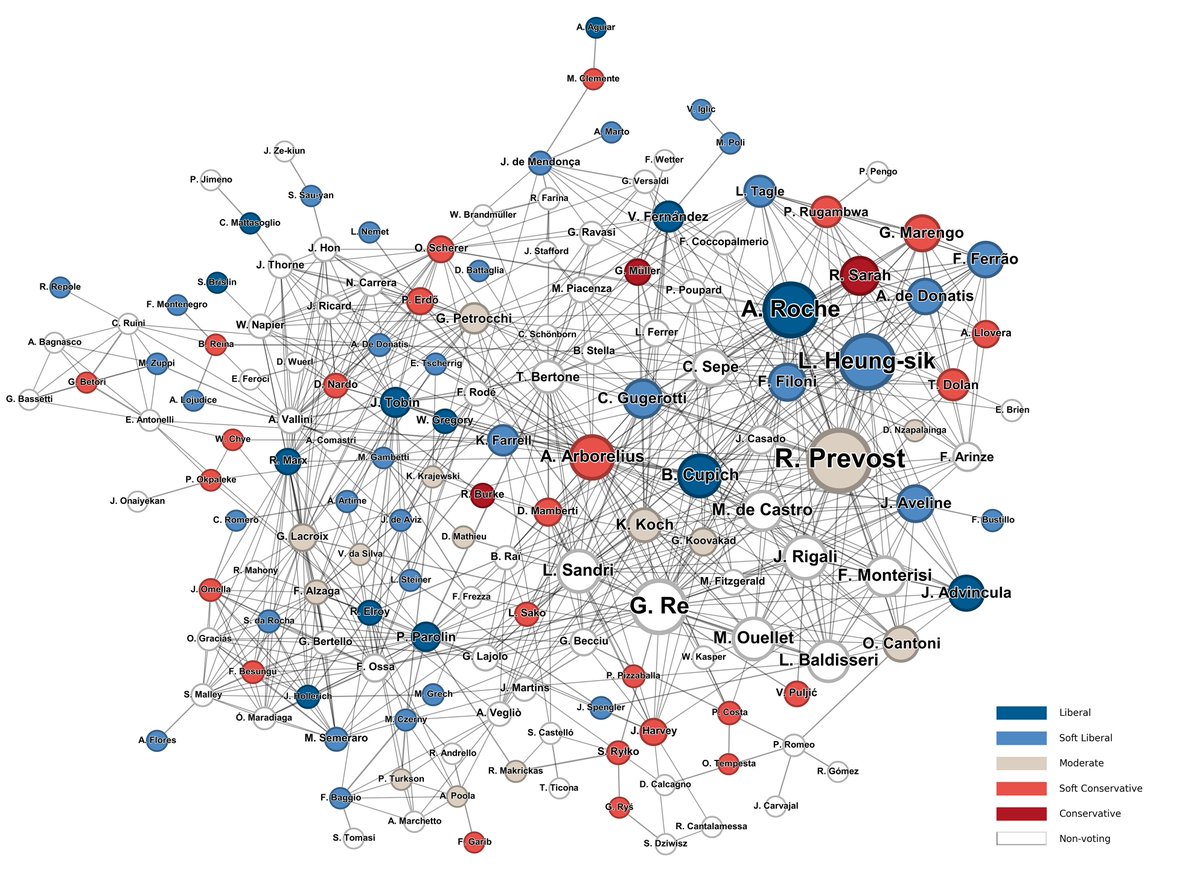
How we "guessed" the Pope using network science: inside the cardinal network. A study by me, Beppe Soda and Alessandro Iorio. Article: https://t.co/xQ0fTmpVxb @Unibocconi
Several openings for PhD in Economics at the Economics School of Louvain. These are TA positions, so some knowledge of French is required. #EconTwitter https://t.co/lGqGgIn3Y5
My new paper with @gguillaumeblanc is out as an NBER Working Paper. Demographic pressures have had lasting effects on the spread of diasporas. Malthusian migrations contributed to sustained improvements in living standards in Europe in the 19th century. https://t.co/lvsAeGrx7q
We are pleased to announce that on February 19, 2025, Professor Oded Galor was awarded an Honorary Doctorate from Nicolaus Copernicus University in Toruń. Professor Galor is renowned for his pioneering contributions to economic theory, particularly his unified theory of growth.
The Italian SuperBonus: How a badly designed fiscal "stimulus" ballooned to 6 times its budget to cost 12% of Italy's GDP, and what it tells us about the fiscal governance of Europe.
A thread on my Silicon Continent post.
(1/11)
Può darsi che, improvvisamente, il 20% dei tedeschi, il 33% dei francesi, il 29% degli austriaci, il 30% degli italiani e più del 50% degli americani siano diventati (a seconda dei luoghi) neo-nazisti, estremisti di destra, nostalgici di Mussolini, o sostenitori di un populista che appoggia gli assalti al parlamento e delira di annessioni di altri stati.
Tipo un virus, che ne so. Un’epidemia improvvisa.
Oppure c’è un’altra spiegazione.
Che il ceto medio - che di diventare “di destra” non ci pensava e non ci pensa neanche lontanamente - si è accorto che c’erano due questioni, in particolare, che cominciavano a creare problemi:
Il primo è la gestione del fenomeno dell’immigrazione, che troppo spesso si traduceva in una minaccia alla sicurezza, soprattutto per i più deboli.
Il secondo sono le tasse. Mentre nei decenni scorsi funzionava lo scambio tra tasse e spesa pubblica erogata, nel corso del tempo è diminuita la soglia di tolleranza nel vedersi prelevare una quota crescente di reddito (guadagnato sempre più faticosamente) per finanziare un apparato pubblico che invece diventava sempre più inefficiente.
La risposta della sinistra tradizionale a queste paure del ceto medio è stata semplice: l’immigrazione non è un problema, è tutta una questione di percezione. E semmai c’è bisogno di nuove tasse, per finanziare crescenti bisogni di spesa pubblica.
Il problema, piuttosto, è usare il pronome “loro” quando ci si riferisce ad un bambino o ad una bambina, perché bisogna aspettare che lui/lei decida se è un maschio o una femmina.
In assenza di una proposta politica liberale sufficientemente forte, comunicativamente attrezzata e politicamente strutturata, il ceto medio allora ha deciso di affidarsi in massa a chi, seppur con linguaggio rozzo e senza nessuna vera preparazione per aggredire davvero quei problemi, almeno ha dato voce (e in modo deciso) al suo disagio.
Non ho la pretesa di sapere quale delle due spiegazioni sia quella giusta. So che la prima implica semplicemente aspettare che il virus passi, la seconda invece implica lavorare per costruire una valida alternativa.
🚨Call for Papers🚨
Our next SED meeting will be held June 26-28, 2025, in Copenhagen!
Submit your paper here: https://t.co/hG29RUjkHY before Feb 15
Julieta Caunedo and Kurt Mitman
Program Chairs






![SteveStuWill's tweet photo. "Williams and Ceci sent fake job applications to more than 800 faculty members in engineering, economics, biology, and psychology... As shown in the graph below, faculty expressed a strong preference for the female candidates - a 2:1 preference overall."
[Link below.] https://t.co/JlwM7ZG0Jf](https://pbs.twimg.com/media/Gq3bvzRa0AA1XS2.jpg)