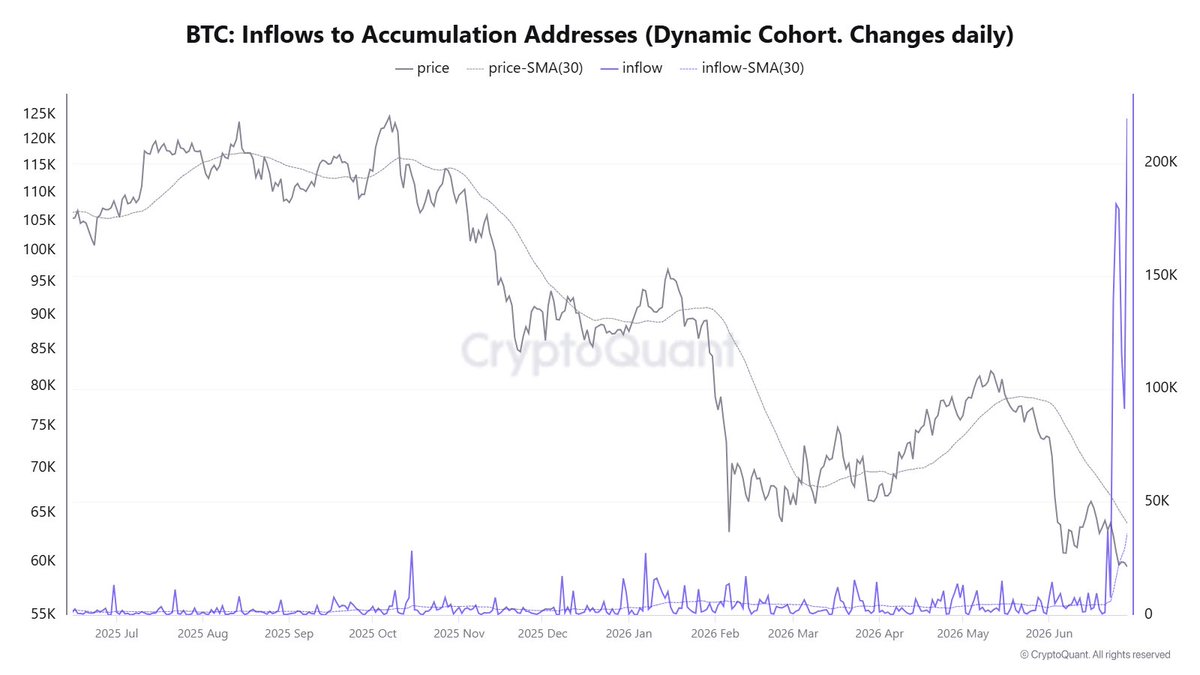
The hige $BTC inflow to accumulation addresses has once again set a new record.
The most powerful accumulation in $BTC history is taking place.
A massive wave is approaching. If a signal for a market reversal appears, everything will be turned upside at once.
A trigger is needed to spark the rally.
Despite quantum and Saylor concerns, it appears that long term BTC holders are viewing these price levels as value.
Their holdings have recently reached an all time high, nearing ~17 million coins.
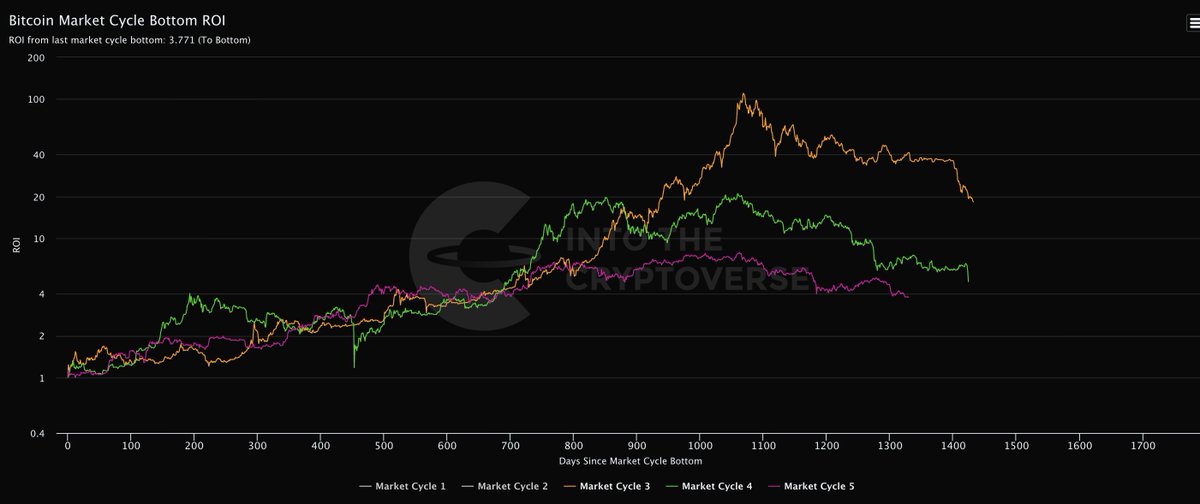
bitcoin simply reverting to its mean trend is a +150% move from here at $59k; it’s either going to zero or mean-reverting, then likely overshooting as it tends to do $btc
Saylor just answered the question every bitcoin holder was dreading: is strategy about to dump its bitcoin?
Nice finally some clarity.
the answer is no,
today microstrategy rolled out its digital credit capital framework. its a simple idea.
its basically a five part framework.
1) a cash war chest.
strategy set aside about $2.55 billion in real dollars, purely to cover dividends and interest.
that's roughly 17 months of payments sitting ready. translation, they can pay everyone for well over a year without selling a single coin.
2) STRC, fixed.
they raised the STRC payout to 12%. a fatter yearly return makes the product attractive again, pulls buyers back, and pushes the price toward its normal $100.
it was built to self-correct, and this is saylor pulling that lever. the policy also lets them adjust the payout later, so they're not locked in.
3) A buyback.
strategy is buying back up to $2 billion of its own credit securities.
since STRC is trading cheap, buying it back below its normal price is smart, it props up the price and retires debt at a discount at the same time.
4) A controlled bitcoin valve.
read this one carefully, because bears will spin it. the framework formally lets strategy tap bitcoin, around $1.25 billion worth, in a structured way.
that's the opposite of a forced fire sale, it's a planned backstop they use only if cash runs short.
stack it with the reserve and they've got about $3.8 billion of total coverage for their bills.
now step back.
the fear was "forced seller, any day now." what saylor actually laid out is 17 months of cash, a repaired STRC, a buyback, and a measured bitcoin backstop.
they even paused buying more bitcoin to focus on stability, holdings flat at about 847,000 coins. and the market bought it, mstr bounced on the news.
but yeah, if btc grinds low for years, even this gets stress-tested.
but the exact thing people were panicking about, a forced bitcoin dump next week, just got answered with a real, funded plan.
Market loved the clarity and hence $MSTR is up today..
Saylor has finally shown some common sense and in my opinion signaled to the market that he's not the irrational and systemically dangerous threat everyone made him out to be.
Should mark the local bottom for $BTC, $MSTR and $STRC, all of which have been massively oversold over the last few weeks.
Wouldn't be surprised if some of this sell pressure already came from @Strategy filling their reserves in advance.
Time to move on from the @saylor drama and shift our attention back to the more exciting projects in this industry.
Bounce imminent. Don't forget how quickly things can turn reflexive into the other direction again.
BREAKING: $MSTR is up 12.80% and $STRC is up 12.24% today.
The market is reacting to Strategy's new capital framework, which includes up to $1 billion in MSTR buybacks and another $1 billion in Digital Credit Securities buybacks.
Investors appear to be pricing in the expectation that Strategy will actually start buying back both, not just holding the authorization in reserve.
The bigger signal is the STRC dividend rate hike to 12.00%, starting July 1.
That's a big move to push STRC back toward its $100 peg, and the market is treating it as credible enough to rally both securities together.
This is optimism building around active capital management rather than just Bitcoin accumulation, the market is betting Strategy can actually defend STRC's price this time.
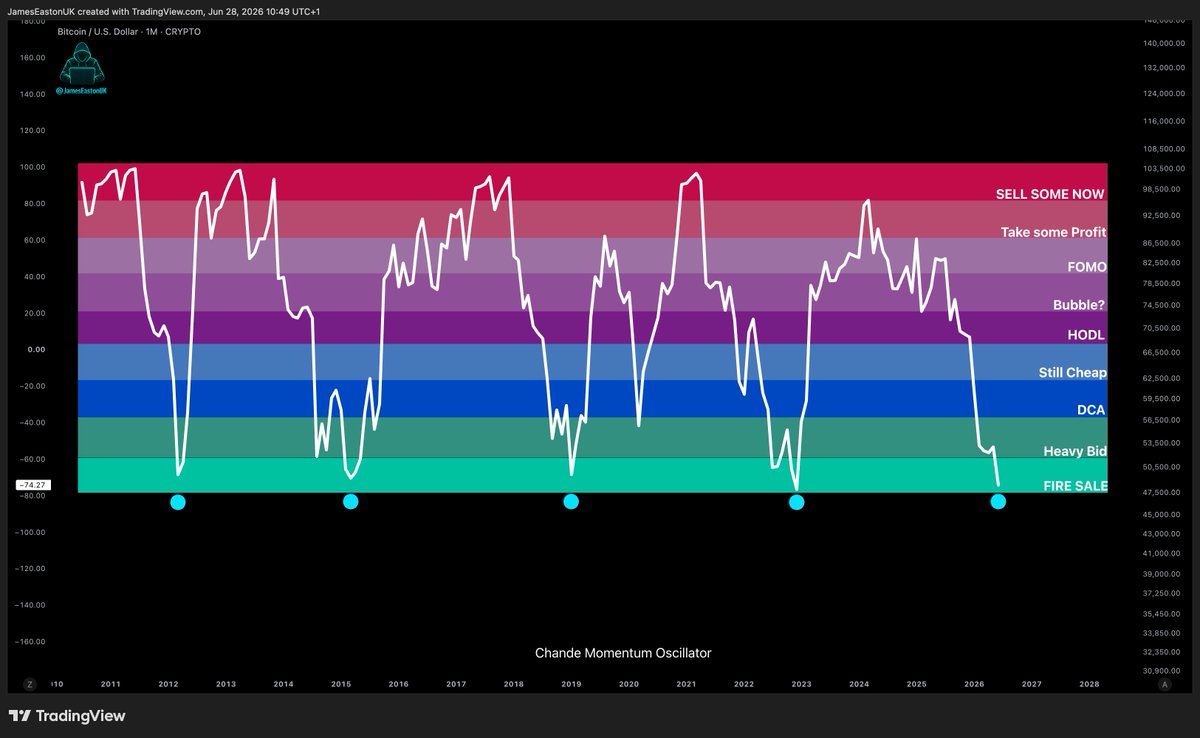
The last time bitcoin was this cheap we had the FTX collapse, Terra Luna exploding, the BlockFi bankruptcy, the Celsius fraud, operation chokepoint and literally zero hope for the future.
Today we have a pro Bitcoin President, Treasury Secretary, entire pro Bitcoin Cabinet, SEC, CFTC, Fed Chair, spot BTC ETF, BlackRock and Larry Fink on board and numerous bills and policies including the Clarity Act, Genius Act and fair value accounting and yet everyone still thinks Bitcoin is going lower than $58,000.
Power law says we should be trading at $170,000. That is a 66% discount at today’s price.
You’d have to be insane to sell here and even more insane to not buy the dip.
We used to only have millionaires.
Then we got billionaires.
Now we have trillionaires.
Soon we’ll have quadrillionaires.
Are we creating more value or just printing more money?
MSTR is probably the most hated asset on my timeline right now.
That’s exactly why I’m going gigalong around $84.
Everyone has the same objections:
Dilution.
“Saylor is printing shares.”
STRC below par.
80%+ drawdown from the highs.
Shorts making money on SMST.
“Just buy spot BTC.”
“Just buy IBIT.”
I get it. None of that is fake. The bear case has real pieces.
But the part people keep missing is that MSTR is not just a cleaner or messier way to own Bitcoin. The common equity has a very weird payoff profile because of the capital structure.
Start with the simple relationship.
Since Saylor started buying BTC, the historical log regression has looked roughly like this:
log(MSTR) ≈ a + 1.53 × log(BTC)
R² ≈ 0.91.
So historically, BTC +100% mapped to MSTR around +189%.
BTC -50% mapped to MSTR around -65%.
Obviously that is not a guarantee. It is just the relationship the market has actually priced over the cycle.
The uncomfortable part is the path.
You do not get the upside without eating the drawdowns, the dilution headlines, the preferred drama, the premium compression, and the endless “Saylor top ticked it” jokes.
Most people cannot hold that.
Now look at the current stack.
Debt + preferred is roughly $22.2B of senior claims, fixed in dollars.
Gross exposure today is about 218k sats per share.
After subtracting that senior stack in BTC terms, common equity is getting about 123k sats per share.
So roughly 95k sats per share are being eaten by the senior claims today.
That sounds bad until BTC moves higher.
If BTC goes to $150k, those fixed-dollar claims shrink hard in BTC terms.
Common equity NAV rises to roughly 180k sats per share.
So the common goes from about 56% of gross BTC exposure today to roughly 82% of the gross ceiling.
Same BTC stack. Same debt stack. Higher BTC price.
That’s the convexity.
With no additional BTC purchases and no mNAV expansion:
BTC from roughly $60k to $150k is about +150%.
Common equity exposure goes from about 478k BTC-equivalent to about 699k BTC-equivalent.
At the same multiple, common NAV is up roughly 260%.
That extra performance is not magic. It is the fixed-dollar senior stack shrinking in BTC terms and the delta flowing to the common.
Current sensitivity is roughly 1.75% common NAV move for every 1% BTC move.
That is why I think people calling this “just levered BTC” are missing the point.
The leverage is embedded in the structure, but it does not behave like a normal margin trade where a BTC drawdown automatically liquidates the position.
There are still risks. Real ones.
Dividend obligations matter.
STRC trading below par matters.
Dilution matters.
mNAV sitting around 1x matters.
Capital markets access matters.
If the market stops paying a premium for the strategy, the flywheel slows down fast.
But when MSTR can issue common above NAV, the math can actually help existing holders because the company raises more BTC-equivalent capital than the shares dilute.
That is the BTC-per-share accretion story.
The new ATM programs, $21B STRC and $21B common, give Strategy a lot more room to keep playing that game.
Issue capital.
Buy BTC.
Manage leverage.
Rebalance.
Repeat.
It is messy. It will never look clean in real time. There will always be a reason to hate it.
That’s why the setup is interesting.
You have a hated equity, a stressed preferred, a compressed multiple, a market obsessed with dilution, and a structure that gets much cleaner if BTC simply grinds higher over the next few years.
That is the bet.
Not that every headline is bullish.
Not that dilution is fake.
Not that STRC does not matter.
The bet is that BTC goes higher, the fixed-dollar claims shrink in coin terms, the common captures more of the stack, and the market eventually prices that convexity again.
The strategy survived 2022, raised tens of billions, added hundreds of thousands of BTC, and now sits with reserves massively above debt.
Volatility breaks most balance sheets.
This one was designed for it.
That’s the whole bet.
I’m not buying comfort.
I’m buying convexity.
$MSTR bitcoin:native
$MSTR is valued at just 57% of the Bitcoin on its balance sheet.
That's near the lows seen during the brutal 2022 bear market.
By this metric, the stock looks incredibly cheap.
When Bitcoin goes up again some of you might realise with hindsight that you were caught up in hysteria during this period.
The tide will turn.
Prepare now.
Dumb bulls will always outperform smart bears.
The oldest lesson in markets, and one that’s held true for decades.
Inflation isn’t going away.
Money printing isn’t stopping.
The cost of living will keep climbing.
Your cash will continue losing purchasing power every single year.
This is the game. It’s been the game for centuries.
Smart people don’t sit in depreciating currency. They park their wealth in scarce assets. Gold, silver, real estate, watches, antiques, legacy markets.
$BTC is still an infant asset. Whether you believe in the fundamentals or not is almost irrelevant. Scarce assets with fixed supply are naturally repriced higher in a world where fiat expands forever.
The real Ponzi is the constant debasement of fiat currency.
Bitcoin doesn’t need to solve every problem tomorrow. What matters is that it has consistently outpaced inflation and I expect it to continue outperforming.
So once again: dumb bulls will always make more money than smart bears in a market that is rigged to go up.
Everyone is crying about the market while I'm having the time of my life.
The bear market did exactly what it was supposed to do: it flushed out everyone who wasn't supposed to be here like grifters, extractors, hype chasers, quick flippers, airdrop farmers etc.
What's left is the most concentrated pool of exceptional founders I've seen in 10 years of crypto. Those who are still around show maximum conviction, long term mindset and the best thing is they work on problems that actually matter.
And the cherry on top is that valuations for pre-seed and seed stages have come down a lot to much fairer ranges again, as everyone is just too afraid to deploy now and rather chasing AI at the top.
Even if it might not look like it right now, but this is the time where you actually make life changing money, not in 6-12 months when the bull is back.
$60k is a strong floor.
I’m not saying it can’t be breached, there is a greater than minimal chance for sure.
But think about it like this.
This month we had:
- $6bn long liquidations over three days(second most ever)
- $6bn ETF outflows(most ever)
- Longest ever period of negative coinbase premium
And Bitcoin couldn’t get below $60k on a daily close, let alone weekly one.
When price is weak, it doesn’t hold against that kind of ferocity.
Right now, this is the second longest period above a key level after 1W Oversold RSI.
140 days.
The only other time Bitcoin consolidated above a key level, whilst HTF oversold, was in 2022 at $18,000.
At 147 days it dropped to $15,000, which was the bottom.
A weak price gives way quickly.
A strong one does not.