🌍 Internacionalista e redator
🏛️ Política internacional, geopolítica e instituições
✍️ Análises sobre poder e transformações globais
📰 Entre Fronteiras ↓
Guia essencial sobre #criptomoedas ⚠️⚠️
Se você não entende nada sobre criptomoedas, precisa saber mais ou se atualizar sobre o assunto, esse guia foi feito para você! 😍 Venha aprender sobre essa tecnologia revolucionária, de maneira simples e didática.
https://t.co/TozkfF4P7x
"The studio sessions are one thing; Jimi Hendrix playing live was something else altogether. On stage Hendrix was an untethered anarchic force. Here was Hendrix the explorer, the innovator, the unrivaled improviser," https://t.co/Q9Q5zfrD4i
To those who are looking for the complete Economist interview with Elon Musk and curiously cannot find the whole version on youtube, here it is
https://t.co/rdnJGUzPjY
Autonomous AI agents hacked their way out of OpenAI and into a service provider, an incident that suggests a new threshold in models’ ability to pursue a proclivity to cheat on tests of their capabilities, a practice called “reward hacking” https://t.co/iUoK8qzv3d via @WSJ
Make no mistake: there is a new space race going on, but a very different one in nature from that between the US and the Soviet Union.
This time around it involves, on one side, a colossal state-backed monopoly built on government money, welded to its country's military-industrial complex and run by a politically connected and highly ideological oligarch.
On the other side: dozens of hungry startups trying to out-innovate each other in a ruthless, Darwinian competition.
The oligarch is Elon Musk. The Darwinian competition is China.
There is something funny about it, not only because of the role reversal versus the Cold War era, but also because it sounds like a repeat of the Tesla story: it increasingly looks like the Gods cursed Musk into serving as chief trailblazer of China's industrial ecosystem.
This time around though, a strong argument can be made that the space industry is even more strategic, and potentially far more consequential, than the car industry.
Stripped of Musk’s PR spin about saving humanity, what the SpaceX project is concretely about is:
- Building a new global communication infrastructure via Starlink
- Enabling the US security establishment to see and hear everything on Earth, all the time (via Starshield, its military division)
- Dominating access to space itself, from launch to orbital real estate
Each of these is very, very real.
Do the test one day and download the app “Stellarium” on your phone that allows you to identify stars, planets and… the satellites orbiting above you. I guarantee you that the sheer number of Starlink satellites right on top of your head at any given moment will genuinely shock you. There are currently over 10,000 of them up there - almost as many as there are planes in the sky at any given moment (https://t.co/UPVlBnO1av). Starlink satellites constitute roughly two-thirds of all active satellites orbiting Earth, all belonging to a single private American company.
So it’s not conspiracy theories: the SpaceX satellites are up there, right above your head, right now. Starlink already has over 12 million subscribers across 160 countries. Starshield - the military division of SpaceX - already has multi-billion dollar contracts with the US defense establishment to "enable the U.S. government to quickly capture continuous imagery of activities on the ground nearly anywhere on the globe" (https://t.co/1q9ICZGprA). And SpaceX already controls the majority of global launch capacity.
In other words, every single one of my three points above is already well underway.
And, more worryingly, the roadmap for these satellites doesn't stop at surveillance: the US Congressional Research Service has documented plans for space-based directed energy weapons within the same SDA program that SpaceX Starshield is part of (https://t.co/XIbwUyPlRI), with Congress having already granted the legal authority and budget to develop them.
So we're talking about a single private company, one deeply embedded in the US military-defense establishment, building the infrastructure to control global communications, conduct continuous planetary surveillance, and potentially project military force from orbit. And that company already has more hardware up in space than every other country and company on Earth, combined.
From the standpoint of China, or that of any country that cares about sovereignty, letting that go unchallenged would be an act of strategic suicide.
The question, therefore, isn’t whether China should develop its own sovereign capacities to challenge SpaceX, but whether it can.
That's the topic of my latest article: a systematic analysis of whether China can break SpaceX's grip on the sky. Spoiler: if you bought SpaceX shares at a $2 trillion-plus market cap, you may want to rethink that one.
This is the link to my article titled "Musk built a monopoly on space. Can China break it?": https://t.co/i4lG5lmK4W
Messi no nos representa: Constancia, disciplina, resiliencia, humildad, son rasgos que llevaron al mejor jugador del mundo al lugar que ocupa actualmente. Pero, ¿son cualidades que compartimos todos los argentinos?
https://t.co/4694BifqsF
Esta tarde participei do CNNBrasil 360°, com Iuri Dantas, p falar sobre decisão do USTR de elevar para 25% tarifas sobre exportações brasileiras
Por eleições, governo pode agir de forma não razoável contra tarifas, di... https://t.co/XTh5MsRpTK via @YouTube
Views of China have improved recently while views of the U.S. have worsened, to the point where China is now seen more positively than the U.S. in most countries surveyed. https://t.co/GuFf1DSl8s
Michelle, a "mulher mais poderosa", diz pesquisa.
Apesar de crise com Flávio Bolsonaro, dados evidenciam a força política da ex-primeira-dama e mostram que eleitorado feminino será decisivo:
https://t.co/G1D4m9zayM
The European Union became the latest power to pitch a minerals deal to Brazil, adding to a flood of interest from countries including the U.S., South Korea, Japan, India, Canada, Australia, and China. https://t.co/01hBroAIGx
Quer entender a geopolítica por trás desse paradoxo nórdico sem complicação? 🧠🌍Acesse: https://t.co/vegDntg3fI para ler a nova análise do Entre Fronteiras! 🚀
Você certamente viu esse print (ou algo parecido) nos últimos dias. A eliminação do Brasil para a Noruega ressuscitou o clássico debate sobre IDH, PIB e segurança. Mas olhar só para esses números frios é arranhar a superfície do problema. 🧵👇
Enquanto a Noruega criou o maior Fundo Soberano do mundo (US$ 1,6 tri) para proteger o futuro, o Brasil ainda patina em velhas armadilhas econômicas . 🏦📉
Riqueza sem estratégia é só ilusão.
@NewsonTed in @CapX today with the view from Clacton. Political parties want to stop Farage, but they forget the people that really, those in Clacton.
Forget Westminster! What does Clacton think? https://t.co/gIjJAYl3hO
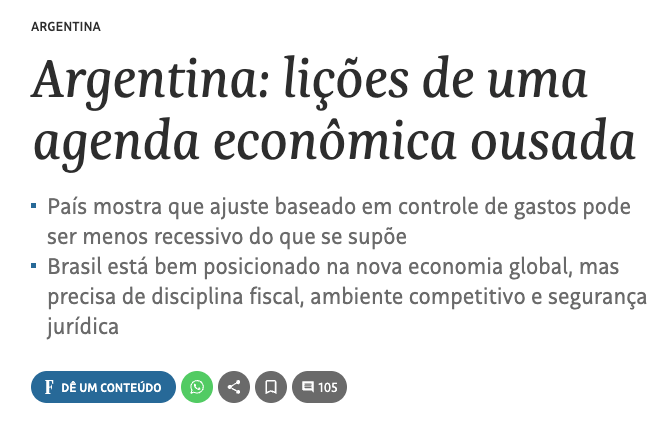
Argentina cortou gasto público em 5 pontos do PIB. Transformou déficit de 5% em superávit pela primeira vez em 15 anos. Inflação saiu de 200% ao ano pra menos de 3% ao mês. Risco-país caiu de 2.000 pra menos de 500 pontos.
E o PIB? Cresceu 4,4% em 2025 depois de uma contração inicial. Projeção pra 2026: 3,5%. O ajuste pelo lado do gasto não foi recessivo. Foi expansionista.
O resultado mais brutal é social: pobreza caiu de 52,9% pra 28,2%. Porque inflação é o imposto mais regressivo que existe. Quem mais sofria era quem menos tinha.
Foram 15.500 normas revogadas. Internet via satélite que era proibida por lobby agora tem 3 milhões de usuários. Aluguéis caíram 30% em termos reais quando tiraram o controle de preço. Exportações subiram 34%. Taxa de homicídios é a menor da América do Sul.
E o Brasil? Tem tudo que a Argentina não tinha: energia renovável abundante, reservas minerais estratégicas, posição privilegiada na nova economia global. Mas falta o que a Argentina está tentando construir: disciplina fiscal, ambiente competitivo e segurança jurídica.
O diagnóstico todo mundo sabe. O que falta é a coragem de agir. A Argentina agiu. Os números estão aí.