When we analyzed $CME before, I was more inclined to view it as a Commodity Meme Launchpad on Robinhood Chain.
0xe2324ff2a59f8ecba8c321c6466e59121c00e795
But with the latest product updates, I think CME’s narrative has clearly upgraded, so let’s break it down further:CME now looks more like it is building:Real-world Assets → On-chain Quote Assets → Meme Markets → Trading → Fee Economy
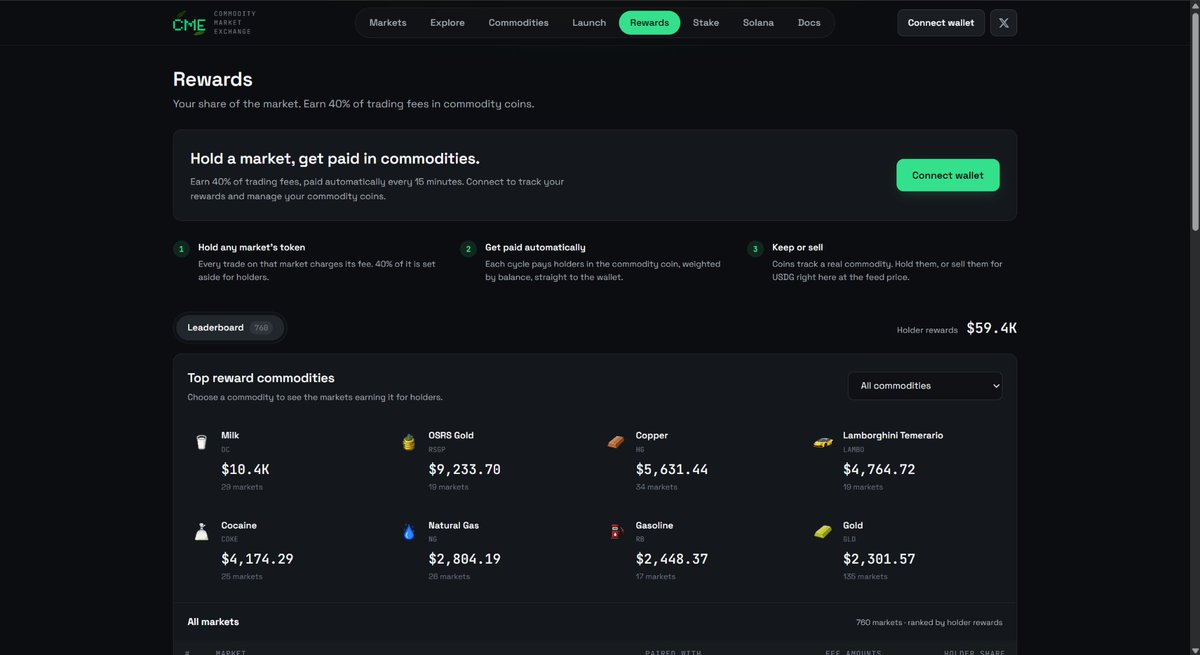
CME currently supports around 220 Commodities and 760 Markets, covering gold, oil, agricultural products, and also expanding into OSRS Gold, CS2 Skins, Pokémon Cards, cars, fast food, and more.
So what it is really trying to build may not just be Commodity markets, but:Anything with a price can become a market.
This is CME’s most important Narrative Upgrade.
A traditional Launchpad looks like:Meme → SOL / ETH / BNB
While CME is:Meme → Gold / Oil / OSRS Gold / CS2 Skin / Pokémon Card / Lambo...
More importantly, users holding Market Tokens can receive 40% of trading fees in Commodity Rewards.
So what CME is actually creating is:Meme → Commodity Exposure + Trading Fee Yield
This is also the biggest difference between CME and a traditional Meme Launchpad.
At the same time, CME’s product infrastructure is also being upgraded.
New Markets can now enter Uniswap V4 directly from the first trade, with the Bonding Curve running inside the Pool Hook, eliminating the traditional:Bonding Curve → Graduation → Migration → New Pool
Instead, it becomes:Launch → V4 Pool → Trading
This reduces the complexity of liquidity migration and early trading, while also making it easier for Terminals, Trading Bots, and other trading infrastructure to integrate.
CME’s Value Capture is also becoming clearer:Trading Fees → 40% Commodity Rewards → 30% CME Buyback → Burn / Staking → 30% Protocol
So far, around 7.4M CME has been burned, with cumulative buybacks of around 21.6 ETH.
This means CME now has three layers of flywheels:
Layer 1: Market Flywheel
More Commodities → More Markets → More Meme Categories → More Creators → More Markets
Layer 2: Trading Flywheel
More Markets → More Trading → More Fees → More Commodity Rewards → More Users → More Trading
Layer 3: CME Token Flywheel
Trading Volume → Protocol Fees → CME Buyback
→ Burn / Staking → Supply ↓ → CME Value Capture
Ultimately:More Assets → More Markets → More Trading → More Fees → More Rewards / Buyback → More Markets
I think there are several major Catalysts to watch next.
First is continued integration with Axiom, GMGN, and other Trading Terminals. If more trading entry points support CME, early liquidity and trading efficiency for new markets should improve.
Second is new asset categories.
OSRS, CS2, Pokémon, etc. are actually testing CME’s core concept:Anything with a price can become a Commodity.
If these non-traditional assets start generating real trading volume, CME’s Narrative could move further away from “Commodity Meme” and toward an Everything Market.
Third is continued growth in the number of Markets.
It is already approaching 760 Markets. If it eventually reaches:1,000 → 2,000 → 5,000
then CME will increasingly look like a real Market Factory.
But this is also CME’s biggest problem right now.
Market Count ↑ ≠ Revenue ↑
If the number of Markets keeps growing but most of them have little trading activity, then:Markets ↑
does not necessarily mean:Volume ↑ → Fees ↑ → Buyback ↑
CME currently has around 760 Markets, but only around $164K–$170K in 24h Volume, which means the key question now is not whether there are enough Markets, but:Can these Markets actually generate sustainable trading volume?
So my current view of CME has upgraded from:“A Commodity Meme Launchpad on Robinhood Chain”
to:“Market Infrastructure on Robinhood Chain that turns real-world price assets into On-chain Quote Assets.”
What makes CME interesting is not Gold, Oil, or any single Commodity.
It is:Real-world Price → On-chain Asset → Meme Market → Trading → Fee Economy
If this mechanism can eventually turn:220 Commodities + 760 Markets
into sustained growth in:Trading Volume + Protocol Revenue + CME Buyback / Burn
then CME’s Narrative could further upgrade from:
Commodity Meme Launchpad
to:Everything Market on Robinhood Chain
So the core data I’m watching now is simply:
Market Count → Trading Volume → Fees → Buyback / Burn
The number of Markets has already shown that CME can expand.
The next thing it needs to prove is whether it can turn those Markets into real trading volume.
Chart: https://t.co/RqlcRLCIkd
$CME staking is live.
Every trade on CME buys back $CME.
From today, half of every buyback burns and half goes to stakers.
Stake, lock 24h, earn from every buyback. Compound or claim any time.
https://t.co/o2czmn29ME
@launchonCME — $CME is now at a $2M market cap, down 90%.
There’s around $400K in dividends here. A portion could be used for buybacks and burns. Make a post — this feels like the bottom.
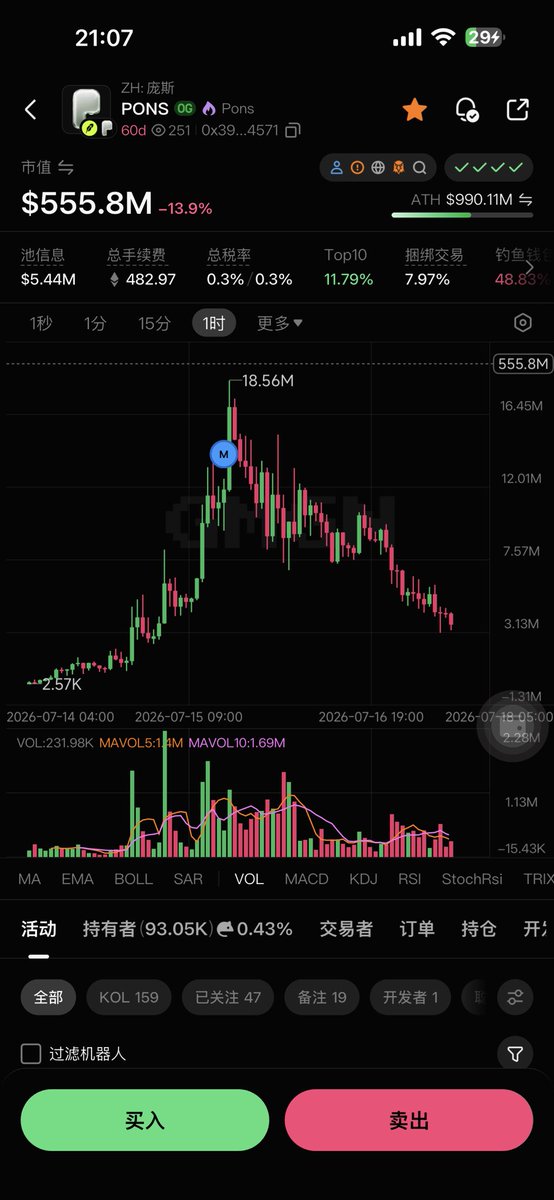
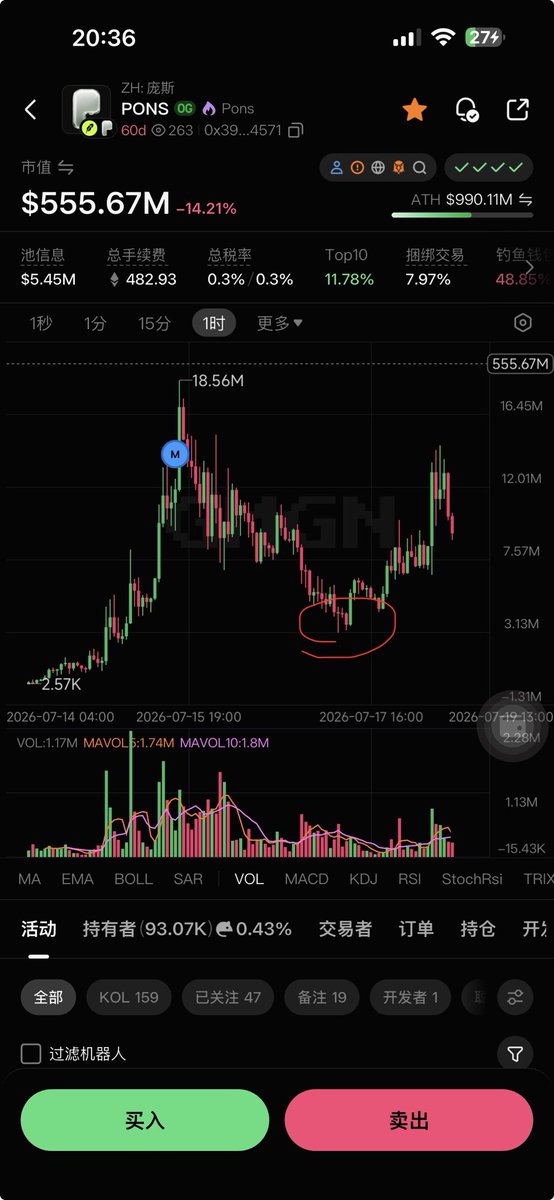
PONS uses 80% of its dividends for buybacks and burns; CME could learn from that.
Also, to clarify: there’s nothing wrong with the dividend mechanism for CME’s product memes. People misunderstood it. $CME holders do not receive dividends; holders of the individual product memes do.
Oh well, i guess some of you already saw it, but it's official, we now have official support on Axiom and many more platforms to come, lot of work to be done, we're not slowing down!
@webthreecool Yeah, hope it bounces back. 2 is my entry point. Kept it from 2 mil to 20, never sold a dime. Seems i am being punished for that. I really still think it’s a great project, has good volume. Price need to move.