@cdriclion second trial : i am currently integrating it in my AI crew. I left the repo distinct from my main obsidian vault as it generates a lot of noise, and just had an agent interfacing it . easy as most of your scripts are headless. however subagents cannot spawns other subagents
@brivael Kegan 3 vs Kegan 4 . socialised vs self authoring . c est lq ligne de demarcqtion de notre ste auj. et c est elle qui bouge . qui doit bouger (ai, etc). que tu essaie de faire bouger .
@cdriclion Btw : it doesn’t only generate interesting ideas — B0, B1 — but also innovations and even breakthroughs at B3.
Where lever of change : - Bateson level 0 is no juste optimization, B1 improvement, B2 innovation, and B3 a system-breaking or identity challenge.
Introducing Open Collider: an open-source engine that mechanically improves LLM creativity.
It generates non-trivial, high-quality ideas at scale, for any ideation problem.
LLMs collapse on the same ideas. Sample the same brief 100 times → most outputs land in the same place. Researchers call it the Artificial Hivemind (Jiang et al., 2025).
"Be more creative" moves the LLM's output by ~0.04 in embedding space.
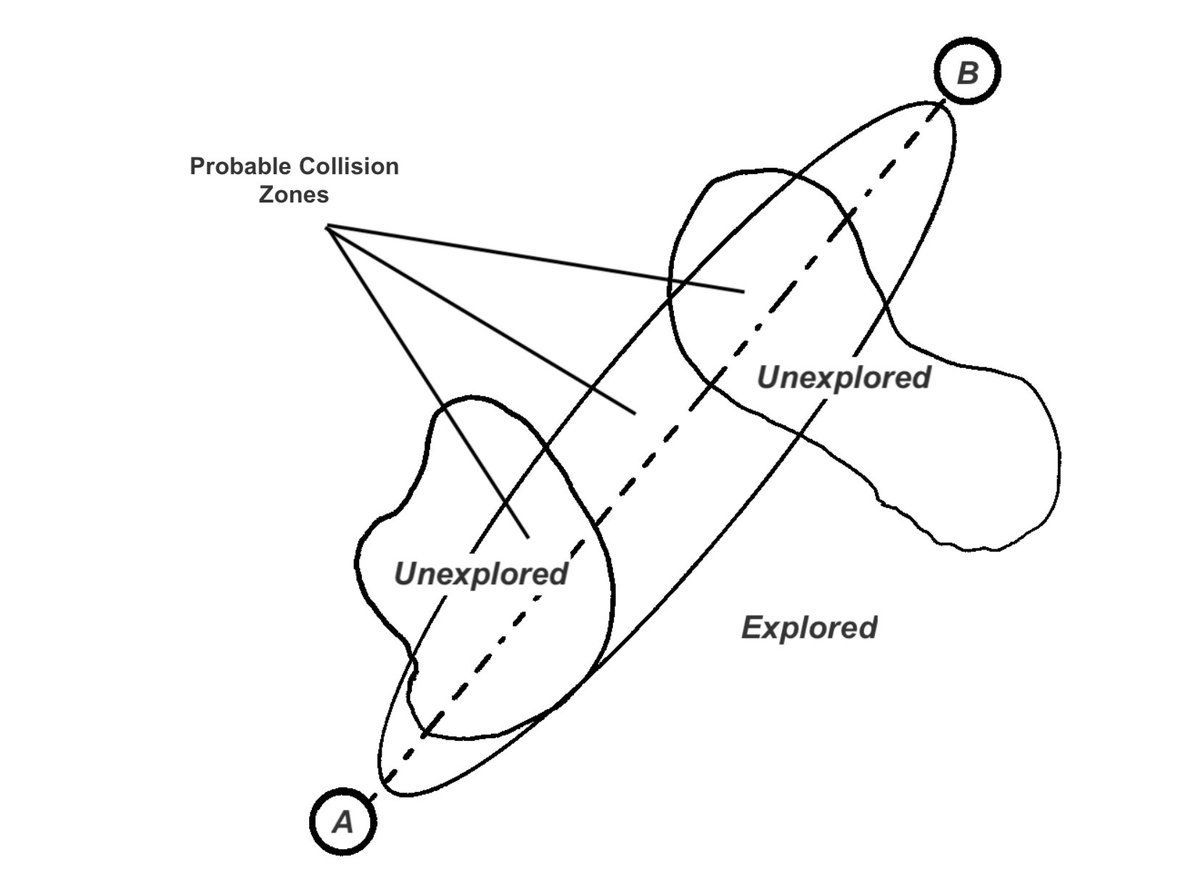
Forcing structurally distant domain collisions moves it by ~0.28.
7× more. Same model, same brief.
So I built Open Collider: a pipeline based on the theory of bisociations (Koestler 1964), the same model that drives human creativity.
📊 Across 12 real-world ideation problems:
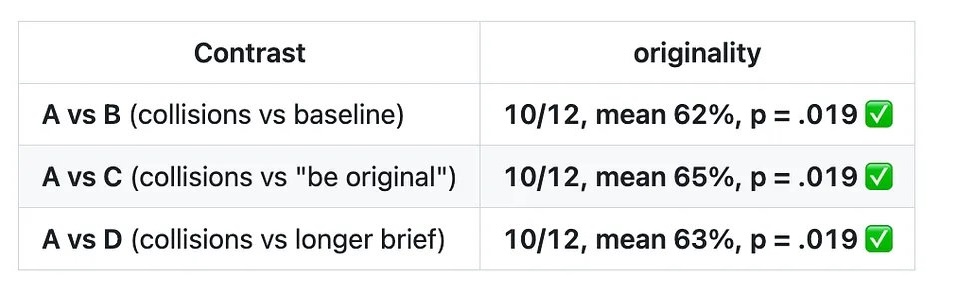
• 12/12 sign-test wins on embedding distance (p = .0002)
• 60%+ originality wins on 4,320 blind LLM-judge verdicts
• 4–13× further from the default cloud than "be original" prompts or longer context
• Idea relevance holds (win rate >50% on overall quality)
💻 Engine: first reply 👇
📝 Launch study: pinned tweet
Try it, Break it, Tell me what you find!
@cdriclion btw re @oparine "...refuse to converge" :
- spot on: !
in an age of "infinite" production, convergence becomes the problem ... especially when this is the dominant mindset ( Kegan 3 : 58 % of people) -> blocking factor
Terence Tao is the greatest living mathematician.
Fields Medal at 31. Solved problems that had been open for a century. Widely regarded as the sharpest analytical mind alive.
And he just told you the thing your entire career is built on is now worthless.
Tao: “AI has basically driven the cost of idea generation down to almost zero.”
For five hundred years, the idea was the prize.
The theory. The hypothesis. The flash of insight a physicist chased for twenty years in a lab before it landed.
That was the bottleneck. That was what tenure rewarded. That was what Nobel committees were looking for.
Gone.
A model can generate a thousand candidate theories for a scientific problem in an afternoon. Not noise. Not garbage. Plausible, structured, publishable-grade hypotheses.
A thousand of them. Before dinner.
The idea used to be the scarcest resource in any room.
Now it is the cheapest.
But Tao went somewhere most people are not ready to follow.
Tao: “Verification, validation, and assessing what ideas actually move the subject forward… that’s not something we know how to do at scale.”
Sit with that.
We automated creation.
We did not automate truth.
We can produce ten thousand explanations for a phenomenon.
We cannot tell you which ones are real.
That is not a gap. That is a chasm.
And it is the most important unsolved problem on Earth right now.
Tao: “Human reviewers… they’re already being overwhelmed actually.”
The entire scientific apparatus was built for a world where a single paper took months to produce.
Peer review. Journal boards. Consensus forged over years of replication and debate.
That infrastructure was never designed for what just hit it.
Journals are flooded. Reviewers are buried. The filters that separated signal from noise for decades were engineered for human-speed output.
They are now absorbing machine-speed volume.
And they are cracking under it.
Tao compared it to the internet.
The internet drove the cost of communication to zero. That did not produce clarity. It produced an ocean of noise with islands of signal buried somewhere inside.
AI just did the same thing to knowledge itself.
Infinite generation. Zero verification.
The person who can produce ideas has never mattered less.
The person who can prove which ideas are true has never mattered more.
That is the inversion nobody is processing.
Every company, every lab, every institution is racing to generate more. Faster models. Bigger outputs. More theories. More code. More content.
Nobody is building the system that tells you which of those outputs are actually correct.
And that is the only system that matters.
Whoever solves verification at scale does not win a market.
They become the filter that all of science, all of engineering, all of human discovery flows through.
The bottleneck of the last five hundred years was producing the answer.
The bottleneck of the next fifty is knowing whether the answer is real.
And right now, according to the greatest mathematician alive, we do not know how to do that at the speed the machines demand.
That is not a research problem.
That is the race beneath the race.
And almost nobody has entered it.
Willpower isn’t your problem.
If everything is possible, nothing is urgent.
Shrink the game. Define “done.” Start ugly.
The rest follows: https://t.co/gA45kwWWdt
you realised that the transformation only happens through action.
you know what to do : you have a plan, a strategy
and you dont do it .
sounds Logic ?
why ?
https://t.co/EnNXAS3jwR
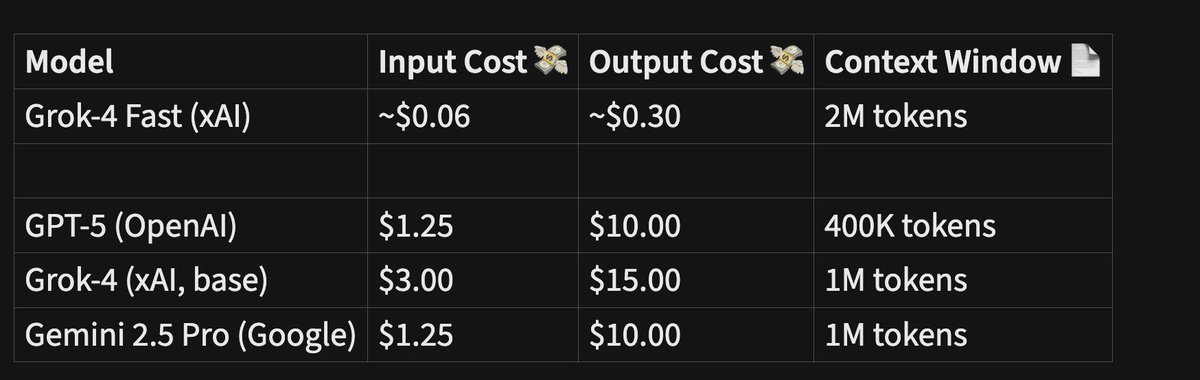
( Todays is my Finops Day, And I found a decrease I could not explain across my models usage, until I found this ... I did not paid attention to the costs factor of grok 4-fast beforehand , only focused to the "fast" part)
AI Costs Slashed 20x: Pros Win Big, Freeloaders Lose Hard
AI just got 20x cheaper overnight—game-changer alert!
Grok-4 Fast crushes the base model's pricing—20x less for similar power
Watch GPT and Gemini scramble to match—competition's a bloodbath
Who's switching?