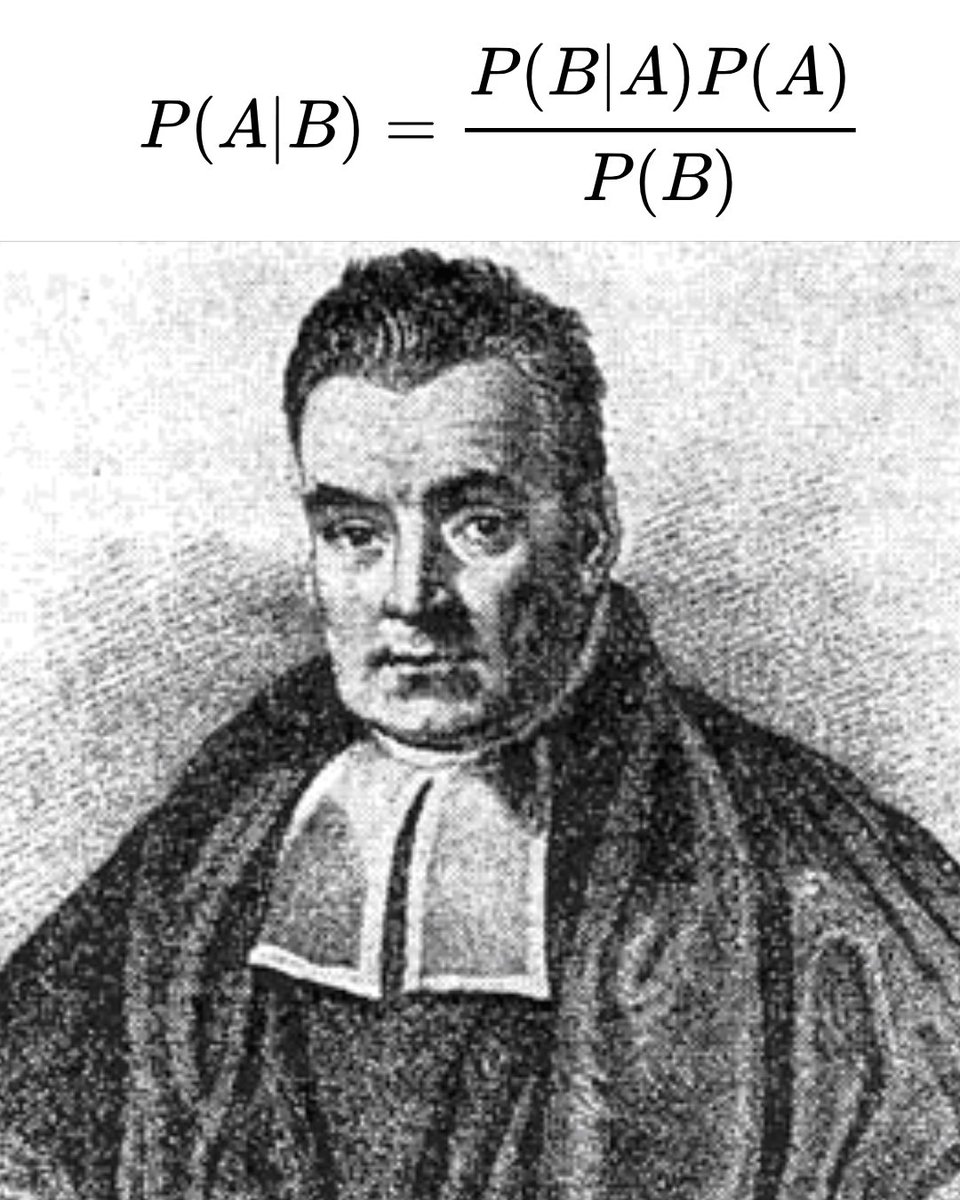
Bayes’ theorem is probably the single most important thing any rational person can learn.
So many of our debates and disagreements that we shout about are because we don’t understand Bayes’ theorem or how human rationality often works.
Bayes’ theorem is named after the 18th-century Thomas Bayes, and essentially it’s a formula that asks: when you are presented with all of the evidence for something, how much should you believe it?
Bayes’ theorem teaches us that our beliefs are not fixed; they are probabilities. Our beliefs change as we weigh new evidence against our assumptions, or our priors. In other words, we all carry certain ideas about how the world works, and new evidence can challenge them.
For example, somebody might believe that smoking is safe, that stress causes mouth ulcers, or that human activity is unrelated to climate change. These are their priors, their starting points. They can be formed by our culture, our biases, or even incomplete information.
Now imagine a new study comes along that challenges one of your priors. A single study might not carry enough weight to overturn your existing beliefs. But as studies accumulate, eventually the scales may tip. At some point, your prior will become less and less plausible.
Bayes’ theorem argues that being rational is not about black and white. It’s not even about true or false. It’s about what is most reasonable based on the best available evidence. But for this to work, we need to be presented with as much high-quality data as possible. Without evidence—without belief-forming data—we are left only with our priors and biases. And those aren’t all that rational.
¡CIERREN TODO!💣💥
😍🎸🇵🇾Berta Rojas se unió a Gustavo Santaolalla para interpretar #TheLastOfUs, la icónica banda sonora de la aclamada serie de videojuegos
Subile el volumen y disfruta🎧
#RockandPop 🎸 #955FM⚡
🗣️ "Debería de haber sido automático pero algo falló"
🔸 La Ing. Lira Giménez, directora general del INTN refiere que funcionarios de la estatal ya se encuentran trabajando para identificar "el error" que causó confusión al cambio de hora.
👉 "Están viendo qué es la causa para saber si fue un error tecnológico o un error humano. Sí me dijeron que los ajustes lo hicieron hace 5 meses, o sea los patrones sí se ajustaron"
#AM1080 📻
Hoy hablaremos de la importancia de los algoritmos y HASH en las agregaciones de enlaces (LAG), y de paso, desmitificaremos eso de que los enlaces se "suman", ya que sí... pero no... aunque puede... con matices... 🥳
super🧶, ponte cómodo/a...
In 1890, Henri Poincaré proved the non-existence of the uniform first integral of the three-body problem and the sensitive dependence to initial conditions of its trajectories.
Yet, stable solutions to it do exist and these are some of them.
Nos tomó menos tiempo abrir una nueva cuenta de empresa en @ItauParaguay a que @uenopy le de solución a todos los problemas que empezamos a tener desde la fusi��n. Lo peor que nos pudo pasar como ex clientes de Visión fue ese banco de juguete.