🎥 The recording of the third ELLISxUniReps Speaker Series session with @victorveitch and @luigigres
is now available at: https://t.co/E4gsxE98hs.
Next appointment: 31st July 2025 – 16:00 CEST on Zoom with 🔵Keynote: @Pseudomanifold
(University of Fribourg) 🔴@FlorentinGuth (NYU & Flatiron)
An extra chapter that describes three different interpretations of identifiability, namely:
- the realist interpretation
- the independent-learners interpretation, and
- the interpretability interpretation.
(also see @luigigres's thesis for more on this topic)
My thesis is now online!
https://t.co/kdraSXMQLy
This is more than just a list of publications. I invested a lot of time and passion writing this thesis in hope that it will make for an interesting read.
Here's a summary of what you'll find in it.
In this one, we explore the linear properties of next-token predictors like LLMs through the lens of identifiability. I learned quite a bit while working on this project!
In collaboration with folks from University of Trento and Copenhagen University!
🧵Why are linear properties so ubiquitous in LLM representations?
We explore this question through the lens of 𝗶𝗱𝗲𝗻𝘁𝗶𝗳𝗶𝗮𝗯𝗶𝗹𝗶𝘁𝘆:
“All or None: Identifiable Linear Properties of Next-token Predictors in Language Modeling”
Published at #AISTATS2025🌴
1/9
Yo! We have an accepted paper at #AISTATS2025!!
Time to prepare for Thailand 🪷🏖️🌴🐒
Huge thanks to my coauthors @luigigres, @sweichwald, and @seblachap for all the joint effort!
More details soon 👇
https://t.co/FG4jouYkcG
This was fantastic news. Thanks @ELLISforEurope!
My thesis, "Learning Identifiable Representations: Independent Influences and Multiple Views", can be found here: https://t.co/qtsC8EZeX1
Congrats to the recipients of the 2024 ELLIS PhD Award!
Co-winners: @Ana_koloskova (efficiency in decentralized learning) & @luigigres (identifiable representation learning)
Runner up: @schwarzjn_ (sparse parameterizations)
Read more about them: https://t.co/2kg7nVihPT #AI#ML
Really grateful to my supervisor, @bschoelkopf, and to all the co-authors of the papers on which my thesis is based. It was great to work with you! Still processing all the things I learned
Why do NNs often learn similar representations? Existing identifiability results offer theoretical insights, but applying them in practice poses challenges.
We’ll present our new work exploring these challenges next week at @unireps#NeurIPS2024 🇨🇦🎉
https://t.co/lCKgRhh43m
1/
Why do NNs often learn similar representations? Existing identifiability results offer theoretical insights, but applying them in practice poses challenges.
We’ll present our new work exploring these challenges next week at @unireps#NeurIPS2024 🇨🇦🎉
https://t.co/lCKgRhh43m
1/
📢 here's a new 𝚐𝚊𝚍𝚓𝚒𝚍 for Causal Structure Learning:
𝐆raph 𝐀𝐃𝐉ustment 𝐈dentification 𝐃istances
to compare DAGs or CPDAGs (!)
in terms of the identifying formulas they suggest for causal effects.
💻 Try it: pip install gadjid
📚 Read it: https://t.co/x1DMXzsIC6
1/
Formally speaking, it shouldn't be possible. Using a benchmark based on @yudapearl ladder of causation (association < intervention < counterfactual), @zhijingjin et al. show that GPT-4 struggles with counterfactual reasoning, obtaining only 60% accuracy.
https://t.co/3hZCRkowM5
Come to poster #904 to hear about nonparametric interventional CRL.
Bonus points if you attended the CauCA poster earlier, the two works are nicely complementary
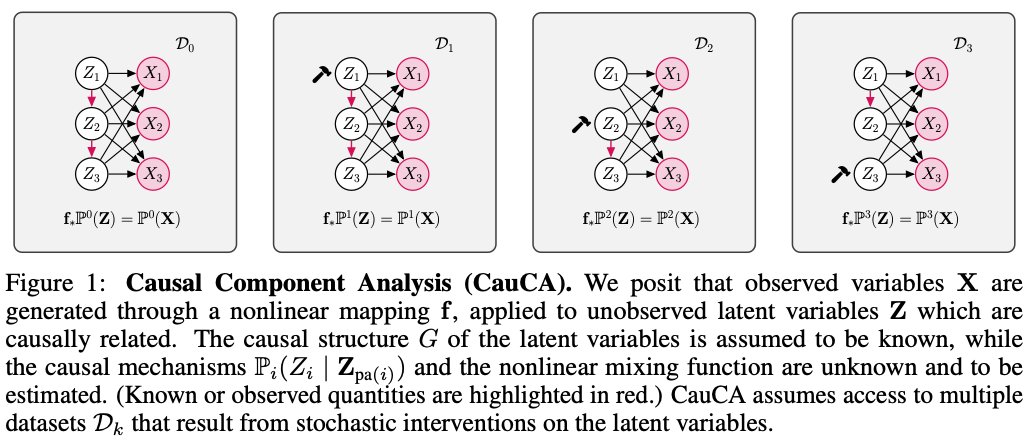
Introducing our #NeurIPS2023 paper: "Causal Component Analysis" (CauCA) – a causal generalization of Independent Component Analysis (ICA), and a special case of Causal Representation Learning (CRL). 1/10
📝: https://t.co/v3l6RK0SlK
💻: https://t.co/mhpVFTzc61