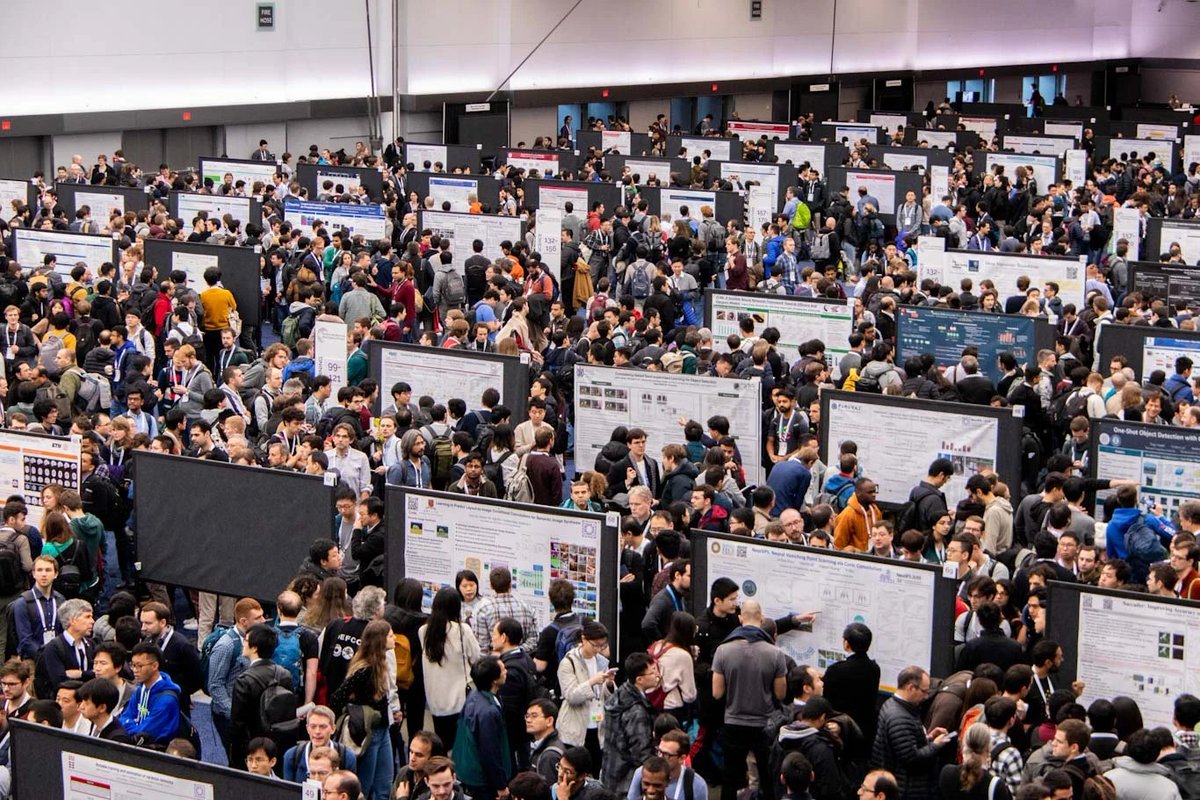
Wondering how to attend an ML conference the right way?
ahead of NeurIPS 2025 (30k attendees!) here are ten pro tips:
1. Your main goals:
(i) meet people
(ii) regain excitement about work
(iii) learn things
– in that order.
2. Make a list of papers you like and seek them out at poster sessions. Try to talk to the authors– you can learn much more from them than from a PDF.
3. Pick one workshop and one tutorial that sounds most interesting. Skip the rest.
4. Cold email people you want to meet but haven't. Check Twitter and the accepted papers list. PhD students are especially responsive.
5. Practice a concise pitch of unpublished research you're working on for "what are you interested in rn?". Focus on big unanswered questions and exciting new directions, *not* papers.
6. Skip the orals. Posters are a higher-bandwidth, more engaging, more invigorating. Orals are a good time to go for a walk or talk in the hallway.
7. for the love of god, do NOT work on other research in your hotel room. Save mental bandwidth for the conference. (This may seem obvious; you'd be surprised.)
8. Talk to people outside your area. There are many smart people working on niches <10 people understand. Learn about one or two that won't help your own work.
9. Attend one social each night. Don't overthink it or get caught up in status games. They're all fun.
10. Take breaks. You can't go to everything, and conferences consume more energy than a normal workweek.
hope this helps, and sad i'm not attending neurips, have fun :)
I'm starting a new project.
Working on what I consider to be the most important problem: building thinking machines that adapt and continuously learn.
We have incredibly talent dense founding team + are hiring for engineering, ops, design.
Join us: https://t.co/EHzWTthvYR
1/2 Paper: "We’re Different, We’re the Same: Creative Homogeneity Across LLMs" by E. Wenger, Y. Kenett.
https://t.co/8LMpX3a0S4
On limited creativity of LLMs:
"We find that LLM responses are much more similar to other LLM responses than human responses are to each other"
We’re running another round of the Anthropic Fellows program.
If you're an engineer or researcher with a strong coding or technical background, you can apply to receive funding, compute, and mentorship from Anthropic, beginning this October. There'll be around 32 places.
new blog post
"All AI Models Might Be The Same"
in which i explain the Platonic Representation Hypothesis, the idea behind universal semantics, and we might use AI to understand whale speech and decrypt ancient texts
Next week I will be in Vancouver 🇨🇦 for #ICML2025. Together with @SimoneM44644 and @SebastianCygert we will present "No Task Left Behind:
Isotropic Model Merging with Common and Task-Specific Subspaces". Visit the poster on Wednesday, 16th July at 11 am.
VLMs are wild. You can glue a vision model to an LLM?! What's up?
The key is that both models learn universal representations. Just training a linear projection, is enough! But image embeddings align only with LATE layer language activations as shown by LLM SAEs, causing issues
I always found it puzzling how language models learn so much from next-token prediction, while video models learn so little from next frame prediction. Maybe it's because LLMs are actually brain scanners in disguise. Idle musings in my new blog post: https://t.co/BxInvWx4y0
excited to finally share on arxiv what we've known for a while now:
All Embedding Models Learn The Same Thing
embeddings from different models are SO similar that we can map between them based on structure alone. without *any* paired data
feels like magic, but it's real:🧵
“When a measure becomes a target, it ceases to be a good measure.” -Goodhart
To enhance the rigour of LM Arena, we propose key recommendations based on our exhaustive study identifying systemic issues distorting the leaderboard.
The new paper from @Cohere_Labs "The Leaderboard Illusion" perfectly exemplifies Goodhart's Law: "When a measure becomes a target, it ceases to be a good measure."