Since the Vatican lifted the excommunication of the Eastern Orthodox in 1965, and the SSPX is now formally excommunicated, we’re literally a more legitimate Church in the eyes of Rome. Just imagine being an SSPX Catholic who has been screaming at us to “submit to Rome”. Bro YOU FIRST😭🤘🏻
“The most influential pro-Lutheran clergyman was Feofan (Theophanes) Prokopovich, another young professor from the Kiev Academy. Peter first met Prokopovich in 1709… Seven years later, Peter brought Prokopovich to his new capital, St. Petersburg, for a series of sermons. This indicated that Prokopovich would soon be made a bishop, causing an uproar at the Moscow Academy, which four years earlier had already protested to Peter that Feofan’s theology was Lutheran and incompatible with Orthodoxy. This time, the Kieven professors at the Moscow Academy, archimandrites Feofilakt Lopatinskii and Gedeon Vishnevskii, together with Metropolitan Yavorskii, submitted a written protest to Peter, which delayed the consecration of Prokopovich for two years. In 1718, he was consecrated bishop of Pskov, and therefore also of St. Petersburg… Seventy-five percent of Prokopovich’s library of 3,000 volumes consisted of Lutheran works; and all his publications, about seventy altogether, mostly polemical tracts, were based on Lutheran authors”
The Orthodox Church in the History of Russia, Dimitry Pospielovsky, p.109
Hot take
I understand both sides of the argumentation from the "dyerrites" and the "latinizers" but I have noticed that rather than posting apologetics against demonic faiths, the "latinizers" just post about PSA and Original Guilt all day. Like bro do something
“Modern Orthodox theology has broken free from the influence of recent scholasticism. This scholastic movement, while claiming to provide a complete definition of God and His saving activity and to equip them with rigid and, in their view, all-encompassing formulas, managed to hinder the progress of theological thought, at least until the recent revolution in human thought forced theology to abandon these formulas.”
Saint Dumitru Staniloae, Questions and Prospects of Orthodox Theology
‘By considering man’s salvation as a simple judicial declaration on his part, as a right because of the price Christ paid on the cross, Protestantism has weakened the permanent relationship between the person who is saved and the eternally alive and loving Christ. The human person’s salvation is no longer considered to have been effected through his continuous relationship with Christ but through a value paid through a past act against the people’s continual sins.
In this view, the entirety of salvation refers to this past act, valuable in itself, not to the Person of Christ in permanent communion with us. This devaluation of salvation from its significance as the human person’s transformation, achieved in the personal relationship with Christ, has also taken place in Catholicism, where the Church valued Christ’s “merit” as an impersonal treasure of created grace that He gained through the satisfaction given to God on the cross.’
Saint Dumitru Staniloae, The Experience of God, Volume 4: The Church: Communion in the Holy Spirit, p.123
“Memorial of our Holy Father, Blessed Augustine, Bishop of Hippo
He was born in Numidia, Africa, in the city of Tagaste in the year 354. Thanks to the advice, tears and prayers of his mother Monica, he was converted from paganism to Christianity. A great teacher of the Church in the West and an influential writer, with certain unapproved extremes in his teachings. He served as bishop for thirty-five years as bishop of Hippo (near Cartagena) and peacefully reposed in the year 430. He left behind him numerous writings of various contents.”
Saint Justin Popovich, Lives of the Saints, June 15
“The 'legal' theory, created by Western thought, nurtured within the narrow confines of Roman legalism, offers an external interpretation of the mystery of redemption... All the essential features of this theory are built on the foundation of commonly practiced (sinful, selfish) relationships between people and are clothed in the form of strict legalism. They are incompatible with the concept of a God of love, which is why the entire 'legal' theory of the interpretation of the mystery of redemption, found in the pages of our textbooks on dogmatic theology, while remaining a matter of the mind, says nothing to the Christian heart.”
Saint Gury Stepanov
‘Among their many other errors and heresies, the Latins still have the error of considering the venerable Cassian to this day as a supposed “semi-Pelagian”! This is how some Roman popes treated him (Gelasius I, 492-496; Boniface II, 530-532), while others among them, such as St. Gregory the Great (540-604), considered him a saint. For us Orthodox, the venerable Cassian was and remained completely Orthodox, faithful to the teachings of the Holy Fathers, and especially faithful to the teachings of his great teacher St. John Chrysostom.’
Saint Justin Popovich, Lives of the Saints, February 29
“In this free acceptance by the love of the God-human heart of human suffering for sin, the Son of God as the New Adam, containing within Himself all of humanity, is the living Sacrifice, the real Atonement, required (called for) by God through the established norms of life, not a sacrifice of legal retribution or punishment, but a sacrifice of selfless Divine love, not a sacrifice (moreover) necessary to God for the propitiation of His angry Justice, but a sacrifice necessary for people”
Saint Gury Stepanov, God-Created Man: An Experience of Orthodox Theodicy of Life
‘We should make mention of the fact that in the last three or four centuries Orthodox theology also suffered from a certain scholastic influence on its soteriological teaching, and came to present salvation therefore as something achieved almost exclusively by means of the cross of Christ and to understand salvation in general as a vicarious satisfaction offered to God by Christ. Beginning however with the Russian theology of the last century, Orthodox theology has returned almost completely to the broader understanding of salvation proper to the Greek Fathers, and, under the influence of the ministry or “diakonia” to the world which the Church has assumed, Orthodox theology in recent years has been developing in a contemporary form those pan-human and cosmic dimensions of salvation which also form part of the patristic heritage.’
Saint Dumitru Staniloae, Theology and the Church
@staniloaean Because the problem is not language... No academic scholar who says that the Early Church Fathers or the New Testament does not teach PSA denies penal language. They deny the implication that people who support PSA think the language means.
Blessed Feast of the Holy Apostles, Saint Peter and Saint Paul!
Image 1: Gold glass vessel base from c. 360-400AD depicting Christ crowning Saints Peter and Paul (who are named). The text around the edge is translated "Biculius, the pride of your friends, may you live as you should, drink that you may live." (Howells, A Catalog of the Late Antique Gold Glass in the British Museum, pg 80)
Image 2: Modern Orthodox icon of Saints Peter and Paul blessed by Christ.
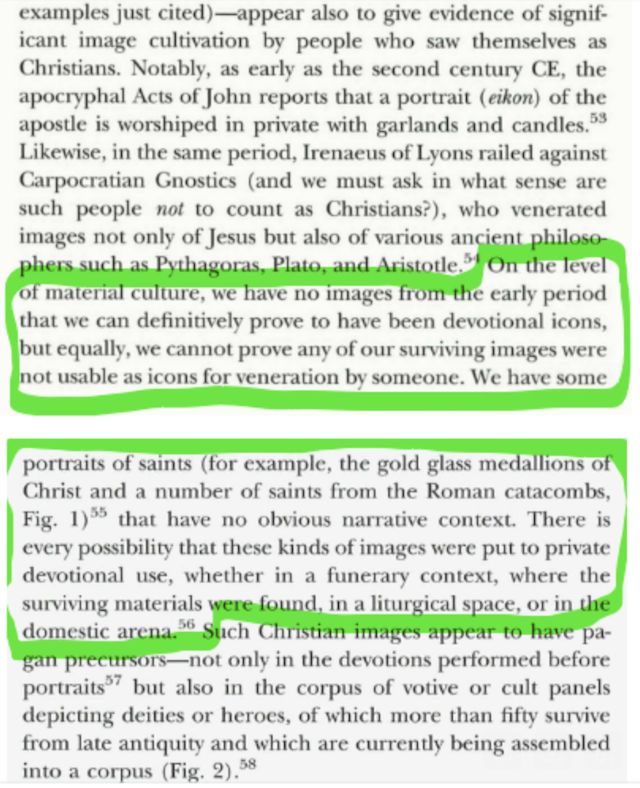
Image 3: quotation from art historian Sean Leatherby acknowledging that many early Christian gold glass images (such as those in the Wilshire collection) are best understood as prayers in visual form.
Image 4: quotation from Oxford art historian Jas Elsner acknowledging the potential for veneration (devotional use) of gold glass images in early Christianity
Simple, because people see different words and assume a meaning they are most familiar with. Few have spent time in say Latin Scholasticism and so are unfamiliar with Satisfaction models and so they do not know how to integrate that language into that framework.
Neither Philaret nor Mogilia were drawing on Reformed sources in the catechism, but Catholic sources. And in some cases we know exactly what those sources were. So we know that they were expressing a Satisfaction view.
So just thinking that "paid for our sins" picks out PSA is making the same mistake those people are making. It is also the same mistake Protestant apologists make. They do the same thing when they see the term "faith alone" in a patristic text and assume it means what the Reformers mean because they don't have any other view in their head where that language fits.
Anyone who believes these councils aren't universal in authority deserves to get flattened by an RC by the "you guys claim councils are the highest authority but haven't had one in 1000 years" argument
Why is Fr. Schooping on a podcast with a guy who thinks Lutherans are heretics to critique EO? We're far closer to the EOC than someone like Ryan from NeedGodnet.
It's one thing to speak to these issues with a Confessional Presbyterian or Anglican, but I don't see the value in discussing these issues with someone who is so far from any sense of sacramental efficacy, historical continuity, or really anything of the Reformation.