Dr. Golea, commenting on Stăniloae, explains that he accepts a penal substitutionary dimension of the atonement but at the same time also an transformation of the human person from within
‘And the Father had pleasure in this state of Jesus, as a melting away of sin, as its humiliation and crushing. It was a suffering as homage brought to God, not as sin against Him. In suffering the torments, Jesus fulfilled the will of the Father; His passion had the highest ethical value, being a suffering in the stead of all men and for the abolition of sin.
Jesus was, therefore, on the one hand, “forsaken” by the Father, subjected to the treatment which sinful humanity deserved, but, on the other hand, He was in accord with the will of the Father, in communion with it.
He was, at the same time, far from and near to the Father. Precisely because He was near to His heart, He felt His distance so greatly. Precisely because He loved Him so much, the abandonment pained Him.
Jesus felt the Father as the wife of Master Manole felt him, while he was building her into the monastery. Reconciling Himself, thus, to taste to the bottom the cup of suffering for sin, without drawing back, experiencing abandonment by the Father, but determining to bear it with the help of prayer to Him, Jesus drew near with every hour to the death on Golgotha, as a perfection and completion of His inner sufferings.’
–St. Demetrius (Stăniloae), “Iisus Hristos sau restaurarea omulu,” pg. 299-300
‘The next modernist tactic is to accuse Orthodox theology of inculcating Western scholasticism, as evidence of the “Latin captivity.” It should be noted that scholasticism is not sterile sophistry, but rather an attempt to systematize theological knowledge using the principles of analysis and synthesis, and the methods of deduction and induction. It should be noted that the Old Testament Church initially had an oral Sacred Tradition, but then, due to the decline in the spiritual level of the people, it needed to be recorded in the form of Holy Scripture, lest it be completely lost.
We can see something similar in the transition from patristics to scholastic theology—when it was necessary to preserve Christian speculative truths through a theological system. This was also a requirement of the times, due to the growing spirit of secularization. At the same time, in Orthodox theology, scholasticism did not reject patristics, but rather relied on it. Unfortunately, in the West, along with scholasticism, rationalism began to penetrate theology—namely, the desire not only to provide a general picture of dogmatics and explain it, but also to test dogmatics itself through human reason. It was precisely this abuse that discredited scholasticism and undeservedly gave it a negative character. But scholasticism itself was and remains a necessary stage in the history of dogmatics; without it, modern theology would degenerate into a chaos of private opinions.
In the Orthodox East, scholasticism was primarily used as a method of school instruction. Scholasticism emerged in the West several centuries earlier than in the East, so it's not surprising that Orthodox theologians were able to use some Catholic texts as their source material, removing errors and inaccuracies, purging them of later misconceptions and theological distortions. This work is reminiscent of the Church Fathers, who used the language and terminology of ancient philosophy in their writings. At the same time, they reinterpreted these borrowings and infused old forms with new content, and in some cases, developed and refined his terminology, adapting it to Christian doctrine.
Until the 20th century, no one accused the Church of “Latin captivity” and apostasy from Orthodox doctrine. Only at the beginning of the revolutionary 20th century did voices begin to demand reform of Orthodoxy. Unfortunately some of these voices came from theological academies. At that time, some teachers and even priests were intoxicated with the word “freedom.” It even reached the point where memorial services for the instigators of the revolution (for example, Lieutenant Schmidt) were demonstratively held within the walls of theological academies, sermons were delivered and published angrily denouncing the suppression of the 1905 rebellion (which Lenin called “a dress rehearsal for the October Revolution”), and students participated in strikes, in other words, expressing solidarity with their future undertakers. In this environment, the slogan “renewed Orthodoxy” arose, and the catchy expression “the Latin captivity of the Church” was coined. One prominent theologian of the time wrote: “The doctrine of the atonement no longer satisfies our contemporaries—they need new ideas.” These words signified a rejection of the eternal truths of Christianity in favour of pragmatics.
There never was and could not be a “Latin captivity” in the Church, otherwise it would have lost its divine inspiration, would have ceased to be the “pillar and foundation of truth,” the keeper of the fire of Pentecost and the immaculate Bride of Christ.’
Archimandrite Raphael Karelin, ‘On Protestantism, Catholicism & the Latin Captivity’
@lukarije@staniloaean I used to think or believe something similar to you but now I do not. I saw and read so much of this language that I started to think "perhaps these men all mean what they say".
Sysoev repeatedly uses “penal substitution,” “substitutionary atonement,” “substitutionary sacrifice,” and similar language, while also explicitly accepting the “juridical/legal theory of redemption”—for all intents & purposes penal substitutionary atonement & satisfactory atonement’s equivalent in Russian.
So where actually is the alleged difference?
Does his understanding differ from the Russian Orthodox Church’s own description of the general Protestant & Catholic teaching on atonement (itself) in its Encyclopaedia?
Does it differ from the formal definition supplied by Russian priests who are critical of the position, such as Archpriest Davydenkov in his dogmatics lectures?
Does it differ from the definition given by popular Protestant sources and by certain English-language scholarship, such as material associated with the University of St Andrews?
If it doesn’t, your assertion sort of falls flat here.
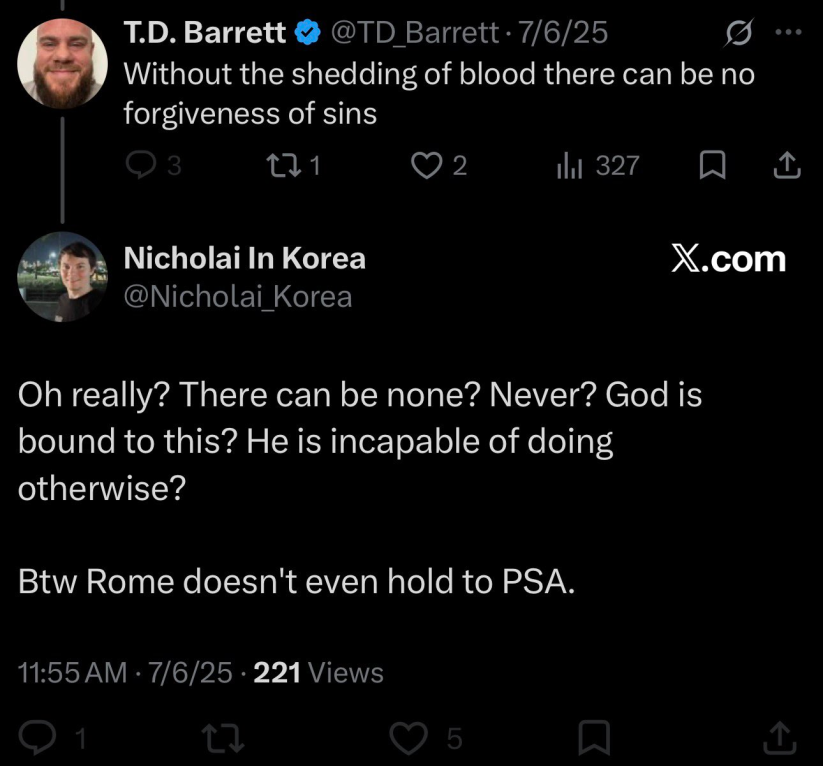
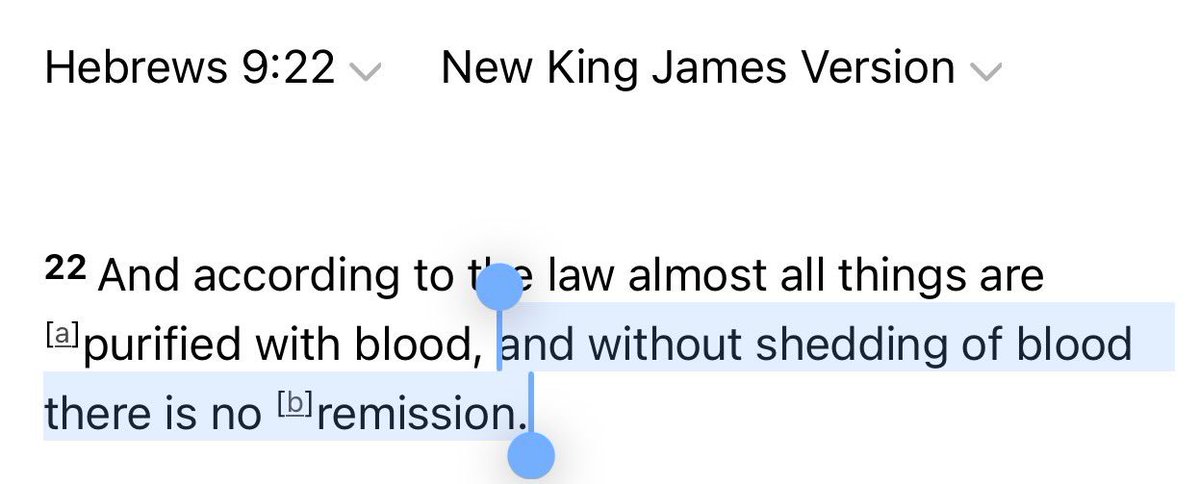
Just a reminder that PSA is the Gospel. The formal content of our theory of atonement is penal and substitutionary. Anyone can put 1 + 1 together and call it PSA, or they dont and just call it atonement. either way the content is identical and so the semantic is irrelevant.