@mladenovic878 Would add Marketplace reviews and we also crawl the Reviews, forums, competitor ads, groups, reel comments of other products for the same problem/desire to get inspiration for new angles to test.
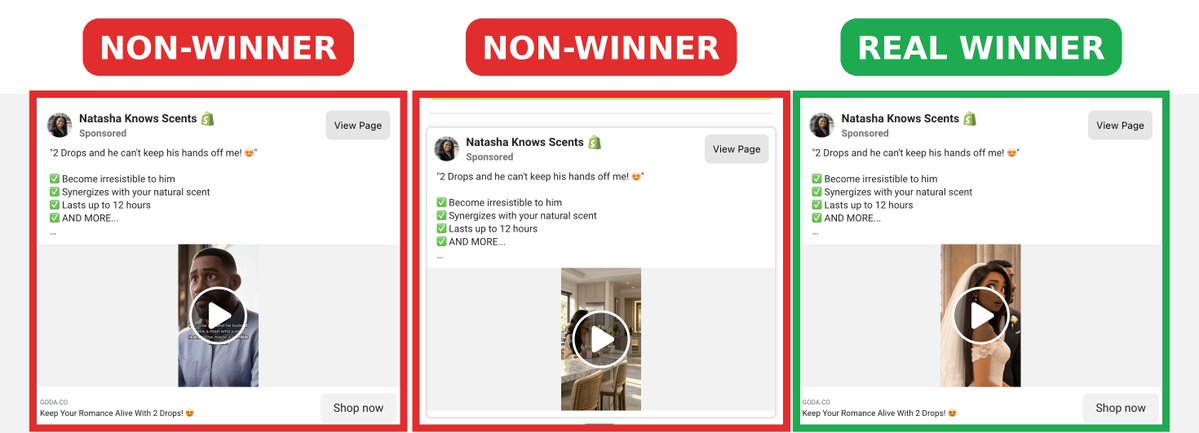
the difference between a good and a bad creative strategist is knowing this:
big brands hide their real winners
they flood the ad library with ads that are bad on purpose and run engagement campaigns on them so they rack up likes and comments and get high rank in meta ads library (where all cs's look everyday)
make sure not to swipe ads blindly, do your research 😴
General make the Video faster, try to compress this message in 45-60 sec.! Its hard for me to watch this and to understand the Message. Do the editing more spectacular: Change the scenes, insert some cuts, maybe animations. Spit them facts in their face and brainwash them as long you have the attention!
First of all you should do a market research. You have to understand Your customer to make tell them what they need to hear to buy.
One Framework could be:
Hook -> Problem -> Solution/Benefits -> CTA
Or whats also works very good for products like this: postive ads, you selling the best possible life thanks to your product. you tell the story
use better hooks, would recommend 3 per Video: take a look at your competitors what’s working – don’t have to be the same product and swipe it.
Otherwise proven hooks are curiosity, fear, make a promise, a proof, the desired outcome…
Wtf? You spend 300$ for tokens? How did you manage that bro??? Write me a DM, we produce Ads like this for 2$ max each, I will give you some tips to get much, much lower production is. You can do it yourself. The ads are Boring af 😅 Boring hooks, nobody cares and After 5 sec u still dont know what it is about. Editing also Boring, they are also too slow
100% agree, Agencys that want to pull u in a call to even tell you the terms and prices, not to mention the contract terms for 12 month+ piss off the most 😂 Never understood this funnel tbh.. When u realy deliver value, you dont have to worry about getting reccuring clients. At my agency everything is transparent, I dont have to convince or pressure someone in a call, if there are calls we focus on fullfilment things to get better results. Works a lot better overall
Exactly what I think. eCom have its downsides too, Cashflow, Payment Processing risks, Margins, Acquistion costs to Name a few.
But when you have an App or SaaS or Agency, you can be replaced within a few months, once a new disruptive tool releases. When u have a reliable supply chain, deliver good quality products with reccuring demand fast and know how to sell it, you have a much better fundament for the next years.
I think it’s the best time ever to be in ecom.
Physical products are way harder to replace with AI than digital products. AI can help you build an app/saas/write booksmake music/movies, but people still need tangible products manufactured and delivered to them.
That’s part of what makes this industry durable, but how we operate in it will change a lot.
1. Acquisition will get way more personalized.
Very specific ads and funnels for very specific people and problems, at scale.
Before, building all of those took a lot of time and people, with ai, you can go much more specific without needing a huge team.
2. Teams will get much smaller.
One good person with AI can cover what used to be several roles. I think we’ll see more roles like:
- Growth engineer: performance marketing, media buying, CRO, A/B testing, unit economics and analytics.
- Creative engineer: creative strategist, editor and designer in one.
- Operations engineer: supply chain, payments, customer service, sourcing and procurement.
- Product engineer: customer research, product development, R&D, testing, quality and continuous improvement.
Not saying every company will have exactly these four roles, but that’s the direction I see things going.
3. Competition will get more global.
As supply chains get more global and localization gets easier, bigger brands will be able to enter smaller markets with fully localized ads and funnels.
I also think Chinese manufacturers will get much better at branding and marketing.
They already know how to make the products. As they get better at selling them too, I think they’ll take a bigger share of some categories, like we’re seeing with cars.
So what stays defensible?
- Actual creativity, combined with acquisition and distribution. Being able to spot something, jump on a trend and execute better than the rest.
- An actual good product. Doing R&D and continuously making what you sell better.
- And brand. Making people genuinely care about your company and product. But that’s much harder to build.
If I were starting now, I’d prioritize learning acquisition and distribution.
Ecom is already extremely competitive, learning how to acquire customers in this industry gives you skills you can take into plenty of other industries too.
So yes, I’m very bullish on ecom.
I wouldn’t assume the way we do it today will work forever, but I think it’s a great industry to build in and a great place to build transferable skills.
The main benefits were cost, speed and creative flexibility. AI produce u dozens of different hooks, angles, characters, and scenarios in an hour, at a fraction of the cost. So u can grow your testing exponentially: more creativies, faster learning and faster optimization, without the constraints of creator availability or production budgets. No I wouldn’t say ads lasted significantly longer, I didn’t collect enough data to show that. The real payoff was a huge increase in creative output, and a reduction in driving costs. Platforms love new content and will reward you for it.
Normal UGC Is a Competitive Disadvantage Now
I ran a six-figure air purifier store.
Ads died every few weeks. Every advisor said the same thing: get more UGC.
So I did. A lot of it.
Most collabs were fine. About 10% weren't — and that 10% still ran through a platform with briefs, deadlines, and "protection."
Those misses didn't just cost the fee. They cost time, product, and momentum while brands that stopped waiting on creators kept testing.
Two that stuck with me:
Creator #1
Shipped a €50 product. Fee upfront. Then silence.
I wrote that I hadn't expected that from a 50-year-old mother.
Instant reply. Zero footage. Full drama.
The job got nothing. The insult got an essay.
Creator #2
Confirmed. Shipped. Package sat seven days.
Excuse: Black Friday was busy. Then she threatened to trash my brand in public.
I was waiting. I was out the product. Somehow I was the problem.
Platform or not — you're not buying a video.
You're handing timeline, inventory, and reputation to a stranger with no skin in your CPA.
Too slow. Too expensive.
Brief. Ship. Wait. Chase.
Get "Hi guys, so today I wanted to share…"
They skip the benefit you asked for in the first 3 seconds. Twenty seconds of unboxing. Basement lighting. Revision. More waiting.
Your winner is dead. You paid $150+ for one angle.
That's not a testing system. That's lottery tickets — while your competitor ships weekly.
Do the math
You need 20–50 variations, not 3.
30 videos × $150 = $4,500 before shipping and revisions.
One batch every 2–3 weeks.
Whoever tests faster finds the next winner first.
Normal UGC as your only pipeline is a competitive disadvantage. New rules.
The real cost isn't $150.
It's the dying ad you keep scaling. The angle you never tested. Your best idea rotting in DMs for 19 days.
Slow creative costs more than expensive creative.
The actual bug
Creators aren't lazy. They're guessing — unless you feed them proof.
They don't know which competitor ads ran 60+ days.
They don't know your 1–3★ review language.
They don't know which promise buyers already believe.
So they film content. Content isn't ads.
Ads that sell start from proof:
1. Market — angles still getting paid spend in your niche
2. Customer — exact words for the problem, the failed fix, the buy moment
Best ads use both.
Then production with AI: multiple concepts, multiple hooks, every ratio — in days.
I'm not dropping the full workflow. The rule is enough:
Proof first. Production second.
UGC isn't dead. Your dependency is.
Most creators I worked with delivered. Some are excellent.
If you find one who gets direct response and delivers on time, keep them — as a supplement.
Real faces for trust. Formats AI still fakes badly. Proof clips next to volume.
What kills accounts is making UGC the whole machine.
Too slow. Too expensive. And even with a platform, a chunk of that pipeline will still burn you.
You lose the testing race.
New rules
1. Volume and speed from research + AI
2. Creators where a real person actually moves the needle
3. Never wait 3 weeks for your next test batch
Speed wins
Not the prettiest creative.
The most ideas before cash runs out.
3 weeks + $4,500 → careful, dying ads, under-test.
Days → kill losers fast while the other guy writes a creator brief.
It's not AI vs humans.
It's iteration vs waiting.
What I do now
- Don't pay for guesses. Start from what's working and what customers say.
- Don't wait weeks. Creative in days.
- Don't test 3. Test 30.
- UGC as add-on — not as the bottleneck.
Stuck in the waiting loop?
That's why I built this.
AI ad creatives for ecom — market research + customer language — delivered in days.
- €149 Starter — 6 ads (3 videos + 3 statics) in 2 days after briefing
- €1,190 Testing Pack — 28 creatives with a test plan
→ https://t.co/L2TFYFmIEu
No lock-in. No ROAS theater.
More shots on goal — without waiting on someone else's calendar.
Focus on winning every single day!
Dont worry about the big picture or the end goal because those things usually change. You must set goals and learn patience while you work to accomplish them. If it was easy it wouldnt be rewarding. Half of the fun is the journey!
@jammer3k Before you add BF budget, check the new per-asset breakdown on your top 3 ads. I've seen "winners" where one weak image ate ~40% of spend. Kill that asset first — cheaper than another creative batch.
@williamkast_ That stack works because each layer has a different job. TOF AI = pattern interrupt. UGC = objections. Statics = offer. Most brands paste the same script into all three and wonder why mid/BOF dies. Match the line to the job.
@williamkast_ Most of that backlash is about fake trust signals, not AI. Fake doctors and fake founders kill it. What works: visuals only AI can do + a hook stolen from real buyer language. Medium is fine. Message is the filter.
@williamkast_ True — and the fastest lever is usually the first 3 seconds. If hook rate is soft, no landing-page tweak saves the account. Pull your top 5 spenders, rewrite only the opening line from 1–3★ review language, keep the body. You'll know in ~48h if creative was the bottleneck.
@rokhladnik Agree. AN pads cheap impressions that look fine in Ads Manager and trash blended CPA. Kill it at account level, let Feed/Stories re-learn a few days, then compare purchase CPA — not CPM.