Great Books for Summer or Winter Reading: Thought-provoking, perhaps controversial, and certainly worth reading!
"The Third Pillar: How Markets and the State Leave the Community Behind" by Raghuram Rajan.
"Raghuram Rajan, distinguished University of Chicago professor, former IMF chief economist, head of India's central bank, and author of the 2010 FT-Goldman-Sachs Book of the Year Fault Lines, has an unparalleled vantage point onto the social and economic consequences of globalization and their ultimate effect on our politics. In The Third Pillar he offers up a magnificent big-picture framework for understanding how these three forces--the state, markets, and our communities--interact, why things begin to break down, and how we can find our way back to a more secure and stable plane."
https://t.co/b9Zu2jgt53
1/ I joined @MarkusEconomist's Markus' Academy (Princeton) to talk about neglected risks in private markets — returns, diversification, fees, liquidity, and why these risks get ignored. The team's summary in a thread. 🧵 Full talk: https://t.co/aWLLnJMw4u
The PRICE of an asset is simply the solution to marginal supply and demand. All of the below are estimates of "Value" and create a catalyst only when the cash flows internal to the company create external cash flows that change marginal supply and demand, e.g. dividends or buybacks
Fundamental Theorem of Welfare Economics: Every competitive equilibrium is Pareto optimal.
How did Arrow and Debreu prove it?
My new article about it:
https://t.co/IugMbqIzvu
My paper ‘Economic Viability of Sports IP Investments’ now available.
https://t.co/oJnzUfCf58
This paper traces the challenges and potential in licensing and commercialization of sports IP assets that hinder, yet would otherwise enhance, investor confidence and revenue streams.
Ray Dalio: Fiat monetary systems are approaching their endgame.
Most major economies are structurally over-indebted.
There are only three ways to deal with that:
1) Austerity: Politically impossible. No one is talking about DOGE
2) Default: Would trigger a global depression-level event.
3) Inflation: Devalue the currency to make the debt manageable
Only one option is politically viable: printing money.
That’s exactly what happened after WW II.
The US entered the post-war period with debt-to-GDP levels similar to today, then inflated that debt away, bringing it down to ~30% by the late 1970s.
This enabled Volcker to hike rates to nearly 20% and finally crush inflation.
That’s exactly why central banks are accumulating gold.
- Gold can’t be printed
- Diluted
- Devalued by policy.
It’s the natural hedge against the money printer, and the final settlement asset when fiat credibility dies.
THE BUDGET CYCLE ~EXPLAINER
(Understanding the Budget Cycle empowers citizens to move from passive observers to active, informed participants in national development.)
The Budget is not a one day event. It is a structured, year round constitutional process that determines how public resources are raised, allocated and accounted for.
Kenya’s Budget Cycle runs from 1st July to 30th June and is anchored in the Constitution of Kenya (2010) and the Public Finance Management Act, CAP 412A.
Here is how it works:
Planning & Policy Formulation (August – February)
Led by the National Treasury, this phase Involves:
30th August of each year- Issuance of the 1st Call Circular - kick starting of the budget process
Budget Review and Out Look Paper- Submitted to the Cabinet by 30th September Each Year - containing economic forecast (medium term fiscal framework) as follows:
✔️ Economic growth projections
✔️ Revenue targets
✔️ Sector expenditure ceilings
✔️ Fiscal deficit levels
Public Hearings- Input from Public and Stakeholders
The Budget Policy Statement (BPS) is submitted to the Parliament of Kenya by 15th February each year. - This defines the fiscal direction for the coming Financial Year.
Submission of the Budget Estimates and Related Documents - by 30th April every Year. Key Documents submitted to Parliament:
Expenditure Estimates
Revenue Estimates
Finance bill
Any other Documents Related to Budget
Legislative Approval (May – June)
Parliament debates and approves key Bills, including:
Finance Bill
Appropriation Bill
Division of Revenue Bill
County Allocation of Revenue Bill
County Government Additional Allocation Bill
Budget Statement - Budget Day (usually the second Thursday of June), the Cabinet Secretary for the National Treasury presents the Budget Statement to Parliament.
Budget Approval
The Appropriation Act and Presidential Warrant - authorizes government spending.
The Finance Act (of that year) gives legal effect to revenue and tax measures.
Implementation (July – June)
Funds are released to Ministries, Departments and Agencies
Development projects are executed
Public services are delivered
Revenue measures take effect
This phase focuses on efficient execution and prudent financial management.
Audit & Accountability
After the Financial Year ends:
Financial statements are prepared
The Auditor-General audits public accounts
Reports are submitted to Parliament for oversight
This ensures transparency, accountability and value for money.
🔁 The Budget Cycle is continuous
As one budget is being implemented, the next is already being prepared under the Medium-Term Expenditure Framework (MTEF).
The Budget reflects national priorities, fiscal responsibility and the Government’s commitment to sustainable economic growth.
#BudgetCycle #PublicFinance #Kenya #FiscalResponsibility
Plastic pollution threatens marine life and poses risks to human health.
We must urgently change the way we produce, consume & dispose of plastics.
See what is the UN doing to #BeatPlasticPollution➡️ https://t.co/NIlpYW35Dv
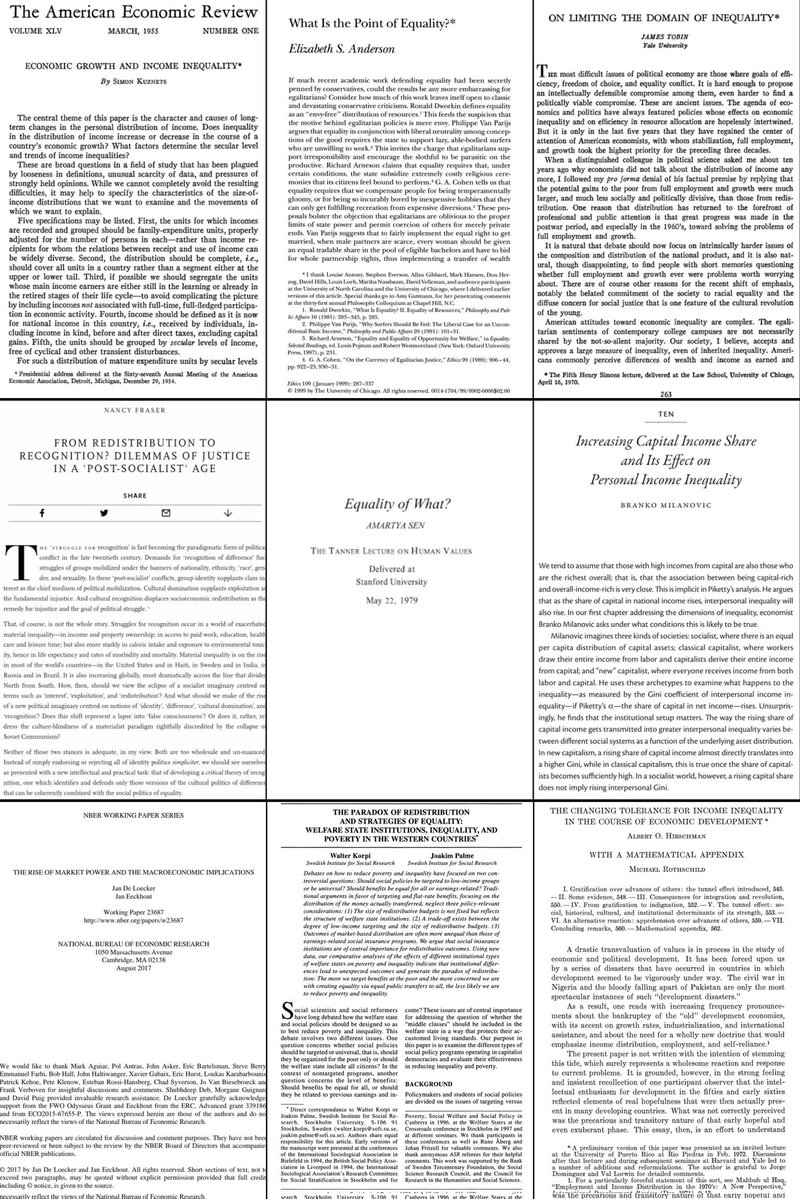
We rarely think of economics as scandalous, but maybe we should. Sam Bowles, in conversation with @sndurlauf & @ethanbdm, argues that a core assumption in the field impedes moral reasoning about wealth redistribution. Watch the full panel → https://t.co/OBAwhPCtXX
Hi all, I've uploaded the 2025 update to my PhD Applied Econometrics slides:
➡️ More on regression & causality
➡️ Dynamic panel data models
➡️ Streamlined diff-in-diff extensions
➡️ More on spillover effects
➡️ Results from new papers on many topics
Link in the original tweet
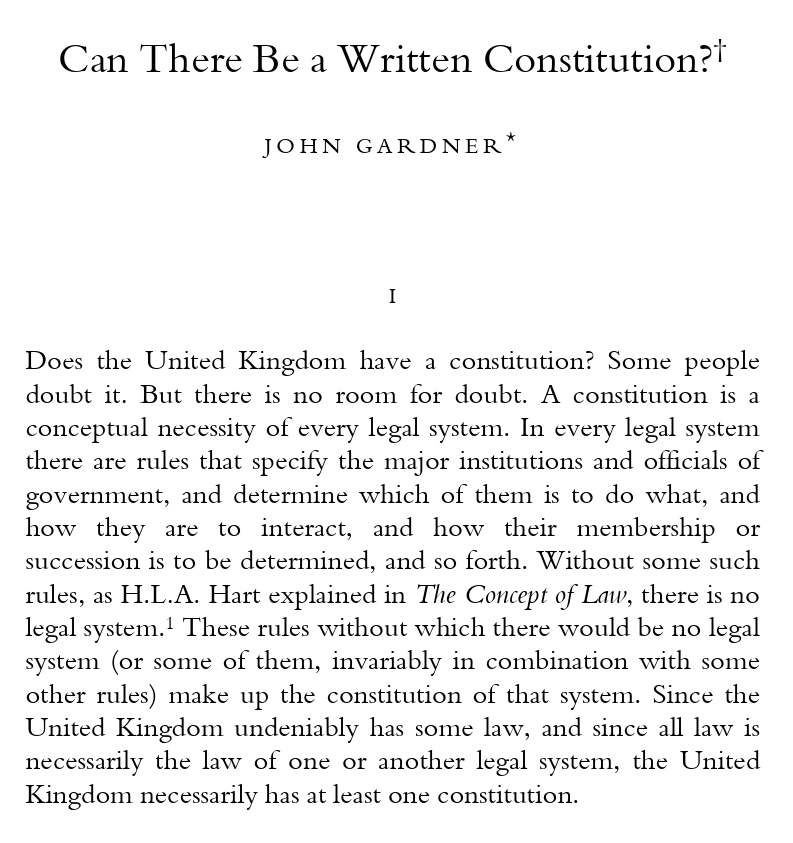
🤩 One of my favorite papers about constitutions, written by one of my favorite teachers ever.
The question the late John Gardner seeks to answer is whether constitutions can "be, or be contained in, documents."
Beautifully written and reasoned, this paper will stretch your mind.
Full text here: https://t.co/2AgbMKHDqt
Food for thought!
"Central bank digital currency and monetary sovereignty" by Lucrezia Reichlin.
"Calls for a digital euro increasingly invoke monetary sovereignty, often on the grounds that Europe must retain control over its payment systems. This column argues that this reasoning conflates two distinct elements within the monetary system: money and payments. Sovereignty has never depended on universal access to public money or control over payment rails, but on legal authority over the unit of account and the capacity of the central bank balance sheet to absorb risk. Private money anchored by public backstops is the historical norm. The main competitive challenge today arises at the level of broad money, where stablecoins compete with bank deposits rather than with cash or central bank money. In this context, the digital euro is best understood as a symbolic response to payment-system dependence and fiscal fragmentation, rather than a functional requirement for monetary sovereignty."
https://t.co/qFvhKOOejt
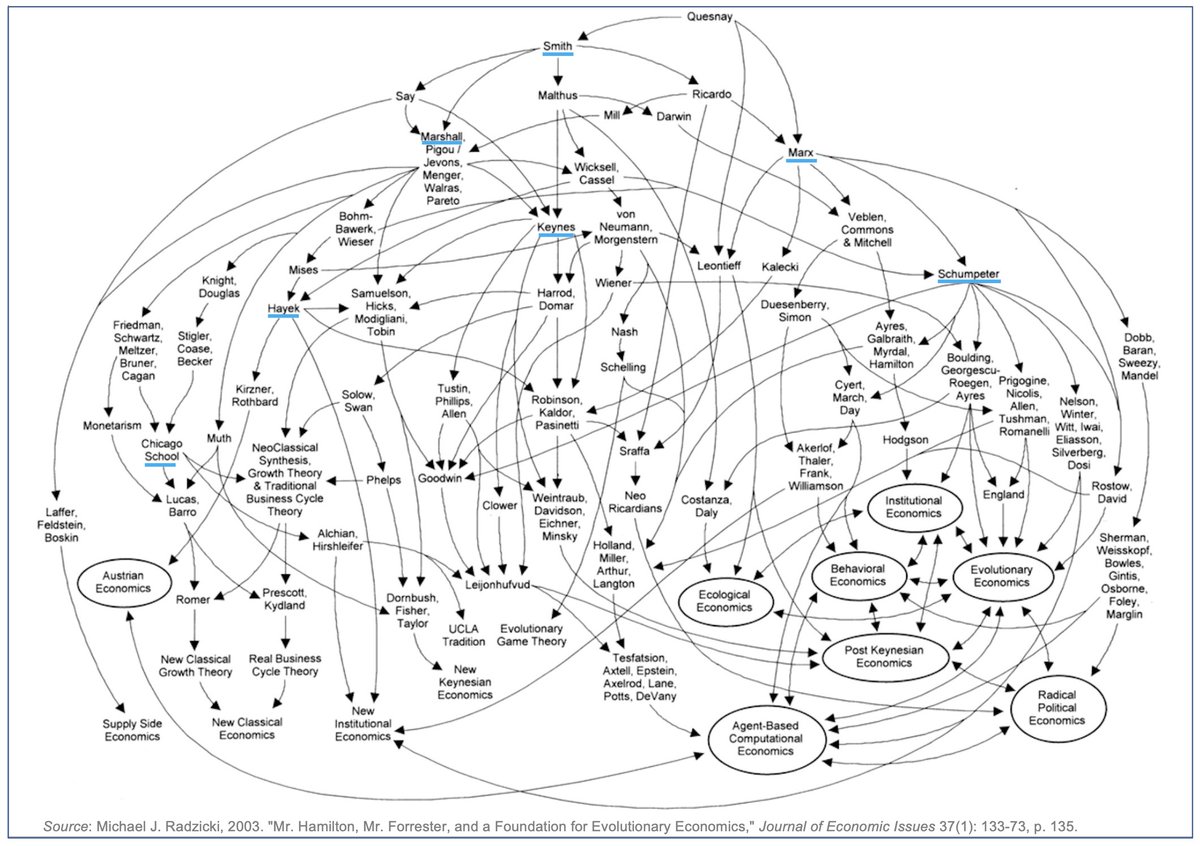
Schools of Thought in Economics
This figure links Smith, Marx, Marshall, Keynes, Hayek, Schumpeter and others to contemporary schools of thought. It helps to understand the genealogy of influential economic theories.
To see it better, download and expand it.
The EU’s decline has been studied... And then implemented.
For years, the EU has spent millions researching degrowth and “beyond growth.”
The framework is clear:
- Shift focus from growth to the environment
- Replace GDP with "beyond growth"
- Reduce energy consumption
Strip away the branding
and it becomes obvious.
“Beyond growth” is Net Zero.
And Net Zero requires:
- less industry
- less production
- less energy use
The EU’s deindustrialization
is not an accident....
It’s the intended outcome.