Today, we introduced Sky 1.
Sky 1 is a new model that rebuilds the world’s starting picture of the atmosphere every hour, six times as often as global operational models today.
Over the past decade, most investment has focused on improving the forecast itself. Until recently, understanding the starting conditions from which a model initializes was largely treated as plumbing.
While global modeling engines raced forward, the fuel for their ignition continued to arrive just four times a day.
Our satellites have driven improvements across our modeling stack since their launch. With Sky 1, they now contribute to creating a global atmospheric baseline from which global forecasts can begin—a completely new picture of the atmosphere in its current state, delivered 24 times a day.
It took a team that builds satellites and atmospheric models in the same building to put this together—because the two go hand in hand.
Here's an online course on an Introduction to Machine Learning.
https://t.co/7xtik1MTSC
It covers fundamentals, #scikitlearn, #TensorFlow, #Keras, #PyTorch, #PyTorchLightning, data pipelines, tuning, transfer learning, and distributed training.
Image: https://t.co/nnC7urSXKo
Here's an online course on High Performance Python.
It includes profiling, vectorisation with #NumPy, compiling with #Numba, parallelisation with #Dask and #Ray, and using GPUs with #JAX and #CUDA.
https://t.co/2EPZvGr882
The cool GIF is from the excellent #Dask
Europe and US in total or partial lockdown to mitigate #COVID19.
Soon more hundreds of millions will be confined to their homes. Huge personal sacrifices. Staggering economic losses.
Ok, we accept the price for the common good. But how does this end? Here are some strategies:
People are asking whether patients with COVID19 who don’t have symptoms, e.g. cough or even just fever, can transmit the disease to others. The answer seems to be yes. Alas, this is not good news, but we can still take rational steps. Let’s talk about this. #QuarantineLoophole 1/
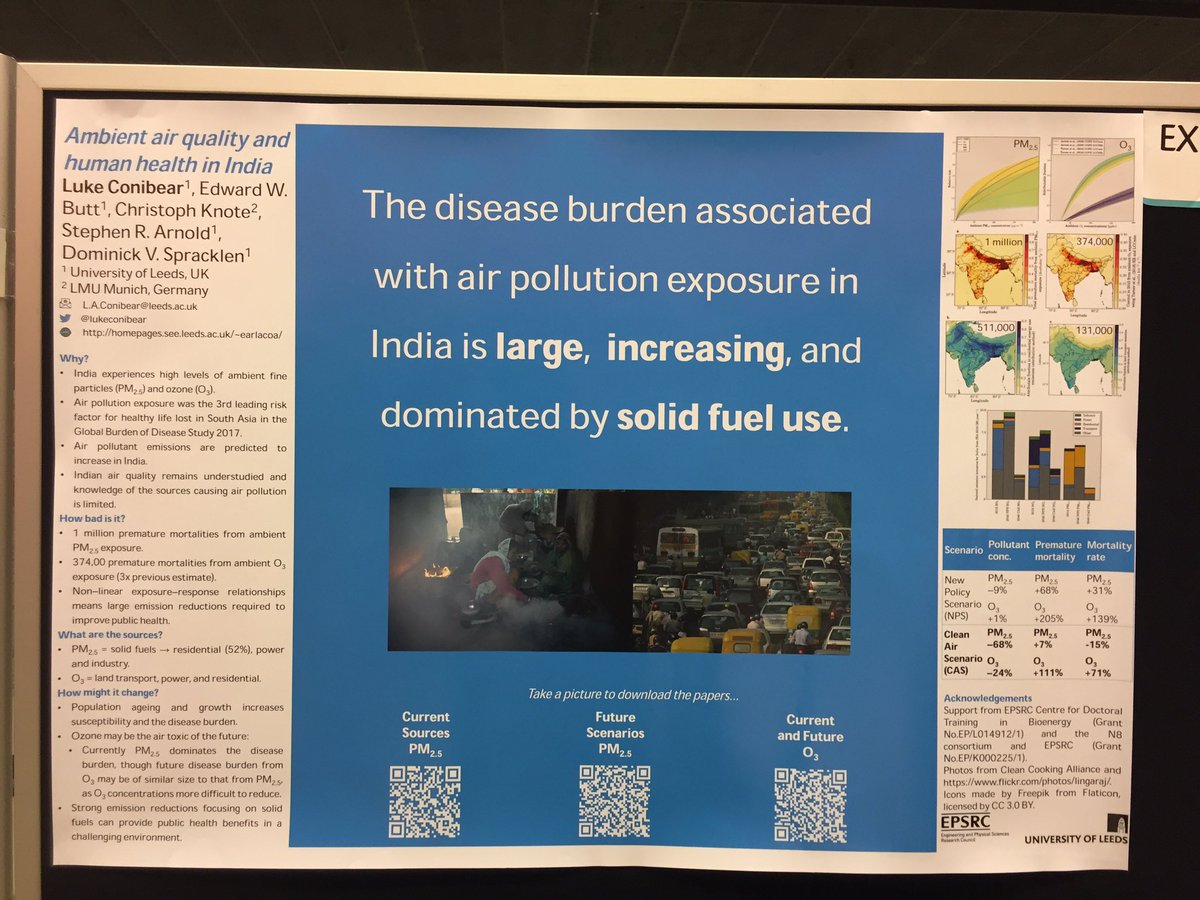
If #health matters: China’s air pollution control policy needs to be adjusted to reflect the current main sources of population exposure to #PM25 & #IPWE. Domestic combustion and agriculture should now be prioritized, see https://t.co/UDAoX9WaEG
New paper led by @laurafkiely shows Indonesian peat fires put out more smoke (particulates) than previously thought. Implications for the impact of fires on air quality @cwiedinm@MTalib_Latif https://t.co/XlJBbHdQ6U
The rural household solid fuel substitution campaign in North China, targeting ambient air pollution, reduces exposure - mainly due to reduced HAP! Great to see our integrated approach to exposure assessment for #PM25 is being used and further developed. https://t.co/2wkV4jOcU3