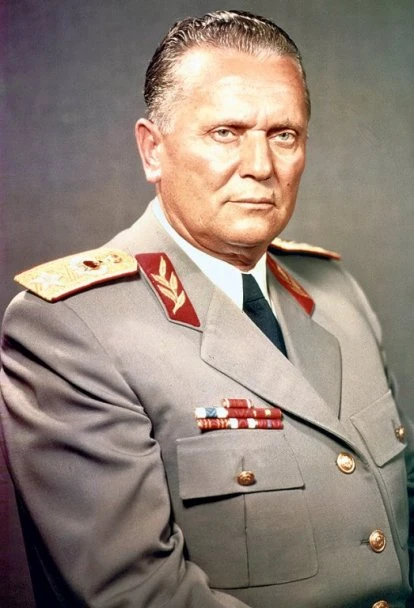
Josip Broz Tito built Yugoslavia's socialist economy on a supposedly clever premise: worker self-management. Factories would be run by elected workers' councils rather than central planners in Belgrade. Western intellectuals practically wept with admiration. Here, finally, was socialism with a human face.
But the math never worked.
Worker-managed firms systematically chose higher wages over capital reinvestment, because workers capturing today's income had no personal stake in machinery that would outlast their tenure. The incentive to maintain and expand productive capital simply vanished.
Yugoslav firms borrowed heavily from state banks to cover the gap, and those banks lent freely because the political cost of bankruptcy was too high for any official to absorb. Inflation ran at 30% annually through most of the 1980s, eventually hitting 2,665% in 1989. You didn't need to theorize about the collapse; you could read it on the price tags.
Tito papered over the structural rot with Western loans. Yugoslavia accumulated $20 billion in foreign debt by his death in 1980. That borrowing bought political legitimacy, but not productive capacity. When global interest rates spiked under Volcker's Fed, the debt service alone crushed the economy.
The decentralization of Tito's model also contained a fatal political logic. Each of Yugoslavia's six republics developed its own economic fiefdom, protecting regional industries from competition with other regions. Six separate planning bureaucracies fought over the same shrinking pie. Slovenia and Croatia, the most productive republics, grew resentful of transfers flowing south and west.
Property rights remained collectivized throughout. No worker actually owned his share of the firm, which meant he couldn't sell it, pledge it, or use it to signal genuine economic preferences. Prices carried noise instead of information. Capital flowed toward political favor rather than toward producers with better ideas.
Socialism doesn't work, whether it's centralized or decentralized.
Just so we’re 100% clear:
A Haitian gang abducts four Salvadoran soldiers from a United Nations mission.
The President of El Salvador launches a rescue operation to bring back his people.
The gang leader asks the UNITED NATIONS to rescue his gang from the rescue operation.
No words.
Johannesburg's city government emptied its own water company's bank account the night before a new rule would have locked that money in for water.
About $200 million, down to zero.
Four months later, people in the city that's home to Africa's biggest stock exchange are lining up at trucks for 13 gallons of water a day.
Johannesburg buys its water from a big regional supplier called Rand Water, and nearly half of what it buys disappears before anybody gets a bill for it. About a quarter of all of it just leaks out of busted pipes into the dirt. Over the past year the city logged more than 50,000 leaks. That works out to about 140 a day, every single day.
Fixing the whole network would cost something like $1.6 billion. At the pace they're going now, one South African think tank figures it would take about 200 years to replace all the old pipes.
The city pulls in roughly $700 million a year selling water, and less than $80 million of that goes back into building and fixing the system. One watchdog group says the city has swept more than $350 million out of the water company this term alone. After the June raid, the water company couldn't pay about $100 million in bills and shut down most of its projects, leak repairs included. So even more water leaked.
Now follow the money on the other side. Every time a pipe stays broken, somebody gets paid to drive water into that neighborhood on a truck. Johannesburg has spent almost $40 million on water trucks in five years, and it still won't tell anyone who got the money. A court threw out one $16 million truck contract last December over irregularities. An investigator with South Africa's Human Rights Commission said they found evidence that water infrastructure was sometimes sabotaged on purpose to drum up truck business, and the country's own water minister has called the people behind it a mafia.
What gets me is that the family waiting at the truck for their 13 gallons still counts as having water service in the official numbers, because their house has a tap.
south africa went from a first world country with nuclear power and one of the largest railway systems in the world to a third world country in just 30 years
progress is not a guarantee. decay is the natural state of things