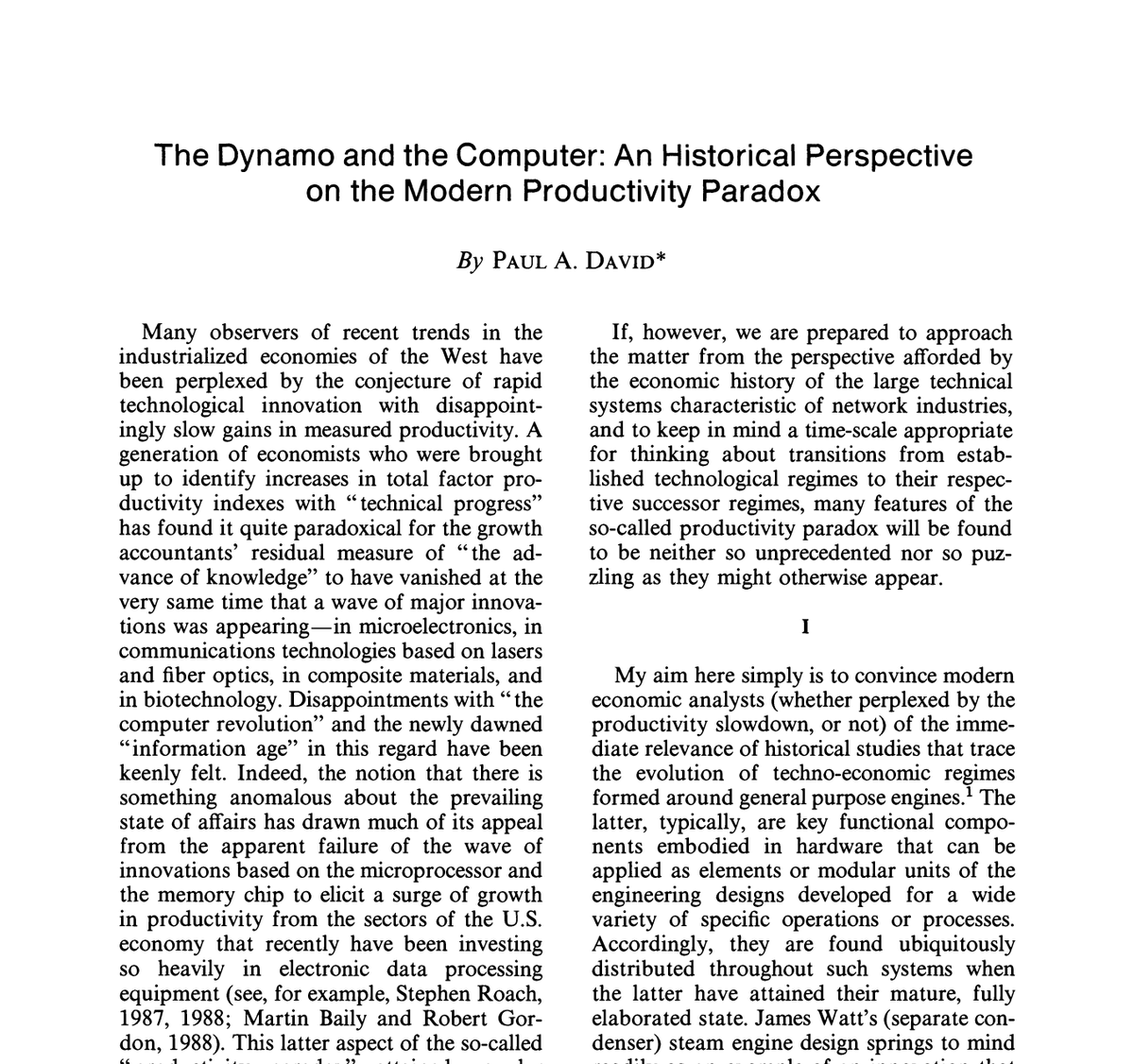
If you've adopted AI at your company but haven't seen any tangible results, read this 1990 article: "The Dynamo and the Computer" by Paul David.
When electricity first arrived, factories that "adopted" it barely got faster. They just swapped the steam engine for an electric one and ran everything else exactly as before: same machine layout, same workflow, same management. Electricity in, no real gains out.
The most common mistake with any new technology is to drop it into the old organization and then declare the transformation done.
The real leap came decades later, when each machine got its own small motor. Suddenly machines no longer had to be lined up around one central drive shaft. They could be rearranged around the actual flow of work.
The productivity gains didn't come from electricity. They came from REDESIGNING THE ENTIRE FACTORY around it.
AI is the same. Bolting it onto your existing process gets you a faster steam engine. The payoff comes when you redesign the work itself.
(link to paper in comments)
As an AI Engineer. Please learn
>Harness engineering, not just prompt engineering
>Context engineering, not just long prompts
>Prompt caching vs. semantic caching tradeoffs
>KV cache management, eviction, reuse, and memory pressure at scale
>Prefill vs. decode latency and why they optimize differently
>Continuous batching, paged attention, and throughput optimization
>Speculative decoding vs. quantization vs. distillation tradeoffs
>INT8, INT4, FP8, AWQ, GPTQ, and when quantization hurts quality
>Structured output failures, schema validation, repair loops, and fallback chains
>Function calling reliability, tool contracts, argument validation, and idempotency
>Agent guardrails, loop budgets, tool budgets, and termination conditions
>Model routing, graceful fallback logic, and degraded-mode UX
>RAG architecture: chunking, embeddings, hybrid search, reranking, and freshness
>Retrieval evals: recall, precision, grounding, attribution, and citation quality
>Evals: golden sets, regression tests, adversarial tests, LLM-as-judge, and human evals
>LLM observability as a first-class discipline: traces, spans, tokens, latency, errors, and drift
>Cost attribution per feature, workflow, tenant, and user journey not just per model
>Safety engineering: prompt injection defense, data leakage prevention, and permission boundaries
>Multi-tenant isolation, cache safety, and cross-user context contamination prevention
>Fine-tuning vs. in-context learning vs. RAG vs. distillation and when each is the wrong tool
>Latency, quality, cost, and reliability tradeoffs across the full inference stack
>Production failure modes: hallucinated tool calls, malformed JSON, stale retrieval, runaway agents, and silent eval regressions
the cost of shipping code went to zero
taste didn't
but "taste" sounds mystical and unfixable, so nobody teaches it. here's the unmystical version: taste is just an eval you haven't written down yet
how you choose what to measure is what matters
1/8
The "GTM engineer" role didn't exist 18 months ago. Now every series A SaaS has one in their JD pipeline. Here's why the role even needed to be invented:
Two years ago, what one GTM engineer does today would have required 4 or 5 people:
→ A list builder who knew Apollo, ZoomInfo, and scrapers
→ A copywriter who understood outbound vs. brand
→ A RevOps person to set up the CRM and tracking
→ A BDR to actually send the sequences
→ A sales manager to tie it all together
They ALL had to be perfectly in sync for the business to make money.
Most teams couldn't pull it off.
Then AI showed up.
Suddenly one smart person, working with the right tools, could replace most of that chain.
A new role got named. GTM engineer.
But "GTM engineer" is the most slippery title in B2B right now.
Some companies expect you to send MQLs to AEs... Others want you owning inbound tracking... others want you running the whole funnel from cold outreach to revenue.
The job description shifts company to company.
What does NOT shift is the skill stack you actually need to be good at it:
1 - Marketing fluency
Not "running ad campaigns" marketing.
The other one.
→ Understanding offers, angles, positioning
→ Researching a target audience and writing a message that lands
→ Knowing what your ICP cares about, not what they say they care about
This is the rarest skill on the list. And it's the one most ex-engineers underestimate.
2 - Living in the tools
Most of the bottleneck for GTM engineers is awareness.
→ People don't know that something CAN be done
→ They don't know which tool just shipped a feature that would solve their problem
→ They're not in the right conversations
3 - The ability to figure shit out
You don't need to be technical. A little, but not much.
→ Read API docs without giving up
→ Push past errors without panicking
→ Stay motivated to solve the problem you've been handed
With AI, that's enough.
The bar for "GTM engineer" is NOT a CS degree.
It's curiosity + marketing + tolerance for ambiguity.
If you have those three, you can ride this role for the next 5 years.
seeing so many people make creative microsites lately and many of them using open source materials, so i made a list of 50 public APIs and databases to inspire your next idea. lmk if you have any additions!
This is effectively the #1 problem for AI agents in the enterprise.
As we go from agentic coding (where a large amount of context is in the code base, and users are technical enough to get the rest to the agent easily) to a world of knowledge work agents, the context problem becomes much more acute.
We see this every day with customers at Box. For existing digital knowledge, it’s often fragmented across legacy systems or environments that don’t play nice with agents, and have access controls that don’t map to the real work that needs to be done, which become a huge hurdle for getting agents the context they need. This has to all get moved to modern, secure cloud environments.
But also, companies often haven’t captured and digitized some of the critical context that agents need to work with. Decisions, processes, and workflows often live in people’s heads and tribal knowledge that need to get turned into unstructured data for agents.
This is actually one of the biggest points of leverage for applied AI companies, because they can work to specialize in getting agents exactly the information and domain expertise they need. But it’s also one of the reasons why FDEs and new system integrator plays will also work so well right now.
The companies that figure this out will be able to get the most out of AI going forward.
Because taste is not a fixed target. It is a moving social negotiation. Once certain aesthetic and interaction conventions stabilize culturally, models can absorb and reproduce them. Which means the frontier continuously shifts toward producing what has not yet stabilized.
Sources: Amazon has shut down an internal leaderboard that tracked employees' use of AI tools after workers tried to boost their scores with needless tasks (@rafeuddin_ / Financial Times)
(Visit Techmeme dot com for the link and full context!)