‘THIS IS WHAT THEY’RE DOING TO US BECAUSE WE ARE IN THE MINORITY’
Naglabas ng hinanakit si Sen. Pia Cayetano matapos ipa-subpoena ang ilang opisyal kaugnay ng imbestigasyon sa ipinatayong sports complex sa New Clark City sa Tarlac.
“Paano naman makaka-focus on our athletes kung ginaganoon kayo, 'di ba? […] I am very sad that it impairs our ability… to give my 100% to you, guys,” pahayag ng senadora sa mga atleta sa Senate hearing para sa post-evaluation ng 2026 Asian Games.
"I'll be honest with all of you. If you come to me and tell me to amend the budget, to include a bigger fund, I will be scared because government today haunts you, persecutes you when you invest in athletes,” pagbabahagi pa ni Cayetano.
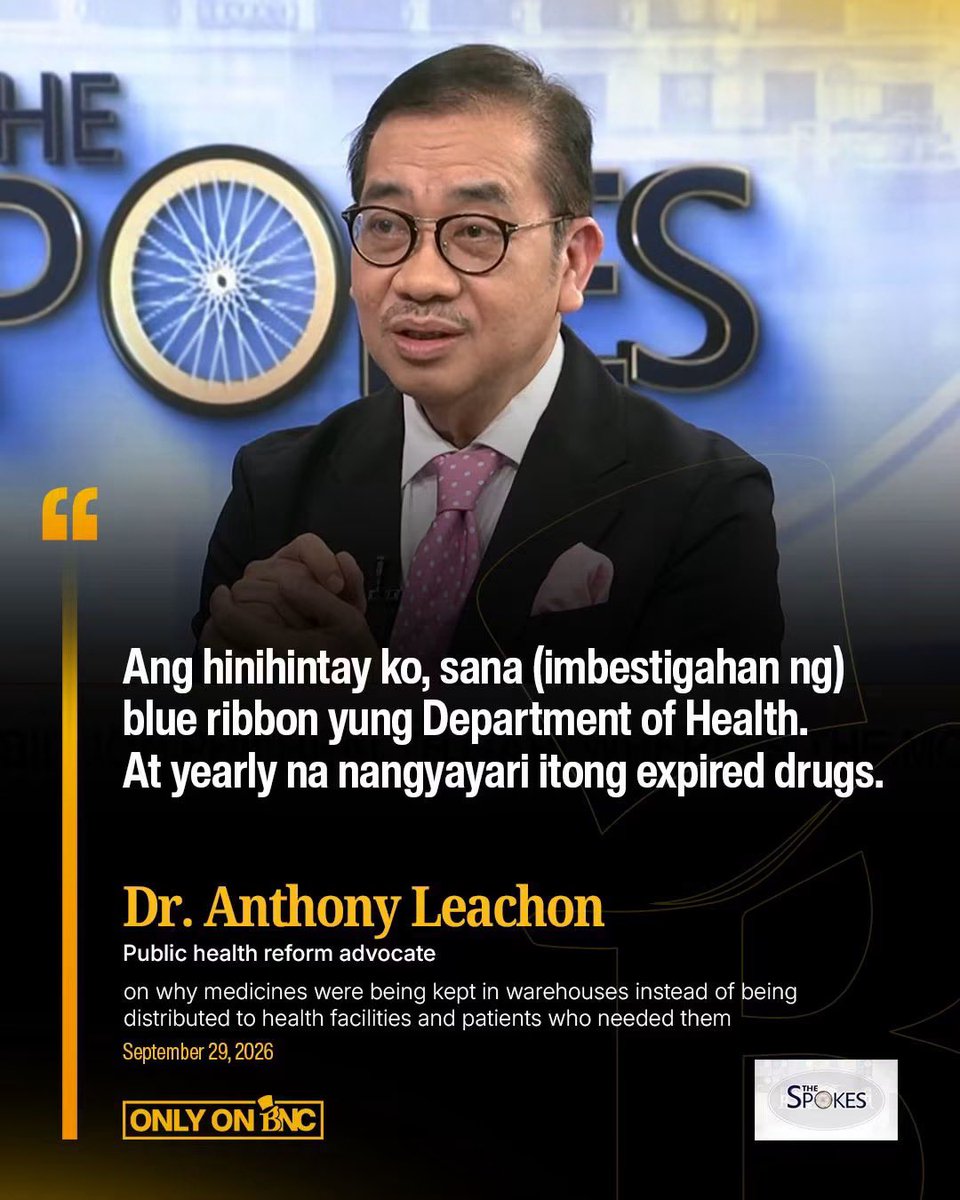
LEACHON CALLS FOR BLUE RIBBON PROBE INTO DOH OVER EXPIRED DRUGS
Public health reform advocate Dr. Anthony Leachon called for the Senate Blue Ribbon Committee to investigate the Department of Health over reports of medicines being kept in warehouses instead of being distributed to health facilities and patients who need them.
“Ang hinihintay ko, sana imbestigahan ng Blue Ribbon yung Department of Health. At yearly na nangyayari itong expired drugs,” Leachon said on BNC’s #TheSpokes.
He raised concerns over the recurring expiration of medicines and the need to examine how government-supplied drugs are stored, managed, and distributed.
Watch the full episode of #TheSpokes.
@bilyonaryo_ph@luminoustrix
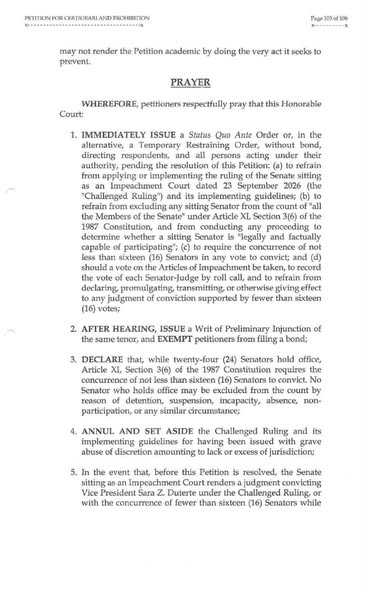
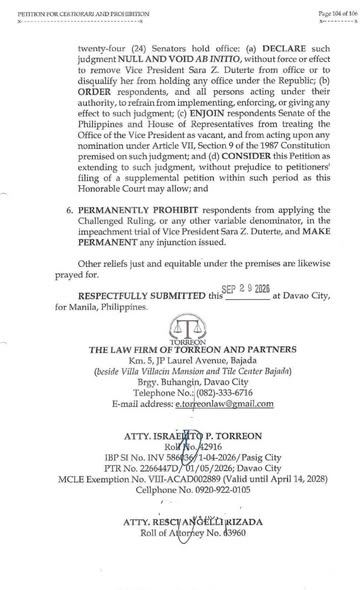
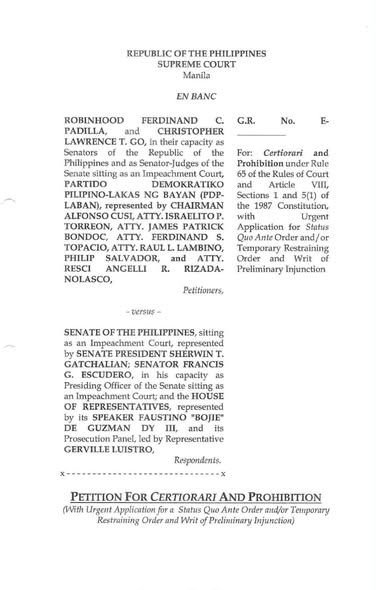
JUST IN | Hiniling nina Senator-Judges Robin Padilla at Bong Go, gayundin ng PDP-Laban, ilang abogado at pribadong indibidwal, sa Korte Suprema na ibalik sa 16 ang voting threshold para sa conviction sa impeachment trial ni Vice President Sara Duterte.
(1/3)
⚖️ Yearly Wastage, Yearly Betrayal
Dr. Tony Leachon
The Commission on Audit (COA), in its April 2026 audit observation memo, flagged ₱217 million worth of expired medicines in the Department of Health’s inventory as of December 31, 2025, with another ₱476.5 million set to expire at the time of the audit. This is not an isolated lapse — it is part of a yearly pattern of wastage that has haunted the DOH for more than a decade.
• In 2024, COA found ₱34.8 million worth of expired and nearly expired drugs, plus ₱99.4 million in other inventories about to be wasted.
• In 2023, ₱11.18 billion worth of supplies and COVID-19 vaccines expired or suffered damage.
• In 2022, ₱7.4 billion worth of medicines and inventories were flagged as expired or nearly expired.
• From 2015 to 2018, ₱18.5 billion worth of drugs reportedly expired.
During Senate hearings, pressed by Sen. Raffy Tulfo, Health Secretary Edwin Mercado acknowledged the ₱217 million in expired medicines and pledged reforms. His admission underscores the depth of the problem: a recurring cycle of poor logistics, opaque procurement, and lack of accountability.
The Human Cost
Every expired vial represents a patient denied treatment. In a country where the poorest citizens often cannot afford doctors or decent medical care, this wastage is not just inefficiency — it is an abomination. It is a betrayal of the covenant between government and people, where public funds meant to save lives are squandered in warehouses.
The Moral Imperative
Respect for the impeachment court and Senate hearings means treating these proceedings not as political theater but as solemn guardians of democracy. They must confront this yearly failure with resolve.
• Transparent procurement: enforce open bidding and digital tracking.
• Professional logistics: hire experts to forecast demand and prevent overstocking.
• Accountability mechanisms: file cases against those responsible for negligence and wastage.
Sad Reflection
This is not simply about expired medicines. It is about expired trust. Each year that billions are wasted, the health of the nation is compromised. Reform must be relentless, accountability must be firm, and compassion must guide every decision. For when medicines expire unused, it is not just drugs that are lost — it is lives, dignity, and the very soul of public service.
#RelentlessForChange
#HealthWithHonor
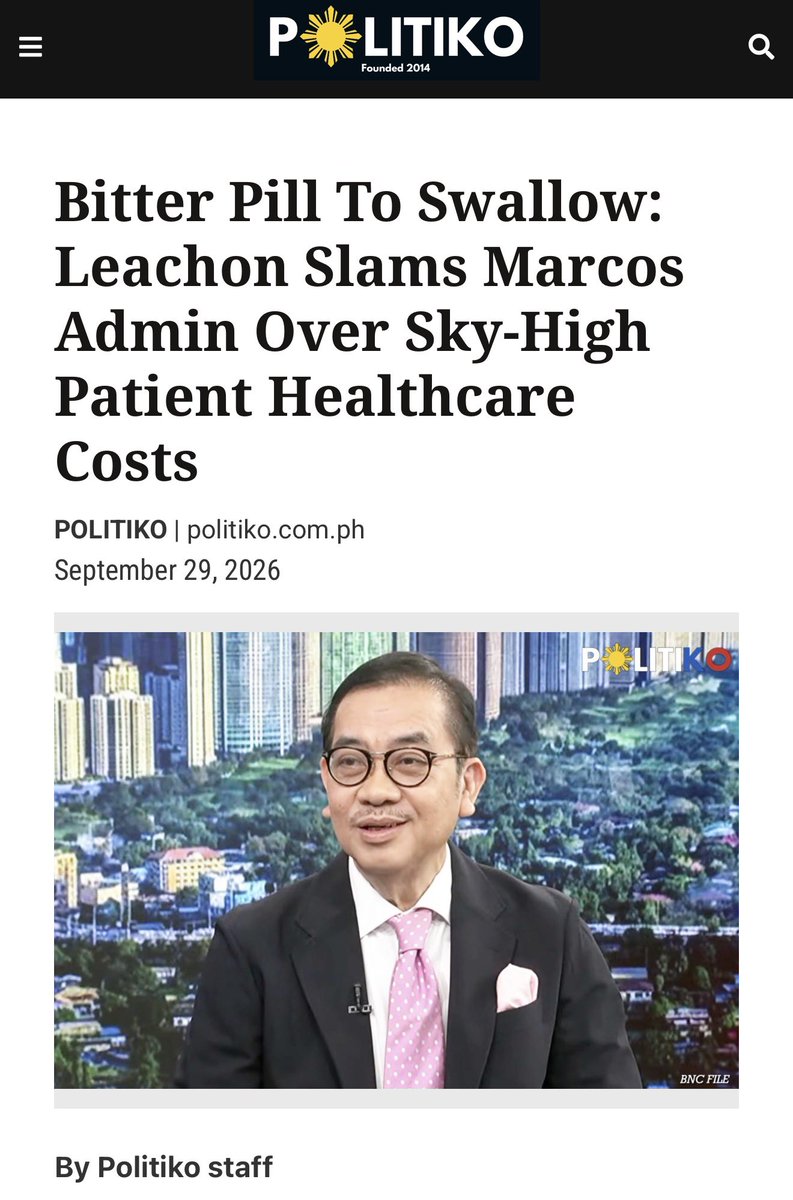
Health reform advocate Dr. Tony Leachon has called out President Ferdinand Marcos Jr. over the country’s soaring out-of-pocket medical expenses, claiming that healthcare remains low on the chief executive’s agenda.
Speaking on Bilyonaryo News Channel’s program The Spokes, Leachon stated that the Philippine Health Insurance Corp. (PhilHealth) needs up to ₱800 billion through 2028 to significantly reduce the direct financial burden placed on patients to 38 percent.
Citing data presented by Dr. Beverly Ho, Leachon noted that sufficient state funding could lower projected out-of-pocket health spending from 44 percent down to 41 percent or 38 percent.
https://t.co/S2vsSQ6elM
Tony Leachon
@Politiko_Ph
Accountability and Reform in DOH Drug Management
- Dr. Tony Leachon
Under Department of Health Administrative Order 2016-0008, medicines and drugs that have passed their expiration date must be properly discarded because their safety, quality, and effectiveness can no longer be guaranteed. This directive reflects a fundamental principle of public health: expired pharmaceuticals are not just useless, they can be dangerous.
DOH Issues and Audit Findings
The Commission on Audit (COA) has repeatedly flagged the Department of Health (DOH) for staggering losses—billions of pesos worth of wasted, spoiled, or unutilized medicines. These failures stem from poor inventory planning, delayed distribution, and weak accountability mechanisms.
Recent controversies have further eroded public trust. Senate hearings revealed stockpiled and expired drug inventories, including millions of vials of vaccines. These lapses prompted calls for stricter supply chain oversight and transparent procurement.
Procurement rules already require that drugs hold a minimum shelf life, yet slow-moving stocks in regional warehouses and hospitals continue to expire before reaching patients. This disconnect between policy and practice underscores systemic weaknesses in governance.
Proper Disposal and Safety
Expired drugs pose serious risks. They may lose potency, alter chemical composition, or foster bacterial growth—leading to failed treatments or harmful reactions. For institutions, disposal is not as simple as throwing medicines away. Bulk pharmaceutical waste requires clearance and specialized destruction methods, such as high-temperature incineration or DENR-compliant treatment facilities. Unsafe dumping or low-temperature burning not only violates standards but also endangers communities and the environment.
Call for Reform
The recurring wastage of medicines is more than a logistical failure—it is a betrayal of public trust. While millions of Filipinos struggle to afford maintenance drugs, life-saving supplies are left to rot in warehouses. Accountability must be enforced through legal cases against negligent officials, alongside structural reforms:
• Transparent procurement: Open bidding and clear rules to prevent overstocking and corruption.
• Professional logistics: Modern supply chain management to ensure timely distribution.
• Real-time inventory systems: Digital tracking to monitor stocks and prevent expiration.
• Public scorecards: Monthly reporting to empower citizens and watchdog groups.
Conclusion
The DOH’s mandate is to safeguard health, not squander resources. Proper disposal of expired drugs is necessary, but preventing expiration in the first place is the true measure of leadership. Reforming procurement and distribution systems is not optional—it is a moral imperative to ensure that medicines reach the sick before they expire, and that public funds serve the people rather than waste away in warehouses.
PRESS RELEASE
29 SEPTEMBER 2026
Leachon calls for P170-B PhilHealth funding gap to be filled, P311-B withheld funds released
Health reform advocate Dr. Tony Leachon called for the government to fully fund PhilHealth and release Php 311.49 billion in legally mandated funds withheld from the health insurer, saying sustainable financing is essential to making Universal Health Care (UHC work.
Leachon said the immediate priority is to address the Php 170-billion funding gap in PhilHealth’s proposed 2027 budget, while ensuring that billions in earmarked revenues from sin taxes, PAGCOR, and PCSO are released as mandated.
Under the proposed FY 2027 National Expenditure Program, PhilHealth is allocated Php 74.45 billion, compared with the Php 244-billion minimum government subsidy cited in Leachon’s presentation.
“The minimum budget is Php 540 billion every year for Universal Health Care to be real,” Leachon said in a recent interview.
His presentation also cited the Department of Health’s estimate of a Php 541-billion annual funding gap for UHC, despite funding from multiple sources, including health taxes.
According to Leachon, the P 311.49 billion in withheld funds consists of earmarked sin tax revenues and mandated shares from PAGCOR and PCSO.
“311 billion ang hindi binibigay,” Leachon said, stressing that funds earmarked for health should reach PhilHealth and be used for their intended purpose.
The financing gap comes as Filipinos continue to shoulder a substantial share of their healthcare costs. Out-of-pocket spending accounted for 41.2% of current health expenditure in 2025, remaining among the highest in the region.
For Leachon, strengthening health taxes should be part of the government's response to the health financing gap.
“Health taxes are not simply about raising revenue. They are also about preventing disease and protecting Filipinos from the costs of illness,” he said.
Leachon supports stronger taxes on vapes, alcohol, and sweetened beverages, including a Php 80-per-mL unified vape tax, as well as stronger alcohol and sweetened beverage taxes. These measures can generate substantial additional revenues while reducing consumption.
Leachon also expressed support for the proposed ProGRESS, particularly its objective of providing tax relief while strengthening government revenues. For him, however, health-tax measures must remain strong enough to generate meaningful revenues and protect Filipinos from preventable disease.
His recommendations include fully funding PhilHealth, reestoring withheld earmarked funds, strengthening preventive health interventions, and using health-tax revenues to support health and nutrition.
“The health system needs sustainable financing, but it also needs to prevent people from getting sick in the first place,” Leachon said.
###
@bilyonaryo_ph@dzrhnews@ancxph@TVPatrol@sarchavez@DOHgovph@teamphilhealth@bawasbisyoPH@iampinkywebb@KarenOwYong@dawende@jvejercito@iampinglacson@loren_legarda@WinGatchalian74@luminoustrix
A woman one month into a new job at the FDA was handed an application to approve a sleeping pill. It looked routine. They gave it to her because she was new and it seemed like an easy one to start on.
She read the file and something was missing. No evidence at all that the drug was safe in pregnancy, and it was being sold as a remedy for morning sickness. The drug was thalidomide, and West Germany was getting through a million doses a day.
Frances Kelsey asked for more data. The company sent representatives to her office, then telephoned her at all hours, then went over her head to her supervisors. Between them they contacted her and her boss around fifty separate times. She later said most of what they called her could not be printed. Ten million tablets were already sitting in warehouses waiting for her signature.
She said no six times. And while she held the line, doctors in Germany and Australia were piecing together what was happening to babies whose mothers had taken it. Limbs that had never formed, hands and feet attached directly at the shoulder and hip, in at least 4,000 children across Europe. The company withdrew its American application in 1962.
Seventeen cases turned up in the United States, all from free samples doctors had handed out before any approval. Without her it would have been thousands.
Congress passed a new law that same year requiring companies to prove a drug is both safe and effective, and requiring informed consent from anyone in a trial. Those rules are now used worldwide. Kennedy gave her the highest civilian award in the country and she was the second woman ever to receive it. She stayed at the FDA another 45 years and died in 2015 at 101.
Every American woman handed a pill in pregnancy is downstream of one woman refusing to sign a form six times while men shouted at her.
https://t.co/Xx4rbkh2gH
Yes: handwriting still matters.
A new study has confirmed that writing by hand activates far more complex and widespread neural networks in the brain than typing, underscoring its importance for learning and memory.
Researchers at the Norwegian University of Science and Technology used a high-density EEG cap with 256 electrodes to record brain activity in university students. They found that the intricate, sensory-rich movements involved in handwriting, especially cursive, trigger highly synchronized brain waves across extensive areas of the parietal and central regions. These coordinated patterns are strongly linked to memory formation, cognitive processing, and encoding new information.
In contrast, typing, which involves repetitive, simpler finger movements, produced significantly less neural connectivity and engagement. The difference was striking: the brain appears much less active during digital writing.
The researchers conclude that the unique motor and sensory experience of holding a pen plays a key role in brain development and learning. As a result, they argue that handwriting instruction should remain a core part of education to support deeper comprehension and cognitive growth in the next generation.
[ “Handwriting vs. Typing: A High-Density EEG Study on Brain Connectivity During Learning” — Norwegian University of Science and Technology (published in Frontiers in Psychology, 2025)]
🔻 In 2011, a neuroscientist at MIT, Dr. Li-Huei Tsai, made a discovery that should have been on the front page of every newspaper on Earth.
She exposed mice with advanced Alzheimer’s disease to a flickering light flashing at exactly 40 Hz—forty times a second. Nothing more. No dope. No operation. Light of a particular frequency.
Within an hour the amyloid-beta plaques in their brains, the protein deposits that define Alzheimer’s, started to dissolve. Not slow at all. Not slowly. In 60 mins.
Plaque levels were reduced by 50% after 7 days of daily exposure to 40 Hz. The mice then regained their memory. Their neurons began firing in sync again. Microglia, the brain’s immune cells, were activated and began cleaning up the toxic buildup like a cleaning crew that had been asleep for years.
The study appeared in Nature. The planet's most prestigious scientific journal. Peer Reviewed . Reproduced. Verified. That was 2016. Year is 2026.
Alzheimer's affects 40 million people worldwide. Pharmaceutical companies earn $13 billion a year on drugs that don’t alter the course of Alzheimer’s disease. Not one of 'em. They slow it down. Possibly. Temporarily. At $26,000 per patient per year.
It costs less than a dollar to make a 40 Hz light.
Dr. Tsai remains at MIT. Her research goes on. It is in phase III human trials. But you'll never see this on the news at evening time. You won’t hear your doctor talk about it. You can’t buy it at any drug store.
Because you can't sustain a $13 billion industry on a free frequency.
The light is 40 Hz. The frequency is a real. The science is settled. And there are still 40 million people waiting for permission to use it.
Share !
♟️
A former airline pricing analyst shared a harsh reality with me over coffee.
"We do not just track your cookies. We track your hesitation."
If you check a flight price twice, the algorithm automatically increases it by 15 percent.
Here is the 30-second trick to force the system to give you the lowest price: 👇
A landmark study has found that two years of regular, structured exercise can dramatically rejuvenate the aging heart, effectively turning back the clock by as much as 20 years in previously sedentary middle-aged adults.
Conducted by researchers at the University of Texas Southwestern Medical Center and published in the journal Circulation, the trial involved healthy but inactive adults aged 45–64. Participants followed a supervised exercise program four to five days per week, combining moderate aerobic training (such as walking, cycling, or swimming), high-intensity intervals, and strength sessions.
After two years, the exercise group showed significant improvements in cardiovascular function. Their hearts became more elastic and efficient at filling with and pumping blood, changes that made their heart performance resemble that of people 15–20 years younger. The control group, which did not exercise, showed continued age-related decline in heart stiffness.
This NIH-funded study is one of the longest and most rigorous trials demonstrating that it’s never too late to start exercising in middle age, and that consistent effort can produce profound, measurable reversal of age-related heart changes.
[Howden EJ, Sarma S, Lawley JS, et al. Reversing the Cardiac Effects of Sedentary Aging in Middle Age—A Randomized Controlled Trial: Implications for Heart Failure Prevention. Circulation. 2018;137(15):1549-1560. doi:10.1161/CIRCULATIONAHA.117.030617]
Malacañang reportedly fires two senior DICT officials
The Office of the President has reportedly terminated two senior officials of the Department of Information and Communications Technology (DICT), prompting a leadership reshuffle at the government agency overseeing the country's digital infrastructure and technology programs.
READ: https://t.co/IQeVkJUz4i
A Stanford professor stood in front of a full lecture hall and told them that depression has almost nothing to do with sadness. Then he wrote two words on the whiteboard that nobody in the room could define. Anhedonia. Psychomotor retardation. That, he said, is the actual illness.
The man is Robert Sapolsky, the neurobiologist who built his career following wild baboons across Kenya to measure what stress does to a living body.
What makes the video worth 52 minutes is not the subject. It is the method.
No slides. No notes he ever glances down at. One camera, one whiteboard, and a man taking depression apart the way a neurologist takes apart a stroke.
He is doing something deliberate, and it takes a while to catch. Every time the material could soften into sympathy, he hauls it back into biology. Hormones. Neurotransmitters. Genes that do nothing whatsoever until life goes wrong, and then decide everything.
Somewhere in the middle he says one sentence about depression that viewers have been pulling out of this lecture for 16 years. It is 5 words long. It reads like a contradiction until he unpacks it.
Under the video, sleepy_and_caffeinated quoted that exact sentence and wrote two words beneath it. That got me. 4.3 thousand people agreed.
Johnny_boy777 said it from another angle. The best thing about the internet, he wrote, is that any ordinary person can sit in on this without ever enrolling at Stanford. 2.6 thousand likes.
16 years old. 6.2 million views. 9410 comments. One of 25 lectures in the Stanford course Human Behavioral Biology, and every one of them is free.
Most people assume they understand depression because they have felt bad. 52 minutes is enough to learn they were describing something else entirely.
52 minutes. 5 words. It is in the video.
People who spend long periods of time at home and slowly lose the desire to go outside often think they're just resting. But psychologically, many of them are experiencing something called mental rumination. It's a state where the brain starts slowing down while the number of thoughts inside keeps increasing and the motivation to do anything slowly disappears. The mind gets stuck in the past, worries about the future and burns itself out. This isn't laziness, it's a nervous system stuck in survival mode. And the longer it lasts, the more distant normal life begins to feel. And the difficult part is that you usually can't escape it through one massive burst of motivation. And sometimes,recovery starts with just one small step.
Reminder to go touch grass
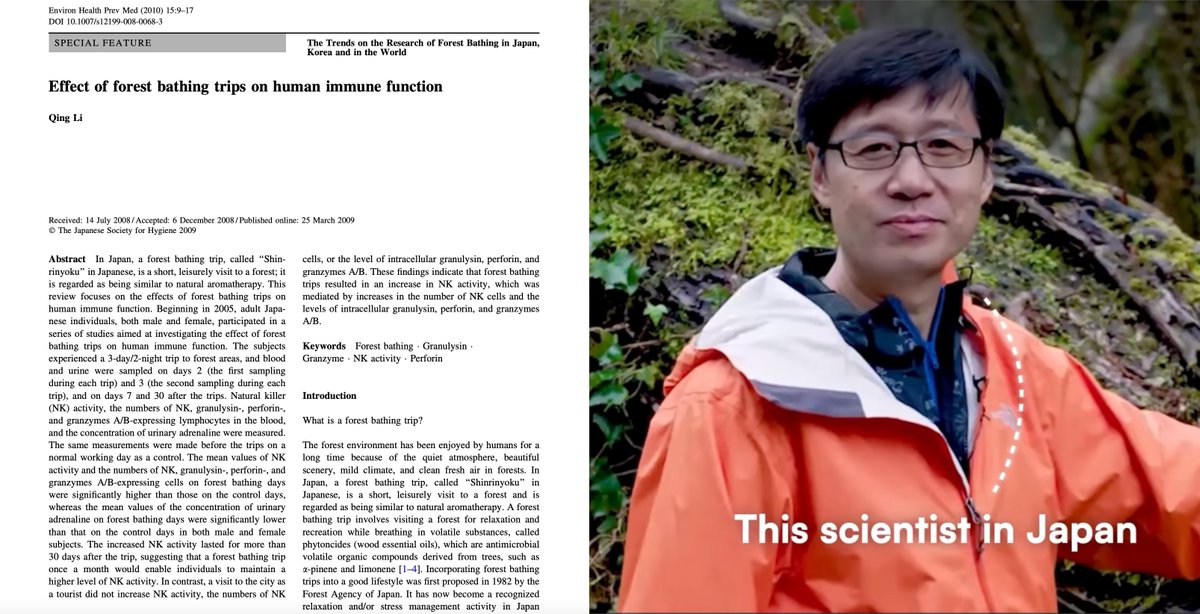
A scientist in Japan demonstrated that the air inside a forest strengthens your immune system for a full month
The study is incredibly fascinating:
Qing Li, an immunologist at Nippon Medical School in Tokyo, took 12 men on a 3-day forest trip. These were slow walks with no breathing exercises and no set route.
Then he tested their blood and found a surge in natural killer cells -- the immune cells your body uses to fight cancer and virus-infected cells.
Remarkably, the effect didn't fade when they went home, it was still measurable 30 days later.
A control group that walked the same distance through a city showed no change at all.
Pine, cedar, and cypress trees release compounds called phytoncides to defend themselves from insects and bacteria. You breathe them in, and Li believes they switch your immune cells into high gear.
He estimates one forest walk a month may be enough to keep those cells elevated all year.
The best medicine might not even need a prescription -- just a walk among the trees.