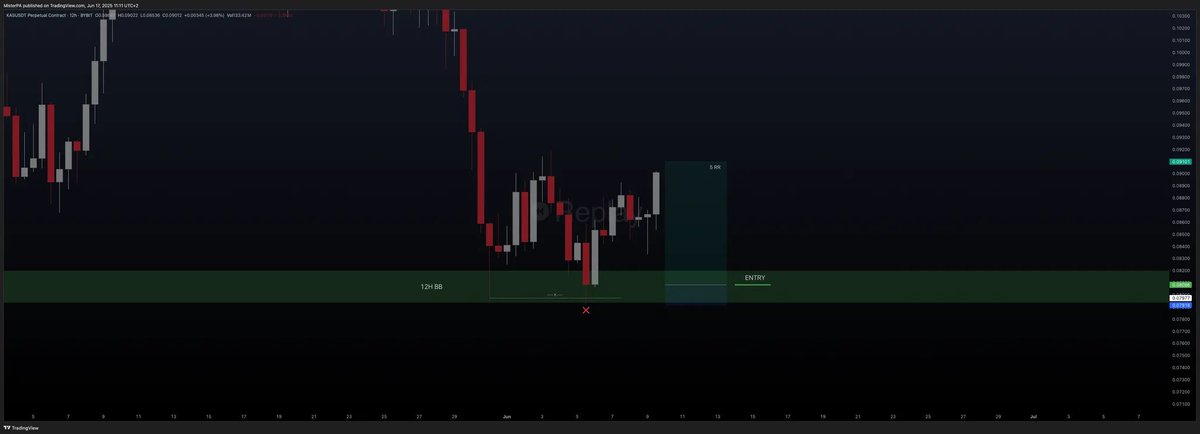
The more HTF liquidity taken before the major move, the more sustainable the move will be.
HTF liquidity taken, raise your targets.
HTF liquidity not taken, lower your targets.
Move with the market, not against it.
Keep It Simple✍️
All you need is clean charts (this takes daily discipline) with every liquidity pool drawn and rated. Do this for BTC, ETH, TOTALs, and USDT.D.
When the majors align at key levels or liquidity pools, your only job is to find an alt at its own key level to determine stop loss.
Assess the strength of the taken liquidity.
Enter with a realistic BCS.
Set TP1 and TP2.
Reduce risk at the appropriate time and level.
Repeat until it becomes instinct.
''Take care of the system, and the system will take care of you''
I'll explain it in more detail:
MT charted out a Monthly BB, which adds selling pressure.
To pinpoint the exact point of reversal, one usually refines using BBs.
In this case, no BB could be found because there is no FVG on lower timeframes to refine the MBB.
If you can’t find a FVG, search for possible OB/BB within the MBB zone.
MT charted out the 2D and 6D to refine for better entries. Additionally, the 2D OB could be refined into a BB aligning with Fibs.
View this as stacking selling pressure: The MBB already provides significant pressure, while the OB adds additional pressure that overlaps with the MBB.
Swing Failure Patterns (SFPs): What They Are and How to Use Them 📝
SFPs are one of the most effective tools for spotting liquidity traps — but they’re often misunderstood or misused.
Let’s break them down properly with real examples:
👇
🔹 What is an SFP?
An SFP (Swing Failure Pattern) occurs when price wicks above a high (or below a low), takes liquidity, then fails to hold outside the SH/SL and closes back in.
This signals exhaustion and often triggers a reversal.
🔹 Why they work
SFPs work because they’re built around one core market mechanic:
👉 Stop-losses are liquidity
Once those are taken, large players can fill size and reverse price — usually catching late breakout traders offside.
🔹 How to enter
The typical SFP entry comes after the sweep, when price closes back inside the prior range.
This gives:
✅ Clear invalidation (above wick)
✅ Great R:R if structure aligns
🔹 But context matters
SFPs at random highs/lows often mean nothing.
To find reliable SFPs, focus on:
👁️ 1. HTF highs/lows (macro levels)
👁️ 2. Key levels (BB's / OB's)
🔹 Example: BTC 2D BB Retest (KLS)
Price sweeps a major swing low + retest 2D BB.
The candle closes back above the low = SFP entry.
🔹 ETH Example – Macro Extremes.
ETH showed two textbook examples of SFP's.
- A low that preceded a 170% impulse rally
- The ATH of 2024, which led to a 30% decline
🔹 2 more SFP's examples for context:
ETH:
KAS:
🔹 KLS: The best kind of SFP
A Key Liquidity Sweep (KLS) is the most reliable form of an SFP.
It happens when price returns to sweep a validated swing — one formed after a major liquidity grab (like the 2D BB on BTC)
That’s where true reversals often begin.
🙌 Shoutout to @traderdune for introducing the term KLS — I had seen this pattern play out often, but didn’t know there was a specific name for it.
KLS = The SFP you should pay the most attention to.
KLS - Key liquidity sweep
🧠 Conclusion.
✅ SFPs are powerful
✅ Not all are created equal
✅ Focus on context
✅ KLS = your highest quality SFP trigger
Spoon-feeding 👌
MT: "A hidden order block buried behind multiple FVGs often becomes a powerful reversal point once taken, especially when refined across multiple timeframes and aligned with a strong move targeting such liquidity levels."
Look for alts to long/short from when BTC is reaching range high/low, if range breaks, then wait for a new range
back test this, so many alts reached bullish HOBs everytime btc went for range low within this range
🔍 TRADING ENTRY CHECKLIST
(Read before every entry)
✅ Hidden liquidity (more fvg's = more powerful)
✅ Fib levels (untested fibs from earlier swings)
✅ Discount/Premium zone
✅ Macro alignment (USDT.D, BTC, ETH, TOTAL, TOTAL2/3)
✅ Volume (VSA, high-volume zones, trending coins)
✅ Market structure
✅ Pattern confluence (3-Drive, HTF Double Top/Bottom)
✅ ETH/BTC confluence (risk-on/off sentiment)
✅ News risk? (FOMC, CPI, etc.)
✅ Bvol (high volatility expected)
✅ Refined level for better RR (LTF entry in HTF zone)
✅ Are you trading HTF, MTF or LTF? (align your bias, size & expectations)
✅ Buy Program or Sell Program active
🧠 You don’t need every box checked.
Less confluences = less risk
No confluence? No Entry or reduce risk accordingly.
Everything listed here (and much more) can be found on @Moneytaur’s account.
Decoding charts will level up your game.