Every landing page has the same flat background.
So I built https://t.co/pdkVQPHKbc, moving gradient backgrounds for any site.
- 207 animated presets
- Tweak colors, speed and grain
- React, Vue, Svelte or plain HTML
- Or ask your agent to add it
39 free, all customizable 👀
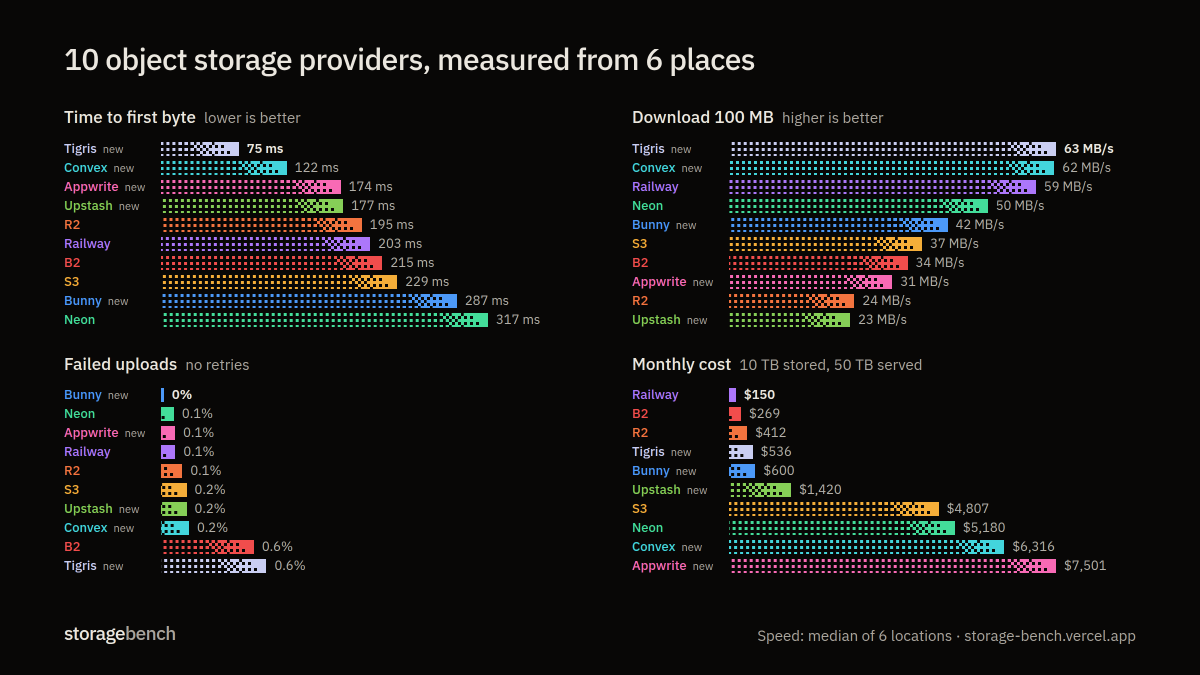
I added 5 more object storage providers to my benchmark
New:
- @TigrisData Storage
- @BunnyCDN Storage
- @appwrite Storage
- @convex_dev File Storage
- @upstash Blob
Same tests from the same 6 locations, now 10 providers in total
Here's a summary 👇 (this is also a thread)
Another insane Jev use case!
Traditional database filters need precise, predefined conditions. But many questions are semantic:
- Is this article mainly about software engineering?
- Which topic best describes it?
- How technically deep does it appear?
These usually require moving rows into application code, invoking a model, parsing its output, and writing the result back.
pg-jev is an open-source Postgres extension that exposes Jev through SQL functions.
- jev() works inside WHERE
- jev_prob() returns a probability
- jev_choice() selects a label
- jev_score() ranks rows across ordered levels.
It needs no vector column or embedding index.
Under the hood, pg-jev batches rows, sends them to Jev, and returns typed answers that SQL can filter, sort, group, and combine with exact predicates.
The recording below runs it against real Hacker News stories stored in Postgres.
It first shows the rows, then asks Jev to find software-engineering stories, classify them by topic, and rank them by technical depth. The final query reports requests, tokens, cost, and cache hits from the database session.
GitHub repo: https://t.co/6OD0nRMgfH
(don't forget to star it ⭐)
Postgres keeps the data and controls the query, while Jev handles the part SQL cannot express as a deterministic condition.
If you want to understand what Jev is doing under the hood, I also wrote a hands-on guide to building a Jev-style model with open models, entirely locally.
Read it below.
introducing Jevbox: an open-source document drive that organizes itself, answers questions, and cites everything (all powered by Jev).
TLDR;
- upload anything and Jev categorizes and files it into the folder tree
- search is hierarchical: Jev picks the folder, then the document, then the section. No embeddings, no vector DB
- every answer cites the page and section it came from
- permissions are enforced at retrieval. If someone loses access to a source, they lose access to answers built on it too
- ships with an MCP server, so your agents get the same permission-aware context
@andrewlu0 has been experimenting with Jev internally and wanted to see how far it could go on a real document library. It's built on Extend Parse + Jev, and fully open-source
The GitHub has instructions to self-host, or you can deploy it to Render in one click
This summer we upgraded our 56TB Postgres database with (almost) no downtime.
And we moved all new runs to @planetscale Metal.
This post covers everything we did and everything we learned along the way.
https://t.co/OIHOf91xpY
Introducing e2e
The agentic testing framework for any app
~/ npx e2e init
→ Fully Open Source
→ Mix deterministic and agentic APIs
→ Supports web, mobile, and more
→ Bring your own agent and infrastructure
→ Run locally or in CI
https://t.co/G3XB2L8tiC