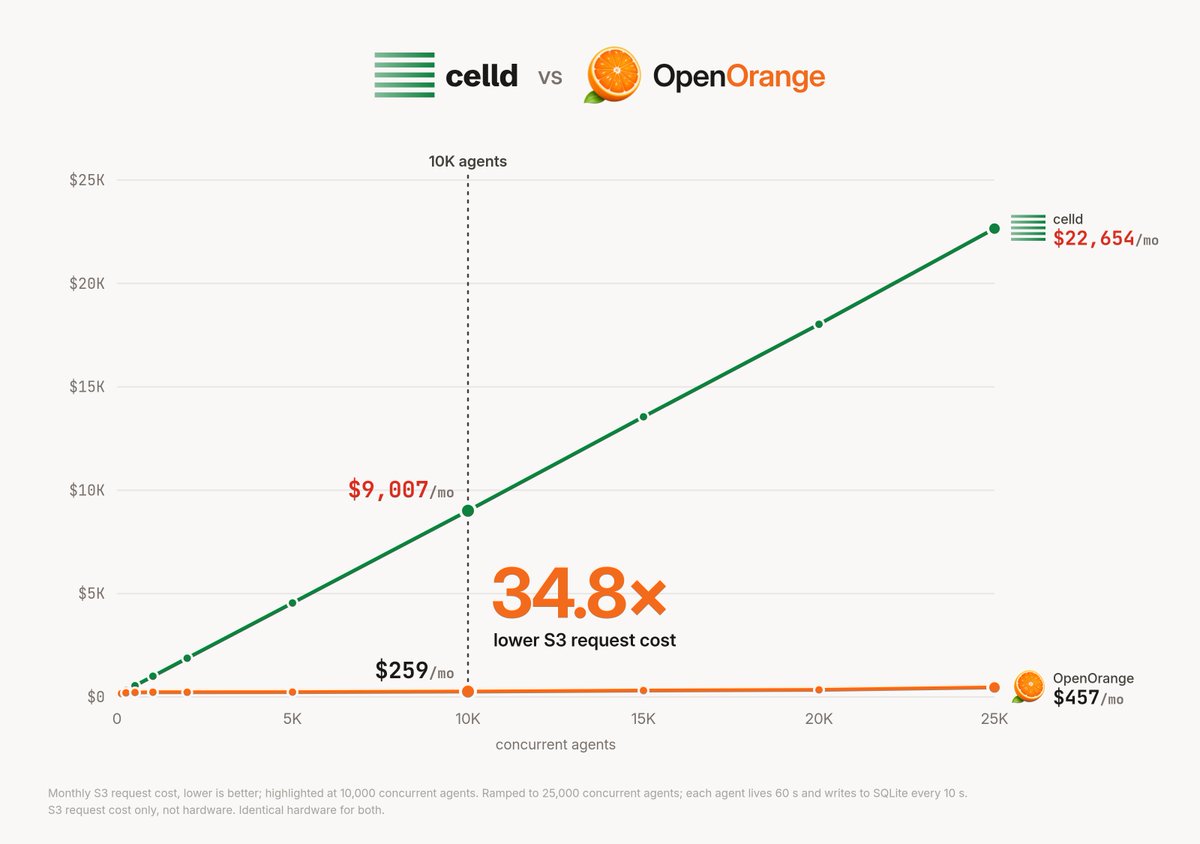
OpenOrange vs celld
34.8x lower S3 costs for agent workloads
This is made possible by building OpenOrange on Rivet's storage engine. We've spent years scaling the actor model, and Rivet's storage engine was built for this.
celld's architecture balloons costs for:
- Agents
- Workflows
- Background jobs
- Session stores
~
Why?
First, a primer on running databases on S3.
S3 is cheap for storing data. It's about 10x cheaper than AWS EBS replicated across 3 availability zones:
$0.023 vs $0.24 per GB per month
But it gets expensive once you actually operate on that data. Writing one object every second for a month costs:
AWS EBS ~$0
S3 $13
This is because S3 charges per operation, while AWS EBS charges for how much you store and for how long:
PUT costs $5 per million
LIST costs $5 per million
COPY costs $5 per million
GET costs $0.40 per million
On AWS EBS, these operations are effectively free.
The catch is that the number of operations scales with how many objects you have. Every object has to be written with its own PUT, so 1,000 objects cost 1,000 PUTs. Pack the same data into one object and it costs one.
~
So why is celld so expensive?
celld stores each Durable Object as its own S3 objects. So the more Durable Objects you create, the more objects you have, and the more you pay.
Every new Durable Object costs PUTs to its own objects: claiming it, then saving it when it goes to sleep. That's ~4 PUTs and 1 GET per Durable Object in our benchmark.
If you have a fixed number of Durable Objects, this cost is reasonable. But if you're constantly creating new ones, your cost grows with every one.
And agents tend to be high churn. Some agents work for days, but most do a quick, discrete task and never get used again.
These types of workloads suffer, since they frequently create new Durable Objects:
- Agents
- Workflows
- Background jobs
- Multiplayer game rooms
- Chat rooms
- Per-user sessions
- Rate limiting
~
So how does OpenOrange stay so cheap?
Rivet's storage engine is built on an LSM tree (log-structured merge tree). It's the same idea behind mature S3-backed databases like ClickHouse, used to keep performance high and cost low.
Instead of giving each Durable Object (called Actors on Rivet) its own S3 objects, Rivet's LSM packs many of them into shared S3 objects.
Here's how PUTs compare per 1,000 new Durable Objects:
- OpenOrange ~90
- celld ~4,000
When you create a Durable Object or write to SQLite on OpenOrange:
1. The write is replicated to SSDs across 3 availability zones (single-digit ms)
2. After about a minute, writes from many Durable Objects are merged into one batch
3. That batch is written to S3 as one object
~
These benchmarks are modeled on real-world agent workloads, measured at 8 to 25,000 concurrent agents. Each agent lives 60 seconds and writes a turn every 10 seconds. We only measured S3 cost, and both ran on identical hardware.
~
OpenOrange is open source today.
We've attached the benchmarks below.
Le site de l'ATTT n'est pas concerné par la mega-faille PHP, vous savez pourquoi ?
Sa version de PHP date d'il y a plus de 15 ans, le module en question n'existait pas 😂