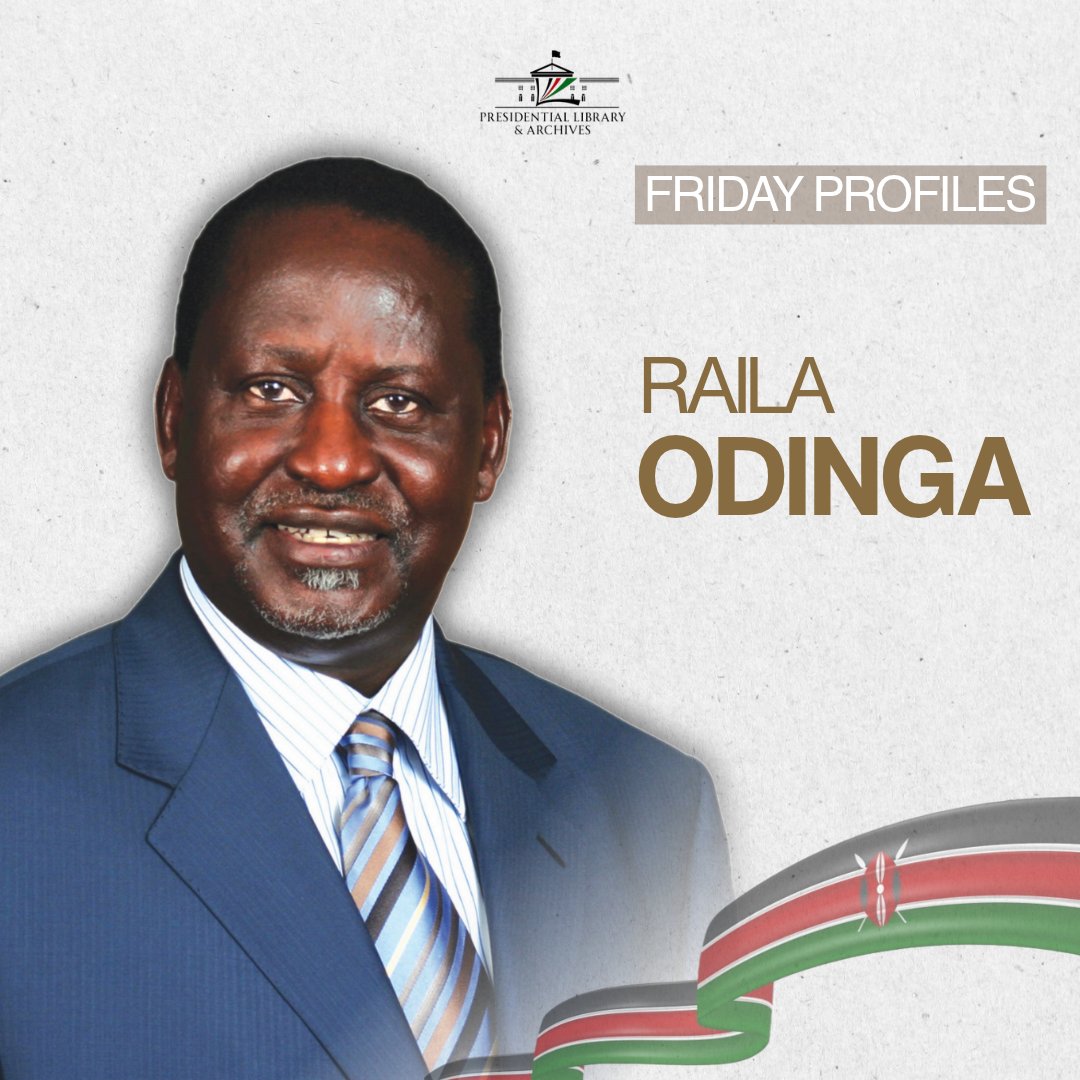
PART ONE: THE MAKING OF AN ENIGMA
There are politicians whose careers follow a straight line. Raila Amolo Odinga's did not.
His journey through Kenya's political history was a sequence of unexpected turns, improbable alliances and sudden reversals, which kept even his opponents guessing his next move. Perhaps that is why one of his names was Agwambo, the mysterious one.
But before he became Baba, the opposition chief, presidential candidate and Prime Minister, a man whose name could turn an ordinary rally into an event, there was a boy born into politics who first became an engineer.
Raila was born on 7 January 1945 to Mary Juma and Jaramogi Oginga Odinga, a towering figure of the independence struggle and Kenya's first Vice President. He went to Kisumu Union Primary, then Maranda Primary and Maranda High School in Bondo, Siaya County.
Around 1962 he left for East Germany, studying German at the Herder Institute in Leipzig before moving to Magdeburg for technical studies. In 1970 he graduated with a Master's-equivalent diploma in Mechanical Engineering and returned to Kenya. Raila taught at the University of Nairobi and worked at the Kenya Bureau of Standards (KEBS)s before politics took over his life.
His political path would break away from his father's, slipping out of that long shadow, like a river that knows its source but chooses its own course.
By the 1970s and early 1980s, Raila was deeply involved in political activism, at a time when Kenya's political space was narrowing.
Then came 1 August 1982.
A section of the Kenya Air Force attempted to overthrow President Daniel arap Moi's government. The coup failed. In its aftermath, Raila was accused of involvement, charged with treason and detained. The accusation would remain one of the most contested chapters of his early political life; what is beyond dispute is that the failed coup changed the course of his life.
For the next several years, the engineer disappeared into detention.
He would not emerge the same man.
Raila spent years behind bars, much of it in solitary confinement. Released in 1988, he was soon detained again, caught up in the turbulent struggle to bring back multiparty politics. In July 1990, during the Saba Saba pro-democracy agitation, he was detained once more. Freed the following year, he slipped into exile in Norway, fearing for his safety.
But exile did not end the journey.
In February 1992, Raila came home to a Kenya preparing for its first multiparty elections in decades. He joined FORD-Kenya, the party his father lead, and later that year won the Lang'ata parliamentary seat, a position that would make him one of the most recognisable faces in Kenyan politics.
Then, in 1994, Jaramogi died. Raila lost the battle for FORD-Kenya's leadership to Michael Wamalwa Kijana, and as the rift in the party deepened, he walked away. He took the reins of the National Development Party and carried it into the 1997 election, where he ran for president and finished third, behind Daniel arap Moi and Mwai Kibaki, while holding on to the Lang'ata seat.
For many politicians, that might have been the end of the road. For Raila, it was merely another turn.
From Moi's jail to Moi's Cabinet
Then came one of the great paradoxes of Raila Odinga's political life.
In 2001, Raila’s National Development Party joined forces with Moi's KANU, and Moi named him Minister for Energy. It was an extraordinary reversal. The man who had spent years fighting the Moi establishment now sat inside it.
But the arrangement was never simply about a Cabinet seat. As the 2002 succession battle gathered pace, Raila and other senior KANU figures expected Moi to choose one of them. Instead, he chose Uhuru Kenyatta, son of Kenya's first President, Jomo Kenyatta.
“Kibaki Tosha”
On 22 September 2002, Raila and the other disgruntled KANU ministers, now calling themselves the Rainbow Alliance, gathered at the Serena Hotel before heading to a huge opposition rally at Uhuru Park. It was open rebellion, yet they were still inside the government.
There, Raila asked a deceptively simple question:
"Si ata Mzee Kibaki anatosha?"
Wasn't Mzee Kibaki enough?
The question birthed the ‘Kibaki Tosha’ declaration.
It was one of those moments in politics when a few words can alter the direction of a campaign.
The opposition had a problem. It had many hopefuls, many parties and plenty of ambition, but no single candidate around whom the factions could unite. Raila threw his weight behind Mwai Kibaki, and the forces that came together would form the National Rainbow Coalition.
On 13 October 2002, Raila resigned from the Cabinet and walked out of KANU, with Kalonzo Musyoka, Joseph Kamotho and George Saitoti beside him. The political landscape was rearranging itself fast.
And Raila stood right in the middle of it.
The man who had wanted to succeed Moi had instead decided to help another man defeat Moi's chosen successor.
And then, just weeks before the election, the campaign nearly collapsed.
On 3 December, Kibaki was returning to Nairobi from a rally in Machakos when his vehicle crashed. He was seriously injured and flown to London for specialised treatment.
The Opposition was suddenly without its candidate on the campaign trail.
Raila stepped into the gap.
A football enthusiast, he reached instinctively for a football metaphor.
“Our captain is injured but the game will go on.”
The campaign continued.
Kibaki returned, but the final stretch of the election was carried largely by the NARC team, with Raila among its most prominent campaigners.
On 27 December 2002, Kenyans went to the polls.
NARC won.
After 39 years of KANU rule, Kenya was about to witness a new political era.
Mwai Kibaki was headed for State House.
And Raila Odinga had played a decisive role in getting him there.
For Raila, however, the victory contained another unanswered question.
What exactly was his place in the new Kenya he had helped create?
The answer would produce another twist.
And perhaps another Raila altogether.
But one Friday is hardly enough for a life this consequential. Join us next Friday for Part II.
TURKANA COUNTY: Candle-lighting ceremony in honour of BABA, led by ODM Chairperson Hon. Ekwom Nabuin and Deputy Chairperson Hon. Abraham Losinyen Ekai Mkombozi.
#MweziWaBaba
@MutahiNgunyi I totally understand that , but people will think you are just talking , it is serious and we will have a new constitution to keep them in power forever.
@MikeSonko Get married now , after you break up in a few years , at least you will still be young, then you will become wise and concentrate on your life .
This is the Boni I want to see , doing great things for his people , we want one day western to turn to a very beautiful place with some income for the people around.
@zoomafrika1 Because all the animal conservation in Africa is not about animals , it's about minerals being conserved for future mining by the white people , have you ever asked yourselves, why all the ranches are owned by whites