I haven’t posted much here or written blogs in a while.
Trying to change that now.
I’ve been reading more AI research papers recently, especially around LLM inference, optimization, serving systems, and model efficiency.
Instead of just keeping notes for myself, I want to turn more of them into blogs.
The plan is simple:
- read papers more regularly
- write practical breakdowns
- focus on intuition, implementation, and tradeoffs
- post on both Substack and Medium
If you’re interested in AI research, LLM systems, and ML engineering, follow along.
Substack: https://t.co/x6ZRoaDGAn
Medium: https://t.co/AQTAH0IFvn
#AI #MachineLearning #LLM #DeepLearning #GenAI
Hiring in my team at Gushwork.
Associate Program Manager on our website development product.
Think Lovable, but for B2B SMBs. Our AI pipeline (Onboarding Studio) takes a domain to a live site in 30 minutes. You own the loop from customer call to shipped website: steer the pipeline, feed it what it's missing, and ship what it can't.
Manage ops + tech.
Bangalore. Startup pace.
Bar: 1-2 years at an early-stage startup. Steps into the code and knows their shit in Claude Code. Turns a messy customer call into 5 clean lines of spec.
Read the JD before you DM. Been filtering hard.
https://t.co/Mi6kND64pV
#hiring
LLMs are still slow because they generate one token at a time.
That is the bottleneck DFlash tries to attack.
I wrote a blog breaking down **DFlash: Block Diffusion for Flash Speculative Decoding**.
The main idea:
Instead of drafting future tokens one by one, DFlash uses a block diffusion drafter to predict multiple future tokens in parallel, then lets the target LLM verify them.
In the post, I covered:
* speculative decoding basics
* why draft models can still be sequential bottlenecks
* block diffusion drafting
* target hidden features
* KV injection
* reported `6x` lossless acceleration
Perfect kinda Saturday: a great workout, laundry and chores done, a good movie or series, 2 hours of badminton, and a poker night with friends to wrap it all up
We’ve acquired Torch, a healthcare startup that unifies lab results, medications, and visit recordings. Bringing this together with ChatGPT Health opens up a new way to understand and manage your health.
We're excited to welcome the Torch team to OpenAI @IlyaAbyzov, @elh_online, @jfhamlin, and Ryan Oman.
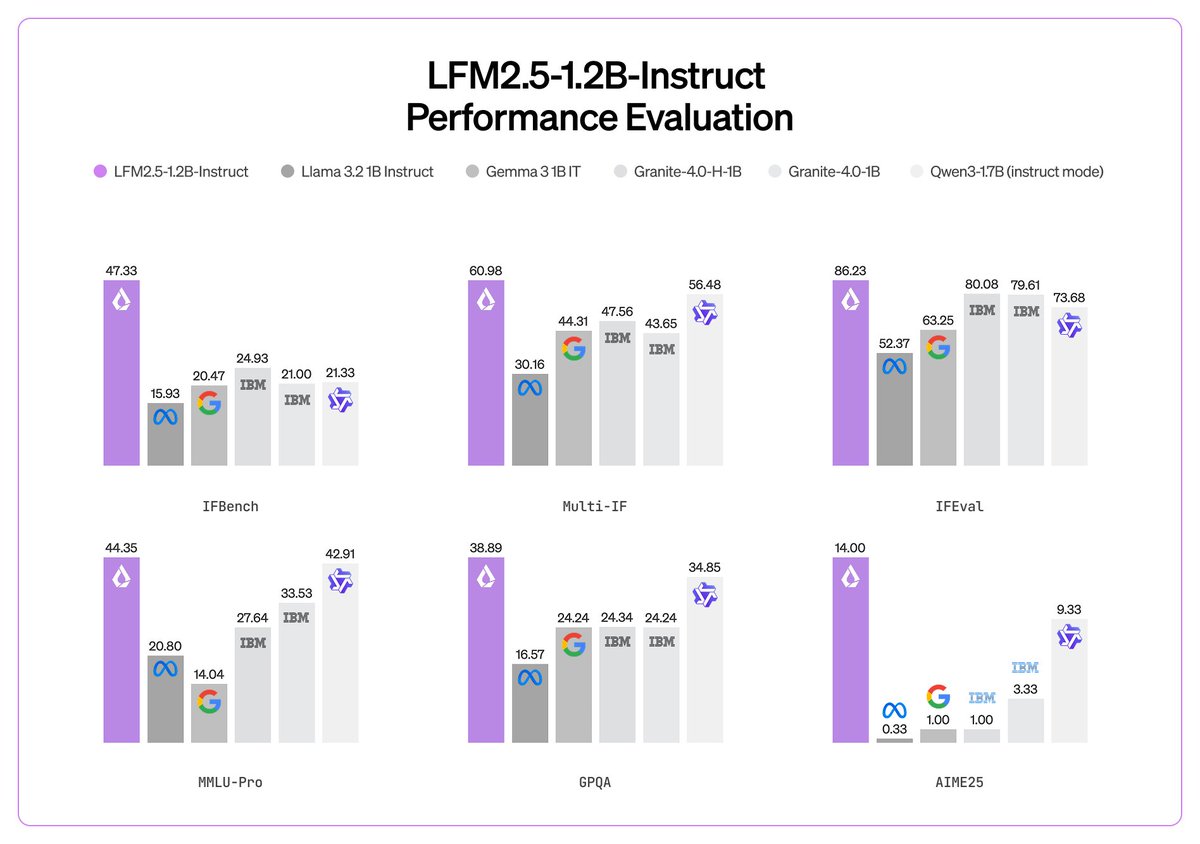
Today, we release LFM2.5, our most capable family of tiny on-device foundation models.
It’s built to power reliable on-device agentic applications: higher quality, lower latency, and broader modality support in the ~1B parameter class.
> LFM2.5 builds on our LFM2 device-optimized hybrid architecture
> Pretraining scaled from 10T → 28T tokens
> Expanded reinforcement learning post-training
> Higher ceilings for instruction following
🧵
Microsoft breaks the SOTA for embedding models!
Using quick & simple training run synthetic data.
---
Paper: https://t.co/33g4aGD0Gx
Model: https://t.co/C7gmdlTEv0
Dataset (by @andersonbcdefg): https://t.co/kRlDH494gn
---
Semantic search models are very hard to get "right".
Oftentimes they require complex multi-stage training:
1. First train on general language data.
2. Then on smaller a labeled dataset.
This is because obtaining large dataset for "fetching tasks" is very hard. (and expensive)
But.
What if we could just ask an LLM to:
1. "Generate text retrieval tasks"
2. "Generate relevant document for the task"
3. "Generate hard negative document for the task"
Then simply train the LLM with contrastive loss.
In this paper the authors fine tuned Mistral-7B.
They trained both on synthetic data alone and on a mixture of synthetic and labeled data.
Result: World record!
Top of Huggingface Leaderboard.
An absolutely amazing idea.
Simple and powerful.
---
My own opinion:
This might be a pivotal moment for RAGs!
From my experience:
RAGS in real life are VERY hard to get right.
They are VERY sensitive to the performance of the embedding model.
It it fetch the wrong context, the generator model has nothing to do that can fix it.
So far, no "off the shelf" model worked good enough for me and always required further fine-tuning.
So this might be the pivotal moment for RAGs.
Now everyone can generate their own dataset with ease and train a powerful embeddings models.
Again,
Amazing Amazing Amazing!
---
Thank you to @andersonbcdefg for pointing out!
This is an important paper.
---