So I rebuilt it: pen positions on a 64×64 grid, and a small transformer that writes strokes the way a language model writes words. It's told what to draw by the meaning of the word, not a category number.
Then one sampling knob (classifier-free guidance) took it from scribbles (top) to readable (bottom).
Update on my AI that learns to draw ✏️
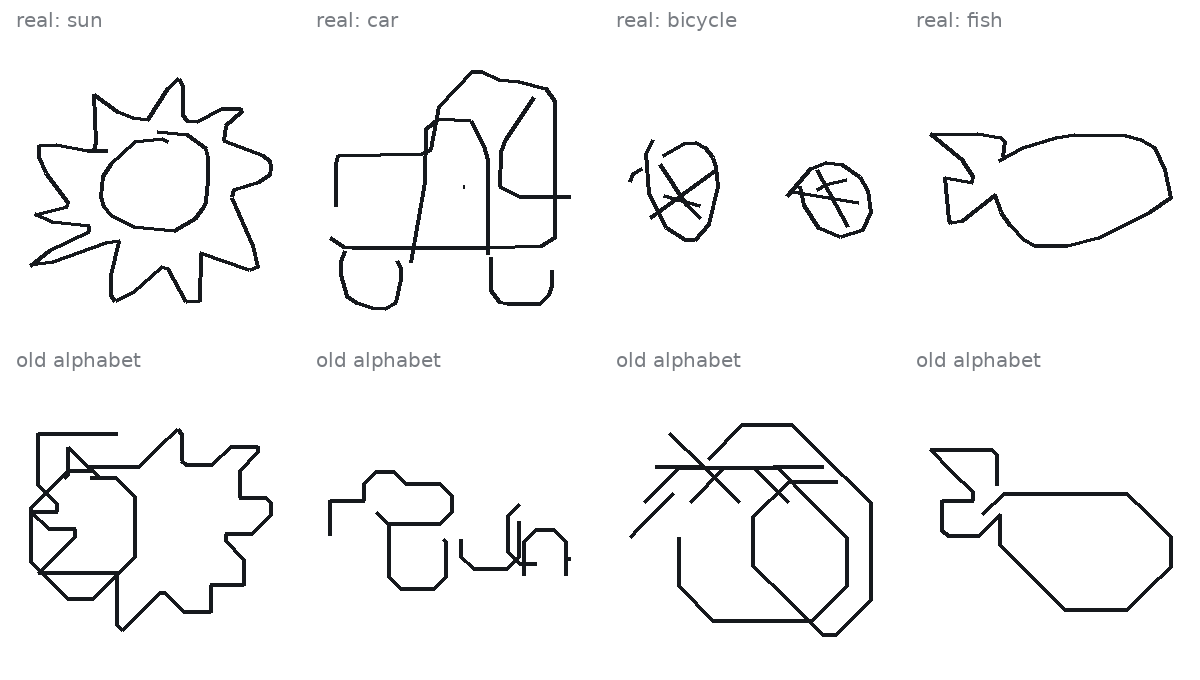
First thing I found: my old model could never have drawn well. Its "alphabet" was 8 directions × 2 step sizes. Circles became octagons.
Top: real doodles. Bottom: the best that alphabet can do, even with a perfect model.
The real problem: I told it what to draw with a category number, not a word.
So it learned a lookup table. "Draw #27" = this cat. It never learned to draw.
Starting over with one question: can it draw something it was never shown?
I'm building an AI that learns to draw.
Not image generation. Actual pen strokes, one line at a time, the way you'd doodle in https://t.co/n65qJJZg5I.
The goal: give it a word it has never seen a single drawing of, and it still draws it.
Building it in public
#buildinpublic #AI
Backstory: my first version learned from Google's Quick, Draw! dataset. 345 categories, millions of doodles.
It sort of worked. Every drawing looked like a 3 year old made it, and it could only draw those 345 words.
@ramxcodes I tried putting so much into my portfolio, now I’m worried it’s too much 😅
Would love your thoughts & feedback, especially on the color palette
https://t.co/65jCjVJKKr