I built a perpetual futures exchange that you can kill - and it comes back with the same state.
No duplicate orders. No lost state.
Single-threaded matching engine, deterministic IDs, crash recovery, self-hosted on Kubernetes.
Built for my first Super30 project.
Here’s how 👇
The project that got me into Super30.
Built an AI code reviewer that actually understands your codebase
→ AST-based code indexing
→ GraphDB for code relationships
→ Symbol-level retrieval
→ RAG with 3 retrieval strategies
→ Redis Streams + Consumer Groups
→ AI pipelines for review, search & fixes
→ Dashboard for repo analysis & reviews
Explained the entire architecture + demo
Built a small GPT from scratch in PyTorch — tokenizer,
attention, transformer, LM head.
No pretrained weights. No API calls.
Noise to Shakespeare in 10,000 steps.
I made an Open Source version of the Grok Bot complete with all the features
It does not need any subscriptions at all and uses the existing subscriptions you already have
It can spin up virtual machines from @asciidotdev
It uses @trycua for computer use
It also has plugin support supporting all the integrations by @composio
Routines coming soon :D
Link to the repo in the comments
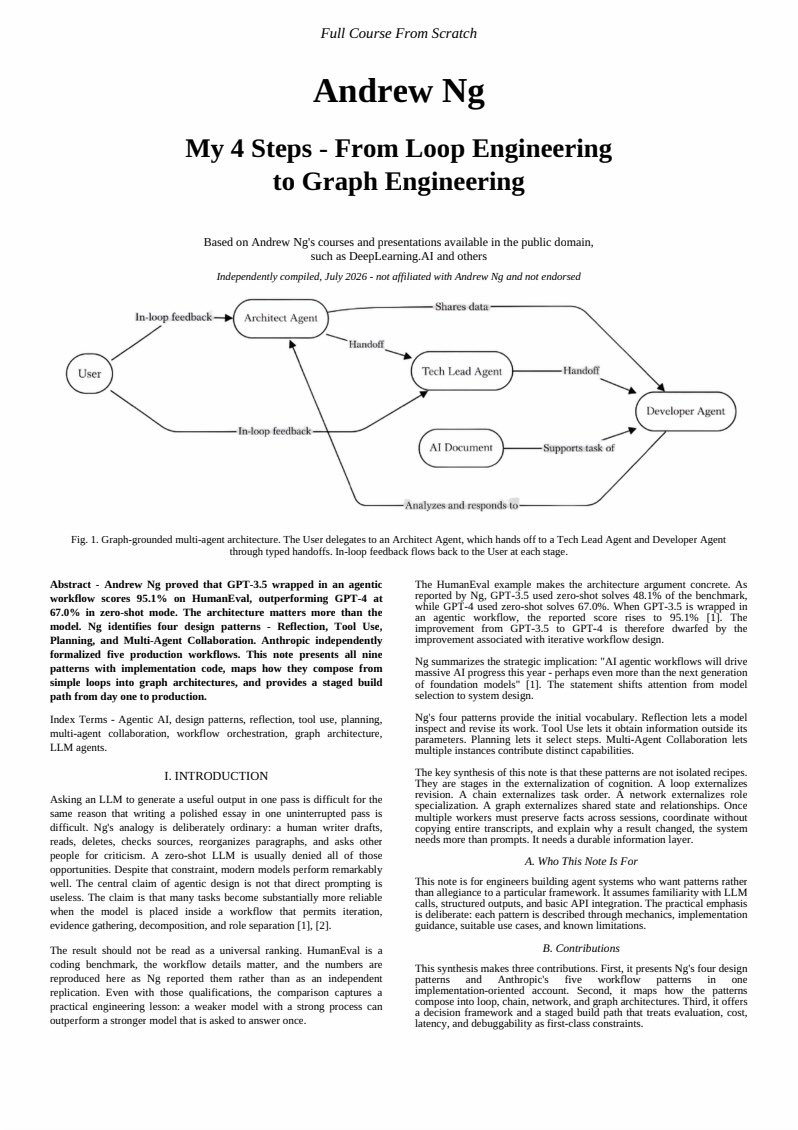
Andrew Ng just dropped 12-page PDF on "Graph Engineering" for multi-agentic systems.
The architecture matters more than the model.
Reflect → Use Tools → Plan → Collaborate → Build the Graph
This 12-page PDF maps Ng's 4 design patterns from a simple loop to a full graph architecture:
• Reflection: add a critic call. The agent reviews its own work against a rubric. 10-30% quality lift on day one.
• Tool Use: let the agent execute code, search the web, query a database. It stops hallucinating and starts checking.
• Planning: the agent writes a structured plan before acting. When a tool fails, it reroutes on its own.
• Multi-Agent: split roles - coder, reviewer, tester. Different rubrics catch different errors.
Graph: externalize shared state. Workers write to it, evaluators fact-check against it.
Loops persist overnight with it. The agent forgets - the graph does not.
A network externalizes roles. A graph externalizes shared state. Each layer solves the failure of the one below it.
This 12-page PDF changed how I'm building agentic systems today.
Read it now, then explore the article below.
MIT 6.824 (Distributed Systems) is hands-down one of the best free engineering courses on the internet.
Instead of staying purely theoretical, the entire curriculum is built around reading and dissecting foundational real-world papers:
GFS (Google File System) : Single master design, chunk allocations, and handling eventual consistency under heavy append-only workloads.
Raft : Leader election, log replication, and safety invariants broken down to be far more approachable than Paxos.
ZooKeeper : Wait-free coordination, read-heavy workloads, linearizable writes, and eventual consistency for reads via watches.
Spanner : Globally distributed transactions, two-phase commit over Paxos, and using TrueTime (atomic clocks + GPS) to enforce external consistency.
MapReduce, Spark, Frangipani, Memcached at Facebook... and more.
If you want to move beyond surface-level system design and actually understand how production distributed storage and consensus engines work under the hood, this playlist is gold.
Playlist: https://t.co/qUc2HNWC8I
this is f*cking gold
Andrej Karpathy joined Anthropic five weeks ago.
Two Anthropic seniors just made Karpathy's loop 1000x better with "Graph Engineering"
the agentic systems got 1000x better the moment you wired agents into a graph
I dropped it into my setup. The very first response was different.
Not slightly different. Completely different.
Claude stopped giving generic answers and started working exactly the way I think.
Bookmark it before it gets lost in your feed.
Read it now, then check the article below.
We’re announcing our $13.5M Series A led by @Standard_Cap.
AI has taken over engineering and companies are wasting millions. Weave gets you the most out of every dollar spent on tokens.
Have fun watching a man attempt to conquer his fears in the video.
Anthropic engineer just released a 2-hour workshop on "Graph Engineering" for agentic systems:
“80% of our engineers are using self-improving loops. Now everyone is building agentic graphs.”
• 00:00 - Introduction to RAG & Graphs
• 06:39 - Core of "Graph Engineering" (state, nodes)
• 14:29 - 3 feedback loops of Graph agents
• 23:06 - Agent evaluation with Graphs
• 36:29 - Agent cycles in graphs
• 1:15:22 - Agentic RAG & agent context
• 1:41:20 - Evaluation datasets based on Graphs
This 2-hour workshop will replace 10 paid courses on agentic engineering.
Watch it today, then learn how to become a Graph Engineer in the article below.
me and @dexhorthy did a full hour yap on system design for agentic memory and how you can use AI to prototype products with your users quickly before building anything
"Reading" blogs/papers quickly and carefully is a great skill to have in this new world of code reviewing. The more quickly you understand what AI code is saying, the faster you'll be able to ship.
Attentive reviewing prevents pushing AI slop to the prod.
I'm still astonished that 12 months ago most engineers wrote code by hand, and now most code is AI-generated.
Makes you wonder what's normal today that's gone by next year.